. 2009 Jul 15;183(2):849-55.
doi: 10.4049/jimmunol.0804104. Epub 2009 Jun 19.

The influence of IgE-enhancing and IgE-suppressive gammadelta T cells changes with exposure to inhaled ovalbumin

Affiliations

The influence of IgE-enhancing and IgE-suppressive gammadelta T cells changes with exposure to inhaled ovalbumin

Yafei Huang et al. J Immunol. .

Abstract

It has been reported that the IgE response to allergens is influenced by gammadelta T cells. Intrigued by a study showing that airway challenge of mice with OVA induces in the spleen the development of gammadelta T cells that suppress the primary IgE response to i.p.-injected OVA-alum, we investigated the gammadelta T cells involved. We found that the induced IgE suppressors are contained within the Vgamma4(+) subset of gammadelta T cells of the spleen, that they express Vdelta5 and CD8, and that they depend on IFN-gamma for their function. However, we also found that normal nonchallenged mice harbor IgE-enhancing gammadelta T cells, which are contained within the larger Vgamma1(+) subset of the spleen. In cell transfer experiments, airway challenge of the donors was required to induce the IgE suppressors among the Vgamma4(+) cells. Moreover, this challenge simultaneously turned off the IgE enhancers among the Vgamma1(+) cells. Thus, airway allergen challenge differentially affects two distinct subsets of gammadelta T cells with nonoverlapping functional potentials, and the outcome is IgE suppression.


Figures
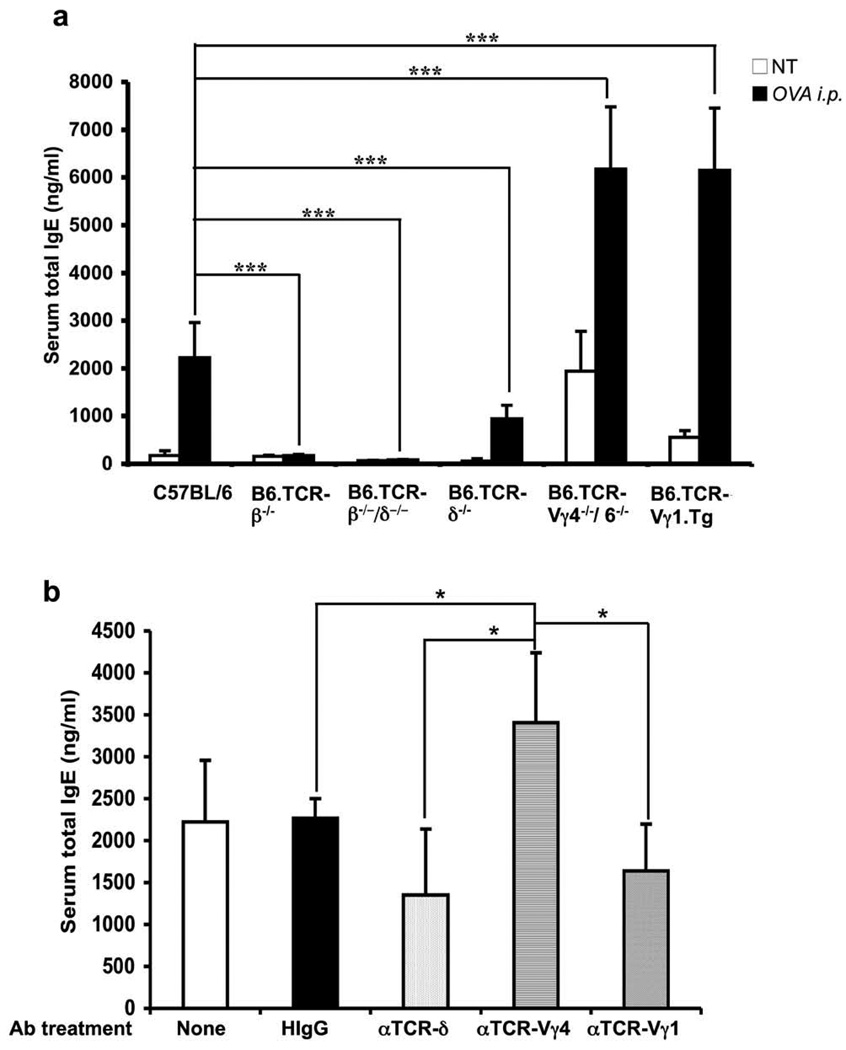
Figure 1
Figure 1
Altered IgE response in γδ T cell-modified mice. (a) Background serum IgE levels and primary OVA/alum-induced IgE responses in genetically altered mouse strains. Total serum IgE concentrations in C57BL/6, B6.TCR-β−/−, B6.TCR-β−/−−/−, B6.TCR-δ−/−, B6.TCR-Vγ4−/−/6−/−, and B6.TCR-Vγ1 Tg mice was measured using sandwich ELISA 14 days after i.p. injection of OVA/alum, and in non-treated controls. Results for each group are expressed as the mean +/− SEM (n=18, 4, 4, 20, 15, 6, in the order shown). NT, Non-treated; ***, Significant difference (p < 0.001) compared to OVA-challenged C57BL/6 mice. Note: Significant differences in basal IgE levels between the mouse strains shown in Fig. 1a are listed in the text. (b) Effect of treatment with anti TCR-mAbs on the primary OVA/alum-induced IgE response in C57BL/6 mice. Normal C57BL/6 mice were injected i.v. with non-specific hamster IgG (HIgG), anti-TCR-δ, anti-TCR-Vγ4, and anti-TCR-Vγ1 mAbs on day -4, and total serum IgE concentrations were determined on day 14 after i.p. injection of OVA/alum. Mice that received the OVA/alum injection but no antibody treatment were included as controls. Results for each group are expressed as the mean +/− SEM (n=4 in each group). *, Significant difference compared to untreated or HIgG-treated controls (p < 0.05).
Figure 2
Figure 2
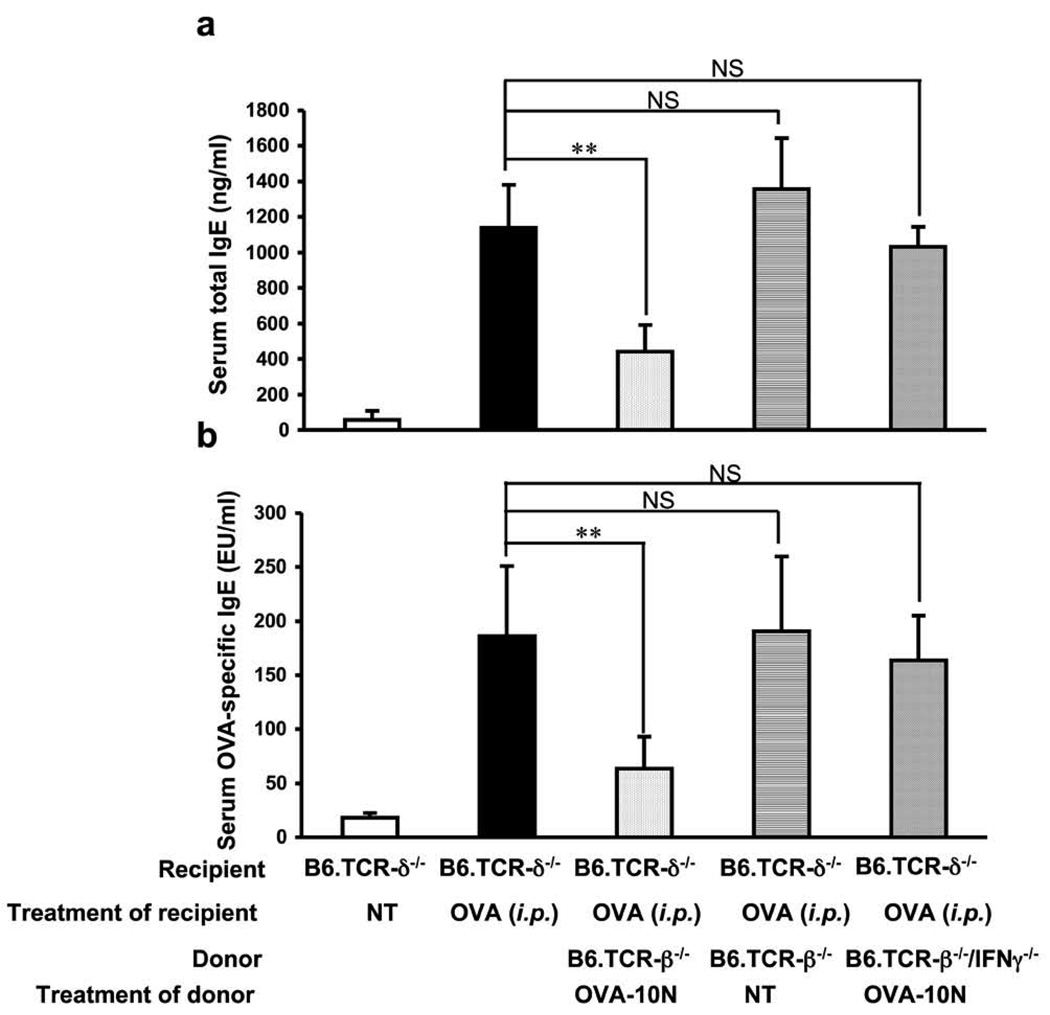
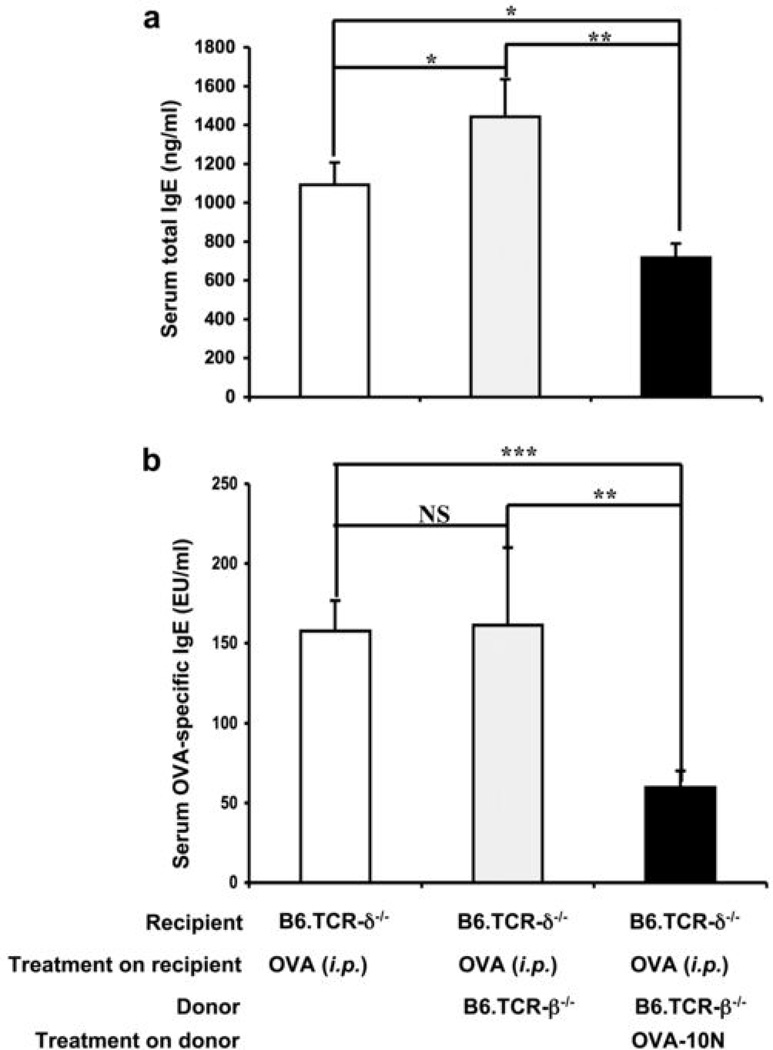
Primary OVA/alum-induced IgE-response in B6.TCR-δ−/− mice is inhibited following adoptive transfer of Vγ4+ cells from airway-OVA-challenged B6.TCR-β−/−mice. Purified Vγ4+ cells (3×10⁴/inoculum) from naïve or 10N-treated B6.TCR-β−/− mice, or from 10N-treated B6.TCR-β−/−/IFN-γ−/− - mice were adoptively transferred i.v. to B6.TCR-δ−/− recipients, just prior to i.p. OVA/alum injection. Serum total IgE (a) and OVA-specific IgE (b) levels were measured 14 days after the OVA/alum treatment.Results for each group are expressed as the mean +/− SEM (n=4 in each group). Significant differences between mice that received cells and those that received no cells are indicated. **, p < 0.01; ***, p < 0.001. NS, not significant.
Figure 3
Figure 3
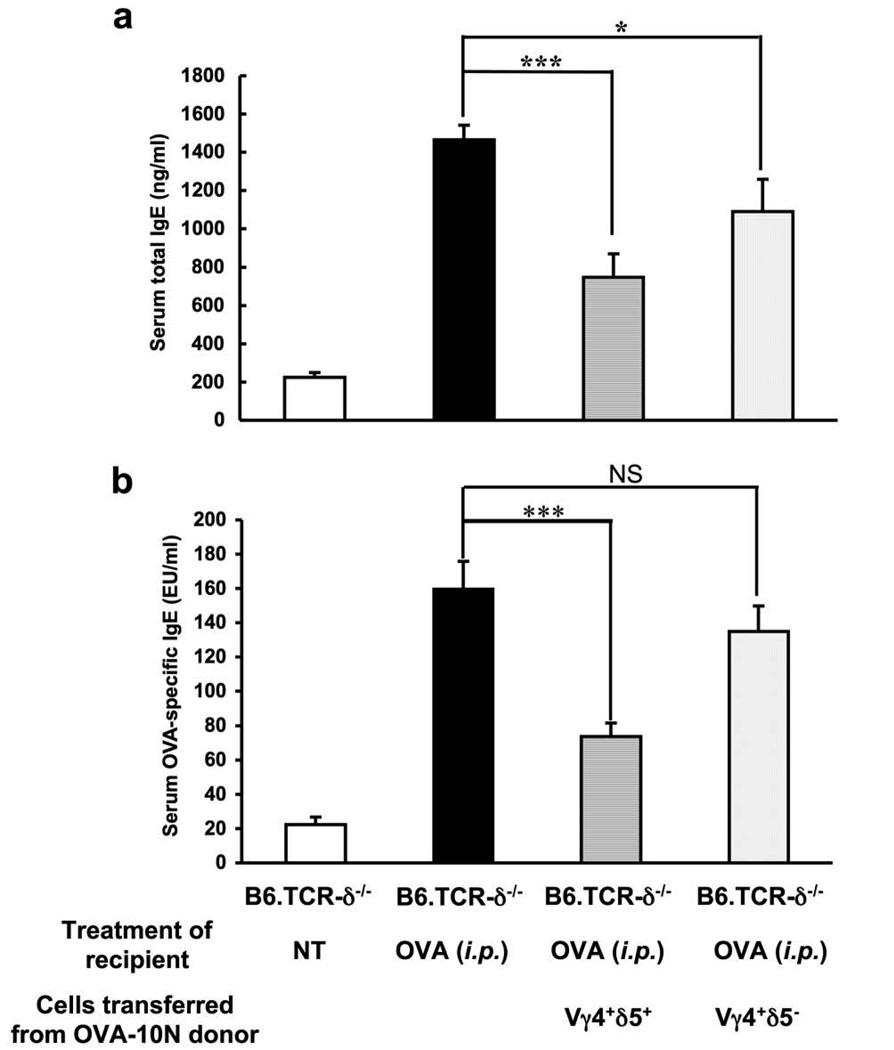
IgE-suppressive Vγ4+ γδ T cells co-express Vδ5. Vδ5+ and Vδ5 Vγ4 cells were purified from the spleen of 10N-treated B6.TCR-β−/− mice by FACS-sorting. Purified Vγ4+/Vδ5+ or Vγ4+/Vδ5 cells (3×10⁴/inoculum) were adoptively transferred i.v. to B6.TCR-δ−/− recipients just prior to i.p. injection of OVA/alum. Serum total IgE (a) and OVA-specific IgE (b) levels were measured 14 days after the OVA/alum injection. Results for each group are expressed as the mean +/− SEM (n=4 in each group). Significant differences between mice that received cells and those that received no cells are indicated. ***, p < 0.001. NS, not significant.
Figure 4
Figure 4
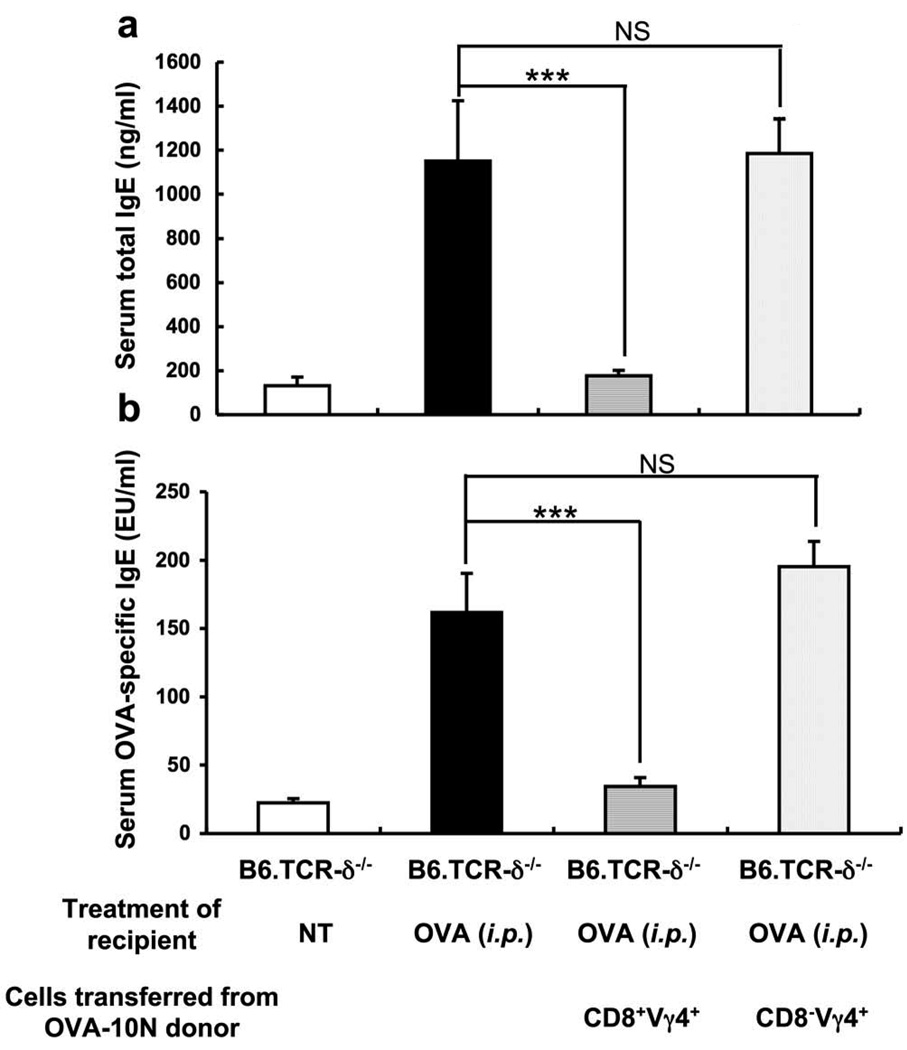
IgE-suppressive Vγ4+ γδ T cells express CD8. CD8α+ and CD8α Vγ4 cells were purified from the spleen of 10N-treated B6.TCR-β−/− mice by FACS-sorting. 3×10⁴ cells of each type were adoptively transferred i.v. to B6.TCR-δ−/− recipients just prior to i.p. injection of OVA/alum. Serum total IgE levels were measured 14 days after the OVA/alum injection. Results for each group are expressed as the mean +/− SEM (n=4 in each group). Significant differences between mice that received cells and those that received no cells are indicated. ***, p < 0.001. NS, not significant.
Figure 5
Figure 5
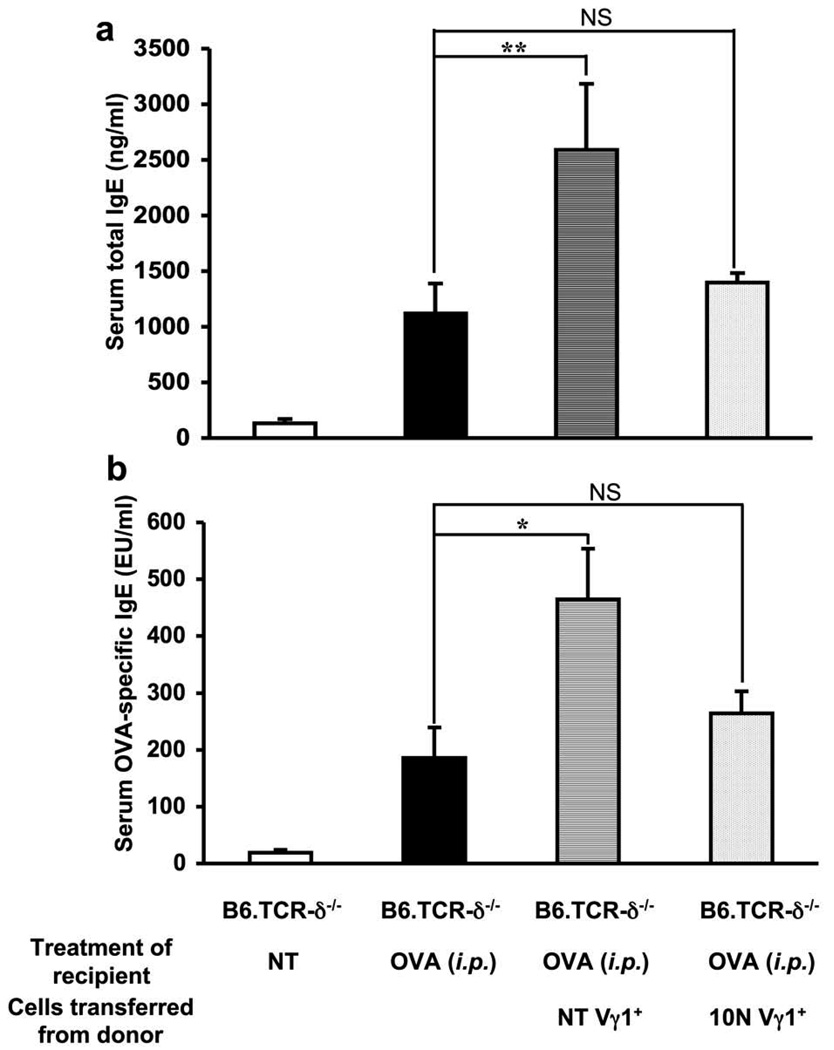
Adoptively transferred Vγ1+ γδ T cells from non-treated but not airway-OVA-challenged B6.TCR-β−/− mice enhance the primary OVA/alum-induced IgE response in B6.TCR-δ−/− mice. Purified Vγ1+ cells (3×10⁴/inoculum) from non-treated or 10N-treated B6.TCR-β−/− mice were adoptively transferred i.v. to B6.TCR-δ−/− recipients just prior to i.p. OVA/alum injection. Serum total IgE (a) and OVA-specific IgE (b) levels were measured 14 days after the OVA/alum injection. Results for each group are expressed as the mean +/− SEM (n=4 in each group). Significant differences between mice that received cells and those that received no cells are indicated. *, p < 0.05; **, p < 0.01. NS, not significant.
Figure 6
Figure 6
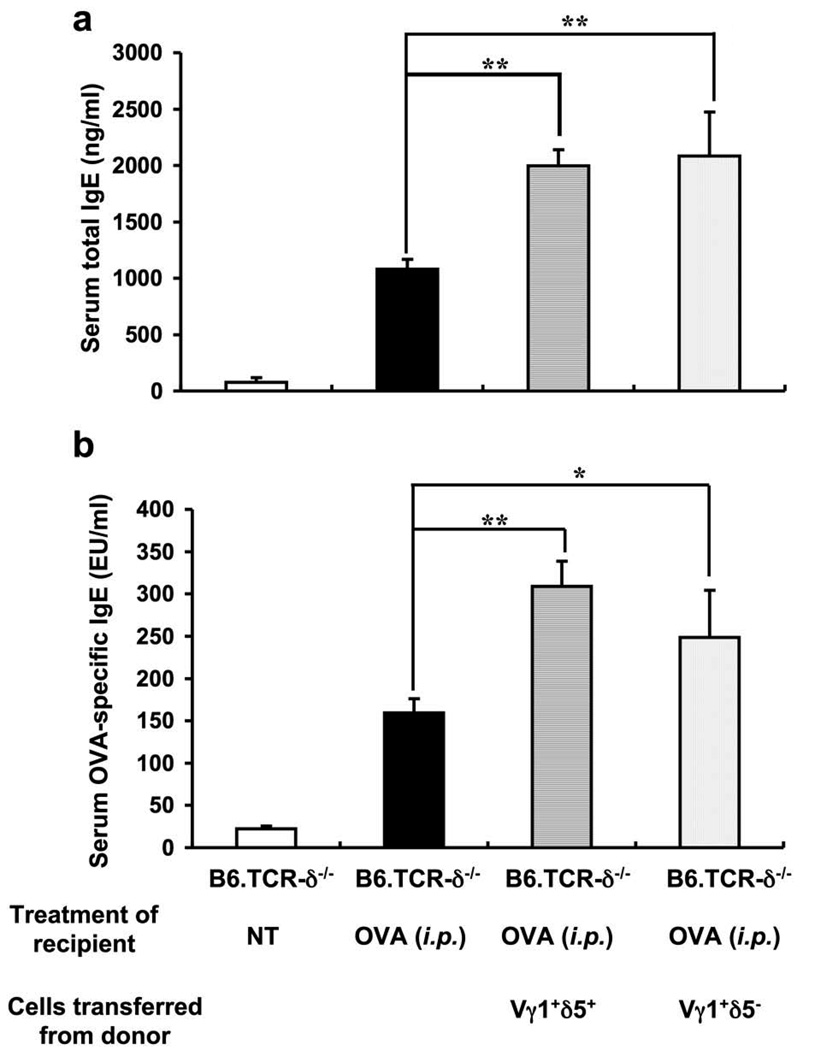
Co-expression of Vδ5 is not required for Vγ1+ γδ T cells from non-treated mice to enhance the primary OVA/alum-induced IgE response. Purified Vγ1+/Vδ5+ or Vγ1+/Vδ5 cells (3×10⁴/inoculum) from non-treated B6.TCR-β−/− mice were adoptively transferred i.v. to B6.TCR-δ−/− recipients directly before antigen challenge. Serum total IgE (a) and OVA-specific IgE (b) levels were measured 14 days after the OVA/alum injection. Results for each group are expressed as the mean +/− SEM (n=4 in each group). Significant differences between mice that received cells and those that received no cells are indicated. *, p < 0.05; **, p < 0.01.
Figure 7
Figure 7
Net-effect of total γδ T cells on the primary OVA/alum-induced IgE response. Purified γδ T cells (3×10⁴/inoculum) from non-treated or OVA-challenged (10N) B6.TCR-β−/− mice were adoptively transferred i.v. to B6.TCR-δ−/− recipients directly before antigen challenge. Serum total IgE (a) and OVA-specific IgE (b) levels were measured 14 days after the OVA/alum injection. Results for each group are expressed as the mean +/− SEM (n=4 in each group). Significant differences between mice that received cells and those that received no cells are indicated. *, p < 0.05; **, p < 0.01, ***, p < 0.001.

References

    1. Gould HJ, Sutton BJ, Beavil AJ, Beavil RL, McCloskey N, Coker HA, Fear D, Smurthwaite L. The biology of IgE and the basis of allergic disease. Annu Rev Immunol. 2003;21:579–628. - PubMed
    1. Gould HJ, Sutton BJ. IgE in allergy and asthma today. Nature Reviews Immunology. 2008;8:205–217. - PubMed
    1. Thornton CA, Holloway JA, Popplewell EJ, Shute JK, Boughton J, Warner JO. Fetal exposure to intact immunoglobulin E occurs via the gastrointestinal tract. Clin. Exp. Allergy. 2003;33:306–311. - PubMed
    1. Eisenbarth SC, Colegio OR, O'Connor W, Jr, Sutterwala FS, Flavell RA. Crucial role for the Nalp3 inflammasome in the immunostimulatory properties of aluminium adjuvants. Nature. 2008;453:1122–1127. - PMC - PubMed
    1. Mowat AM. The regulation of immune responses to dietary protein antigens. Immunol. Today. 1987;8:93–98. - PubMed

Publication types

MeSH terms