


Neurons in the white matter of the adult human neocortex
- PMID: 19543540
- PMCID: PMC2697018
- DOI: 10.3389/neuro.05.007.2009
Neurons in the white matter of the adult human neocortex
Abstract
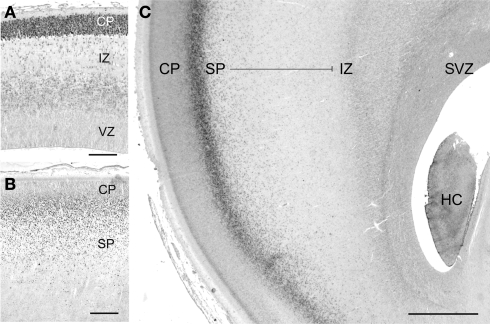
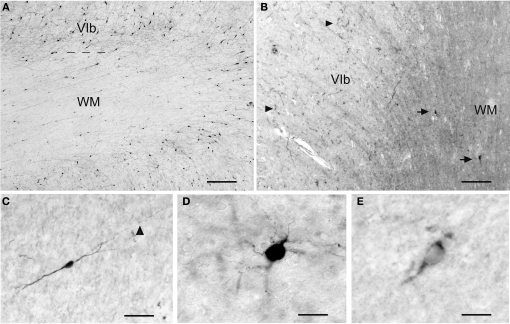
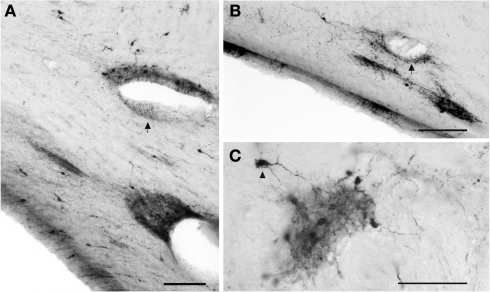
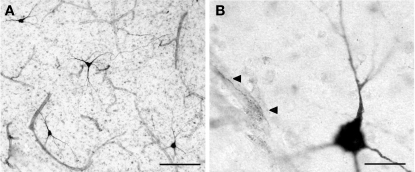
The white matter (WM) of the adult human neocortex contains the so-called "interstitial neurons". They are most numerous in the superficial WM underlying the cortical gyri, and decrease in density toward the deep WM. They are morphologically heterogeneous. A subgroup of interstitial neurons display pyramidal-cell like morphologies, characterized by a polarized dendritic tree with a dominant apical dendrite, and covered with a variable number of dendritic spines. In addition, a large contingent of interstitial neurons can be classified as interneurons based on their neurochemical profile as well as on morphological criteria. WM- interneurons have multipolar or bipolar shapes and express GABA and a variety of other neuronal markers, such as calbindin and calretinin, the extracellular matrix protein reelin, or neuropeptide Y, somatostatin, and nitric oxide synthase. The heterogeneity of interstitial neurons may be relevant for the pathogenesis of Alzheimer disease and schizophrenia. Interstitial neurons are most prominent in human brain, and only rudimentary in the brain of non-primate mammals. These evolutionary differences have precluded adequate experimental work on this cell population, which is usually considered as a relict of the subplate, a transient compartment proper of development and without a known function in the adult brain. The primate-specific prominence of the subplate in late fetal stages points to an important role in the establishment of interstitial neurons. Neurons in the adult WM may be actively involved in coordinating inter-areal connectivity and regulation of blood flow. Further studies in primates will be needed to elucidate the developmental history, adult components and activities of this large neuronal system.
Keywords: Tbr1; calretinin; neuropeptide Y; nitric oxide synthase; schizophrenia; subplate.
Figures
References
-
- Akbarian S., Bunney W. E., Potkin S. G., Wigal S. B., Hagman J. O., Sandman C. A., Jones E. G. (1993). Altered distribution of nicotinamide-adenine dinucleotide phosphate-diaphorase cells in frontal lobe of schizophrenics implies disturbances of cortical development. Arch. Gen. Psychiatry 50, 169–177 - PubMed
-
- Akbarian S., Kim J. J., Potkin S. G., Hetrick W. P., Bunney W. E., Jones E. G. (1996). Maldistribution of interstitial neurons in prefrontal white matter of the brains of schizophrenic patients. Arch. Gen. Psychiatry 53, 425–436 - PubMed
-
- Ascoli G. A., Alonso-Nanclares L., Anderson S. A., Barrionuevo G., Benavides-Piccione R., Burkhalter A., Buzsáki G., Cauli B., Defelipe J., Fairén A., Feldmeyer D., Fishell G., Fregnac Y., Freund T. F., Gardner D., Gardner E. P., Goldberg J. H., Helmstaedter M., Hestrin S., Karube F., Kisvárday Z. F., Lambolez B., Lewis D. A., Marin O., Markram H., Muñoz A., Packer A., Petersen C. C., Rockland K. S., Rossier J., Rudy B., Somogyi P., Staiger J. F., Tamas G., Thomson A. M., Toledo-Rodriguez M., Wang Y., West D. C., Yuste R. (2008). Petilla terminology, nomenclature of features of GABAergic interneurons of the cerebral cortex. Nat. Rev. Neurosci. 9, 557–568 10.1038/nrn2402 - DOI - PMC - PubMed
LinkOut - more resources
Full Text Sources
