. 2009 Jul 7;106(27):11177-82.
doi: 10.1073/pnas.0900964106. Epub 2009 Jun 19.

Formation of harmful algal blooms cannot be explained by allelopathic interactions

Affiliations

Formation of harmful algal blooms cannot be explained by allelopathic interactions

Per R Jonsson et al. Proc Natl Acad Sci U S A. .

Abstract

Many planktonic microalgae produce a range of toxins and may form harmful algal blooms. One hypothesis is that some toxins are allelopathic, suppressing the growth of competitors, and it has been suggested that allelopathy may be one important mechanism causing algal blooms. In a metaanalysis of recent experimental work, we looked for evidence that allelopathy may explain the initiation of algal blooms. With few exceptions, allelopathic effects were only significant at very high cell densities typical of blooms. We conclude that there is no experimental support for allelopathy at prebloom densities, throwing doubts on allelopathy as a mechanism in bloom formation. Most studies tested allelopathy using cell-free manipulations. With simple models we show that cell-free manipulations may underestimate allelopathy at low cell densities if effects are transmitted during cell-cell interactions. However, we suggest that the evolution of allelopathy under field conditions may be unlikely even if based on cell-cell interactions. The spatial dispersion of cells in turbulent flow will make it difficult for an allelopathic cell to receive an exclusive benefit, and a dispersion model shows that dividing cells are rapidly separated constraining clone selection. Instead, we propose that reported allelopathic effects may be nonadaptive side effects of predator-prey or casual parasitic cell-cell interactions.


Conflict of interest statement

The authors declare no conflict of interest.

Figures
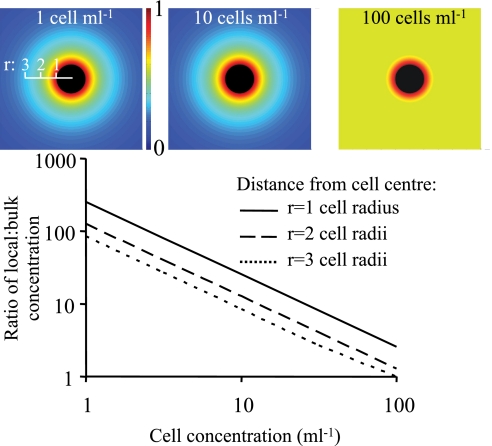
Fig. 1.
Fig. 1.
Ratio of the local concentration of a released allelopathic compound to the far-field concentration in the bulk in the absence of flow. The ratio is modeled using Eq. 7 with a cell radius of 10 μm and results are shown for 3 distances (cell radius units) from the cell surface. The Insets give a graphical view for 3 cell densities (1, 10, and 100 cells mL−1) of the relative magnitude (0–1) of an exuded compound diffusing out from the cell (in black) and out into the bulk medium (scale in cell radii).
Fig. 2.
Fig. 2.
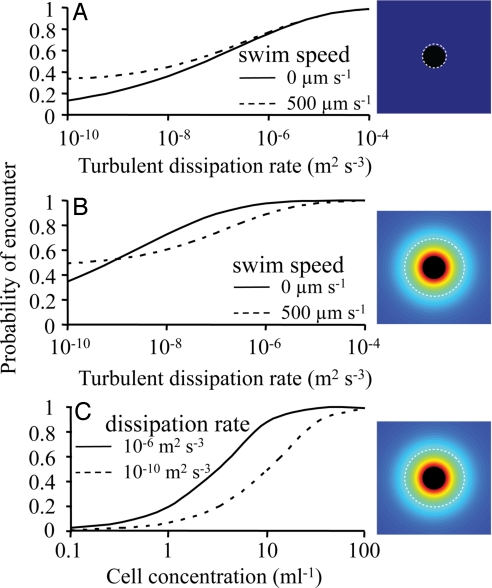
The probability of encounter between a susceptible cell and a population of cells producing an allelopathic compound (Eqs. 810). (A) Encounter radius is equal to the physical dimension of the cells. Probability of encounter is shown for swimming (500 μm s−1, typical for protists) and nonmotile cells, and for a range of turbulent dissipation rates (from calm deep to well mixed surface waters). Concentration of allelopathic cells is 10 mL−1. (B) Encounter probability when encounter is a function of the radius of the chemical envelope surrounding an allelopathic cell. The radius of the allelopathic envelope under flow conditions was determined by the concentration found three cell radii from the cell surface for nonflow conditions (Eq. 9). Concentration of allelopathic cells is 10 mL−1. (C) Encounter probability as a function of the concentration of allelopathic cells for two turbulent dissipation rates. In all calculations the cell radius is 10 μm and the diffusion coefficient for the allelopathic compound is 5 × 10⁻¹⁰ m2 s−1. The broken, white line in the graphic Insets show the position of the encounter radius. Note that in B and C, the encounter radius represents the distance from the cell centre to where the concentration of a compound elicits an allelopathic effect in the absence of flow. This distance is then a function of cell motility and turbulent energy which act to erode the chemical envelope.
Fig. 3.
Fig. 3.
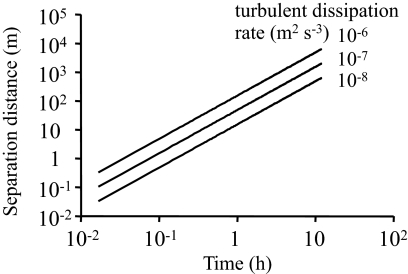
Separation distance as a function of time for two initially close cells based on the Richardson–Obukhov law (Eq. 11). The rate of separation is shown for 3 turbulent dissipation rates representing the low-end of turbulent energy found in surface waters.

References

    1. Hallegraeff GM. A review of harmful algal blooms and their apparent global increase. Phycologia. 1993;32:79–99.
    1. Turner JT, Tester PA, Hansen PJ. In: Physiological Ecology of Harmful Algal Blooms. Anderson DM, Cembella AD, Hallegraeff GM, editors. Berlin: Springer; 1998.
    1. Selander E, Thor P, Toth G, Pavia H. Copepods induce paralytic shellfish toxin production in marine dinoflagellates. Proc R Soc B. 2006;273:1673–1680. - PMC - PubMed
    1. Bertin C, Yang X, Weston LA. The role of root exudates and allelochemicals in the rhizosphere. Plant Soil. 2003;256:67–83.
    1. Levine JM, et al. Mechanisms underlying the impacts of exotic plant invasions. Proc R Soc B. 2003;270:775–781. - PMC - PubMed

Publication types

LinkOut - more resources