


The large contribution of projected HFC emissions to future climate forcing
- PMID: 19549868
- PMCID: PMC2700150
- DOI: 10.1073/pnas.0902817106
The large contribution of projected HFC emissions to future climate forcing
Abstract
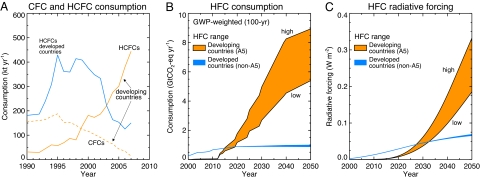
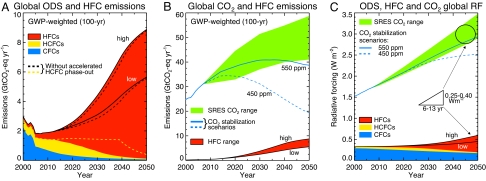
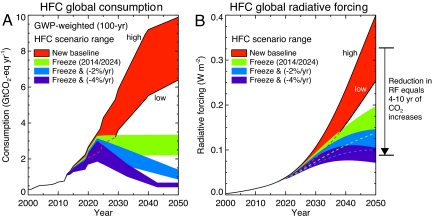
The consumption and emissions of hydrofluorocarbons (HFCs) are projected to increase substantially in the coming decades in response to regulation of ozone depleting gases under the Montreal Protocol. The projected increases result primarily from sustained growth in demand for refrigeration, air-conditioning (AC) and insulating foam products in developing countries assuming no new regulation of HFC consumption or emissions. New HFC scenarios are presented based on current hydrochlorofluorocarbon (HCFC) consumption in leading applications, patterns of replacements of HCFCs by HFCs in developed countries, and gross domestic product (GDP) growth. Global HFC emissions significantly exceed previous estimates after 2025 with developing country emissions as much as 800% greater than in developed countries in 2050. Global HFC emissions in 2050 are equivalent to 9-19% (CO(2)-eq. basis) of projected global CO(2) emissions in business-as-usual scenarios and contribute a radiative forcing equivalent to that from 6-13 years of CO(2) emissions near 2050. This percentage increases to 28-45% compared with projected CO(2) emissions in a 450-ppm CO(2) stabilization scenario. In a hypothetical scenario based on a global cap followed by 4% annual reductions in consumption, HFC radiative forcing is shown to peak and begin to decline before 2050.
Conflict of interest statement
The authors declare no conflict of interest.
Figures
References
-
- UNEP. Production and Consumption of Ozone Depleting Substances Under the Montreal Protocol. Nairobi, Kenya: United Nations Environment Programme; 2008. Available at www.ozoneunep.org/Data_Reporting/Data_Access.
-
- IPCC/TEAP. Special Report: Safeguarding the Ozone Layer and the Global Climate System: Issues Related to Hydrofluorocarbons and Perfluorocarbons. New York: Cambridge Univ Press; 2005.
-
- Forster P, et al. Changes in atmospheric cnstituents and in radiative forcing. In: Solomon S, et al., editors. Climate Change 2007: The Physical Science Basis. Cambridge, UK: Cambridge Univ Press; 2007.
-
- Mohanraj M, Jayaraj S, Muraleedharan C. Environmental friendly alternatives to halogenated refrigerants—a review. Int J Greenhouse Gas Control. 2008;3:109–119.
-
- Calm JM. Comparative efficiencies and implications for greenhouse gas emissions of chiller refrigerants. Int J Refrigeration. 2006;29:833–841.
MeSH terms
Substances
LinkOut - more resources
Full Text Sources
Other Literature Sources
Medical
Miscellaneous
