. 2009 Sep;35(9):1567-74.
doi: 10.1007/s00134-009-1560-y. Epub 2009 Jun 24.

Circulating angiopoietin-2 levels in the course of septic shock: relation with fluid balance, pulmonary dysfunction and mortality

Affiliations

Circulating angiopoietin-2 levels in the course of septic shock: relation with fluid balance, pulmonary dysfunction and mortality

Melanie van der Heijden et al. Intensive Care Med. 2009 Sep.

Abstract

Purpose: To investigate whether angiopoietin-2, von Willebrand factor (VWF) and angiopoietin-1 relate to surrogate indicators of vascular permeability, pulmonary dysfunction and intensive care unit (ICU) mortality throughout the course of septic shock.

Methods: In 50 consecutive mechanically ventilated septic shock patients, plasma angiopoietin-2, VWF and angiopoietin-1 levels and fluid balance, partial pressure of oxygen/inspiratory oxygen fraction and the oxygenation index as indicators of vascular permeability and pulmonary dysfunction, respectively, were measured until day 28.

Results: Angiopoietin-2 positively related to the fluid balance and pulmonary dysfunction, was higher in non-survivors than in survivors and independently predicted non-survival throughout the course of septic shock. VWF inversely related to the fluid balance and pulmonary dysfunction throughout the course of septic shock, was comparable between survivors and non-survivors and predicted non-survival on day 0 only. Angiopoietin-1 positively related to pulmonary dysfunction throughout the course, but did not differ between survivors and non-survivors.

Conclusions: In contrast to VWF, plasma angiopoietin-2 positively relates to fluid balance, pulmonary dysfunction and mortality throughout the course of septic shock, in line with a suggested mediator role of the protein.


Figures
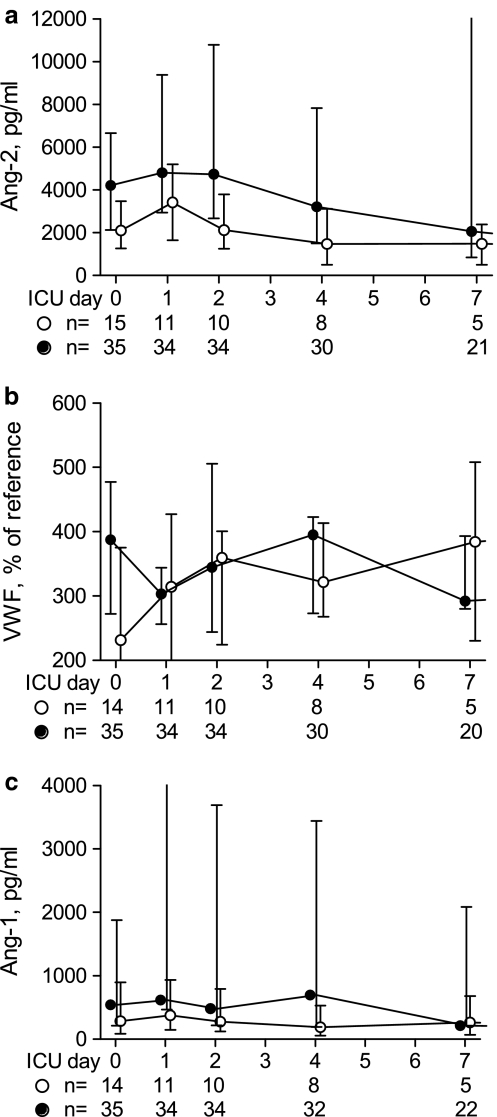
Fig. 1
Fig. 1
The course of angiopoietin and VWF levels in survivors and non-survivors. Median and interquartile range of a circulating angiopoietin-2 (Ang-2; pg/ml), b von Willebrand factor (VWF; % of reference) and c angiopoietin-1 (Ang-1) levels (pg/ml) in plasma of intensive care unit (ICU) survivors (open circle) and ICU non-survivors (filled circle) on day 0, 1, 2, 4 and 7. Days 14, 21 and 28 are not shown because of low numbers, but are included in the analysis. a Ang-2 levels tended to be higher in non-survivors than in survivors throughout the course of septic shock (P = 0.199 for survivor vs. non-survivor and P = 0.028 for interaction between day and survivor vs. non-survivor). One non-survivor had extremely high Ang-2 levels: day 0 125,100 pg/ml; day 1 149,000 pg/ml; day 2 114,300 pg/ml; day 4 115,550 pg/ml and day 7 116,800 pg/ml. Therefore, the upper limit of interquartile range at day 7 is 88,263 pg/ml. Analysis without this non-survivor yields a P = 0.039 for survivor versus non-survivor and P = 0.016 for the interaction between day and survivor versus non-survivor. b VWF levels did not differ between survivors and non-survivors throughout the course of septic shock (P = 0.545 for survivor vs. non-survivor and P = 0.218 for interaction between day and survivor vs. non-survivor). c Ang-1 levels did not differ between survivors and non-survivors throughout the course of septic shock (P = 0.189 for survivor vs. non-survivor and P = 0.070 for interaction between day and survivor vs. non-survivor)
Fig. 2
Fig. 2
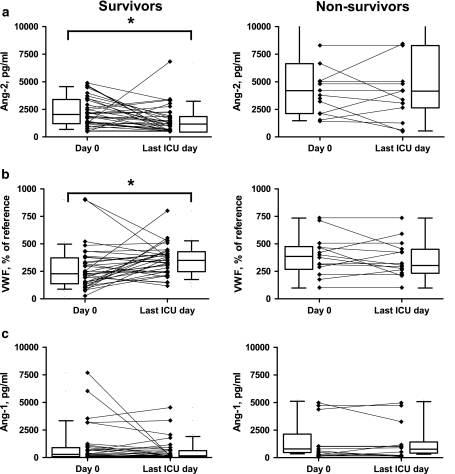
Angiopoietin and VWF levels on day 0 and the last ICU day in survivors and non-survivors. Individual levels and box plot of a circulating angiopoietin-2 (Ang-2; pg/ml), b von Willebrand factor (VWF; % of reference) and c angiopoietin-1 (Ang-1) levels (pg/ml) on day 0 and the last intensive care unit (ICU) day in ICU survivors and ICU non-survivors. Values in boxes are at 25th percentile, median and 75th percentile; whiskers are 10th and 90th percentile. a Ang-2 levels decreased from day 0 to the last ICU day in survivors (*P = 0.0033, n = 35 pairs), while they did not change in non-survivors (P = 0.3910, n = 15 pairs). Data not shown: Day 0 survivor: 25,090 pg/ml; day 0 non-survivor: 17,980 and 125,100 pg/ml; last ICU day non-survivor: 12,050 and 116,800 pg/ml; 90th percentile of non-survivors day 0: 60,828 pg/ml; 90th percentile of non-survivors last ICU day: 53,950 pg/ml. b VWF levels increased from day 0 to the last ICU day in survivors (*P = 0.0057, n = 35 pairs) and did not change in non-survivors (P = 0.5070, n = 14 pairs). c Ang-1 levels did not differ between day 0 and the last ICU day in survivors (P = 0.1044, n = 35 pairs) or non-survivors (P = 0.7612, n = 14 pairs)
Fig. 3
Fig. 3
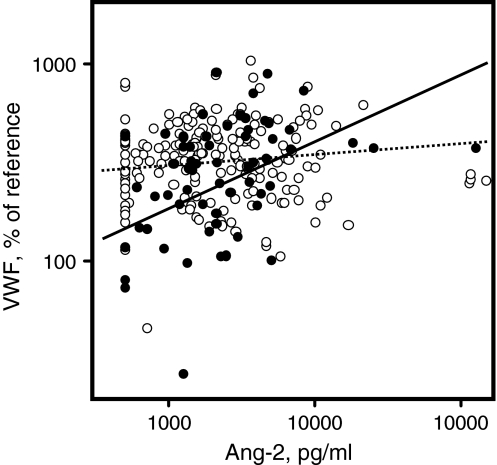
The relation between Ang-2 and VWF levels. Angiopoietin-2 (Ang-2) levels (pg/ml) positively related to von Willebrand factor (VWF) levels (% of reference) at day 0 (filled circle, r = 0.45, P = 0.001, black line). Ang-2 levels throughout the course of septic shock did not relate to VWF levels (open circle day 1, day 2, day 4, day 7, day 14, day 21 and day 28, r = 0.10, P = 0.1190, dotted line)

References

    1. Hotchkiss RS, Karl IE (2003) The pathophysiology and treatment of sepsis. N Engl J Med 348:138–150 - DOI - PubMed
    1. Aird WC (2003) The role of the endothelium in severe sepsis and multiple organ dysfunction syndrome. Blood 101:3765–3777 - DOI - PubMed
    1. Groeneveld ABJ (2002) Vascular pharmacology of acute lung injury and acute respiratory distress syndrome. Vascul Pharmacol 39:247–256 - DOI - PubMed
    1. Orfanos SE, Kotanidou A, Glynos C, Athanasiou C, Tsigkos S, Dimopoulou I, Sotiropoulou C, Zakynthinos S, Armaganidis A, Papapetropoulos A, Roussos C (2006) Angiopoietin-2 is increased in severe sepsis: correlation with inflammatory mediators. Crit Care Med 35:199–206 - DOI - PubMed
    1. Parikh SM, Mammoto T, Schultz A, Yuan HT, Christiani D, Karumanchi SA, Sukhatme VP (2006) Excess circulating angiopoietin-2 may contribute to pulmonary vascular leak in sepsis in humans. PLoS Med 3:356–370 - DOI - PMC - PubMed

Publication types