


Yes-associated protein is an independent prognostic marker in hepatocellular carcinoma
- PMID: 19551889
- PMCID: PMC2811690
- DOI: 10.1002/cncr.24495
Yes-associated protein is an independent prognostic marker in hepatocellular carcinoma
Abstract
Background: Yes-associated protein (YAP), a downstream target of the Hippo signaling pathway, was recently linked to hepatocarcinogenesis in a mouse hepatocellular carcinoma (HCC) model. The objective of the current study was to investigate the clinical significance of YAP in HCC and its prognostic values in predicting survival and tumor recurrence.
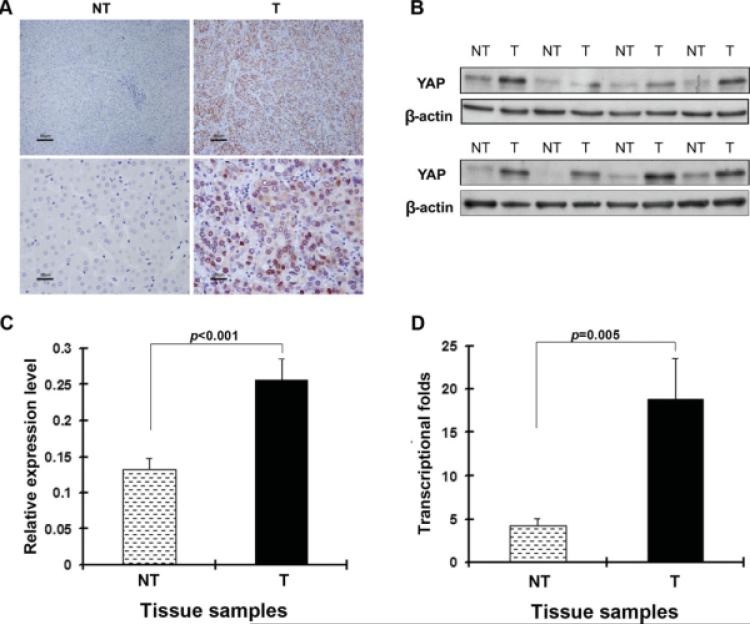
Methods: The authors collected 177 pairs of tumor and adjacent nontumor tissue from HCC patients with definitive clinicopathologic and follow-up data. YAP expression was determined by immunohistochemistry, Western blot analysis, and quantitative polymerase chain reaction. Association of YAP with each clinicopathologic feature was analyzed by Pearson chi-square test, and HCC-specific disease-free survival and overall survival by Kaplan-Meier curves and log-rank test. Multivariate Cox regression analyses of YAP in HCC were also performed.
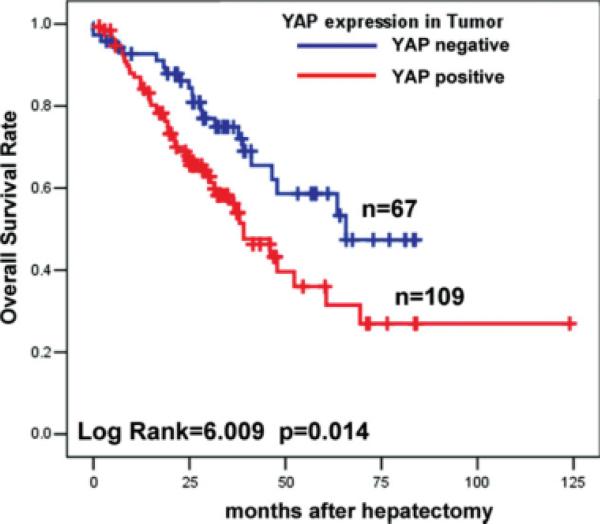
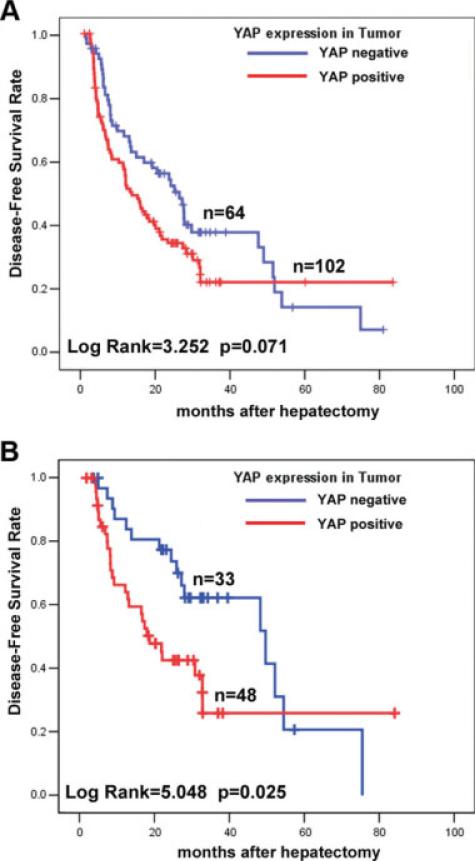
Results: YAP was expressed in the majority of HCC cases (approximately 62%) and mainly accumulated in the tumor nucleus. Overexpression of YAP in HCC was significantly associated with poorer tumor differentiation (Edmonson grade; P = .021) and high serum alpha-fetoprotein (AFP) level (P < .001). Kaplan-Meier and Cox regression data indicated that YAP was an independent predictor for HCC-specific disease-free survival (hazards ratio [HR], 1.653; 95% confidence interval [95% CI], 1.081-2.528 [P = .02]) and overall survival (HR, 2.148; 95% CI, 1.255-3.677 [P = .005]).
Conclusions: YAP is an independent prognostic marker for overall survival and disease-free survival times of HCC patients and clinicopathologically associated with tumor differentiation and serum AFP level. It is a potential therapeutic target for this aggressive malignancy.
2009 American Cancer Society.
Figures
References
-
- Kamangar F, Dores GM, Anderson WF. Patterns of cancer incidence, mortality, and prevalence across 5 continents: defining priorities to reduce cancer disparities in different geographic regions of the world. J Clin Oncol. 2006;24:2137–2150. - PubMed
-
- Jemal A, Murray T, Ward E, et al. Cancer statistics, 2005. CA Cancer J Clin. 2005;55:10–30. - PubMed
-
- Yu MC, Yuan JM. Environmental factors and risk for hepatocellular carcinoma. Gastroenterology. 2004;127(5 suppl 1):S72–S78. - PubMed
-
- El-Serag HB. Hepatocellular carcinoma: an epidemiologic view. J Clin Gastroenterol. 2002;35(5 suppl 2):S72–S781. - PubMed
-
- Jemal A, Siegel R, Ward E, Murray T, Xu J, Thun MJ. Cancer statistics, 2007. CA Cancer J Clin. 2007;57:43–66. - PubMed
Publication types
MeSH terms
Substances
Grants and funding
LinkOut - more resources
Full Text Sources
Other Literature Sources
Medical
