


Increased intra-individual reaction time variability in attention-deficit/hyperactivity disorder across response inhibition tasks with different cognitive demands
- PMID: 19552927
- PMCID: PMC4766847
- DOI: 10.1016/j.neuropsychologia.2009.01.022
Increased intra-individual reaction time variability in attention-deficit/hyperactivity disorder across response inhibition tasks with different cognitive demands
Abstract
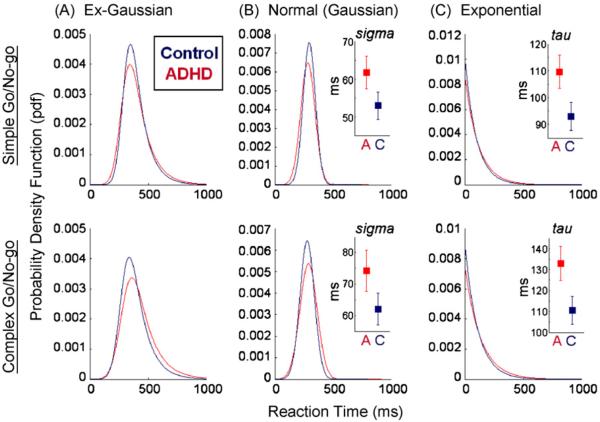
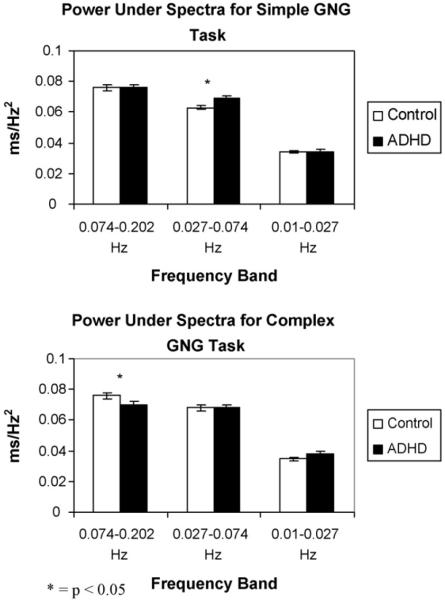
One of the most consistent findings in children with ADHD is increased moment-to-moment variability in reaction time (RT). The source of increased RT variability can be examined using ex-Gaussian analyses that divide variability into normal and exponential components and Fast Fourier transform (FFT) that allow for detailed examination of the frequency of responses in the exponential distribution. Prior studies of ADHD using these methods have produced variable results, potentially related to differences in task demand. The present study sought to examine the profile of RT variability in ADHD using two Go/No-go tasks with differing levels of cognitive demand. A total of 140 children (57 with ADHD and 83 typically developing controls), ages 8-13 years, completed both a "simple" Go/No-go task and a more "complex" Go/No-go task with increased working memory load. Repeated measures ANOVA of ex-Gaussian functions revealed for both tasks children with ADHD demonstrated increased variability in both the normal/Gaussian (significantly elevated sigma) and the exponential (significantly elevated tau) components. In contrast, FFT analysis of the exponential component revealed a significant task x diagnosis interaction, such that infrequent slow responses in ADHD differed depending on task demand (i.e., for the simple task, increased power in the 0.027-0.074 Hz frequency band; for the complex task, decreased power in the 0.074-0.202 Hz band). The ex-Gaussian findings revealing increased variability in both the normal (sigma) and exponential (tau) components for the ADHD group, suggest that both impaired response preparation and infrequent "lapses in attention" contribute to increased variability in ADHD. FFT analyses reveal that the periodicity of intermittent lapses of attention in ADHD varies with task demand. The findings provide further support for intra-individual variability as a candidate intermediate endophenotype of ADHD.
Figures
References
-
- American Psychiatric Association . Diagnostic and statistical manual of mental disorders. 4th ed. Author; Washington, DC: 2000.
-
- Barkley RA. Behavioral inhibition, sustained attention, and executive functions: Constructing a unifying theory of ADHD. Psychological Bulletin. 1997;121(1):65–94. - PubMed
-
- Buitelaar JK, Montgomery SA, van Zwieten-Boot BJ. Attention deficit hyperactivity disorder: Guidelines for investigating efficacy of pharmacological intervention. European Neuropsychopharmacology. 2003;13:297–304. - PubMed
-
- Castellanos FX, Sonuga-Barke EJS, Milham MP, Tannock R. Characterizing cognition in ADHD: Beyond executive dysfunction. Trends in Cognitive Sciences. 2006;10:117–123. - PubMed
Publication types
MeSH terms
Grants and funding
LinkOut - more resources
Full Text Sources
Medical
