


Pitch then power: limitations to acceleration in quadrupeds
- PMID: 19553249
- PMCID: PMC2781967
- DOI: 10.1098/rsbl.2009.0360
Pitch then power: limitations to acceleration in quadrupeds
Abstract
Rapid acceleration and deceleration are vital for survival in many predator and prey animals and are important attributes of animal and human athletes. Adaptations for acceleration and deceleration are therefore likely to experience strong selective pressures--both natural and artificial. Here, we explore the mechanical and physiological constraints to acceleration. We examined two elite athletes bred and trained for acceleration performance (polo ponies and racing greyhounds), when performing maximal acceleration (and deceleration for ponies) in a competitive setting. We show that maximum acceleration and deceleration ability may be accounted for by two simple limits, one mechanical and one physiological. At low speed, acceleration and deceleration may be limited by the geometric constraints of avoiding net nose-up or tail-up pitching, respectively. At higher speeds, muscle power appears to limit acceleration.
Figures
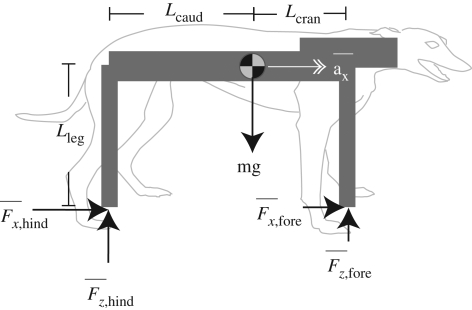
 vertical ground reaction force (opposes weight), and
  horizontal force that accelerates/ decelerates (−
 ) the animal. We consider only
  during braking and
  during propulsion. Lleg is the length of leg, Lcran and Lcaud are the distances from CoM to hip/shoulder joint, respectively.
References
-
- Aerts P.1998Vertical jumping in Galago senegalensis: the quest for an obligate mechanical power amplifier. Phil. Trans. R. Soc. Lond. B 353, 1607–1620 (doi:10.1098/rstb.1998.0313) - DOI
-
- Aerts P., Van Damme R., d'Aout K., Van Hooydonck B.2003Bipedalism in lizards: whole-body modelling reveals a possible spandrel. Phil. Trans. R. Soc. Lond. B 358, 1525–1533 (doi:10.1098/rstb.2003.1342) - DOI - PMC - PubMed
-
- Askew G. N., Marsh R. L., Ellington C. P.2001The mechanical power output of the flight muscles of blue-breasted quail (Coturnix chinensis) during take off. J. Exp. Biol. 204, 3601–3619 - PubMed
-
- Bennet-Clark H. C.1975The energetics of the jump of the locust Schistocerca gregaria. J. Exp. Biol. 63, 58–83 - PubMed
-
- Biewener A. A.1989Scaling body support in mammals: limb posture and muscle mechanics. Science 245, 45–48 (doi:10.1126/science.2740914) - DOI - PubMed
Publication types
MeSH terms
Grants and funding
LinkOut - more resources
Full Text Sources
