. 2009 Aug;136(15):2505-10.
doi: 10.1242/dev.032136. Epub 2009 Jun 24.

Beta-catenin controls differentiation of the retinal pigment epithelium in the mouse optic cup by regulating Mitf and Otx2 expression

Affiliations

Beta-catenin controls differentiation of the retinal pigment epithelium in the mouse optic cup by regulating Mitf and Otx2 expression

Peter Westenskow et al. Development. 2009 Aug.

Abstract

The retinal pigment epithelium (RPE) consists of a monolayer of cuboidal, pigmented cells that is located between the retina and the choroid. The RPE is vital for growth and function of the vertebrate eye and improper development results in congenital defects, such as microphthalmia or anophthalmia, or a change of cell fate into neural retina called transdifferentiation. The transcription factors microphthalmia-associated transcription factor (Mitf) and orthodenticle homolog 2 (Otx2) are crucial for RPE development and function; however, very little is known about their regulation. Here, by using a Wnt-responsive reporter, we show that the Wnt/beta-catenin pathway is activated in the differentiating mouse RPE. Cre-mediated, RPE-specific disruption of beta-catenin after the onset of RPE specification causes severe defects, resulting in microphthalmia with coloboma, disturbed lamination, and mislocalization of adherens junction proteins. Upon beta-catenin deletion, the RPE transforms into a multilayered tissue in which the expression of Mitf and Otx2 is downregulated, while retina-specific gene expression is induced, which results in the transdifferentiation of RPE into retina. Chromatin immunoprecipitation (ChIP) and luciferase assays indicate that beta-catenin binds near to and activates potential TCF/LEF sites in the Mitf and Otx2 enhancers. We conclude that Wnt/beta-catenin signaling is required for differentiation of the RPE by directly regulating the expression of Mitf and Otx2. Our study is the first to show that an extracellular signaling pathway directly regulates the expression of RPE-specific genes such as Mitf and Otx2, and elucidates a new role for the Wnt/beta-catenin pathway in organ formation and development.


Figures
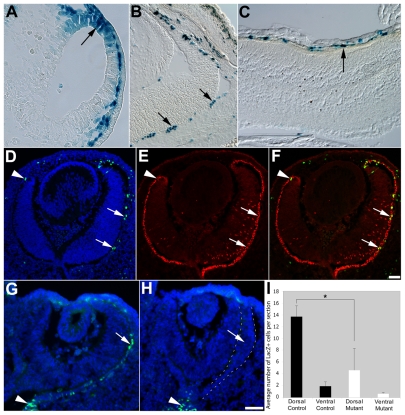
Fig. 1.
Fig. 1.
TCF/LEF activity in the developing RPE in mouse is dependent on β-catenin. (A-C) X-gal staining marks TCF/LEF-responsive cells (arrows) in BATgal RPE at E9.5 (26 somites; A), E15.5 (B) and P16 (C). (D-F) Colocalization of β-galactosidase (D; green; DAPI in blue) and Otx2 (E, red) in the dorsal (arrows) and ventral (arrowheads) RPE at E12.5. (F) Merge of D and E. (G,H) β-galactosidase-labeled cells in E11 BATgal control (G, green, arrow) and Tyrp1-Cretg/0;β-cateninfloxdel/FL RPE (H, between dashed lines, arrow). Arrowheads indicate the optic nerve. (I) Quantification of β-galactosidase-labeled cells in dorsal and ventral RPE of control and mutant embryos. Note the statistically significant reduction in TCF/LEF-responsive cells in dorsal RPE (P=0.039), but not in ventral, non-transdifferentiated RPE (P=0.089), of mutant embryos. Scale bars: 50 μm.
Fig. 2.
Fig. 2.
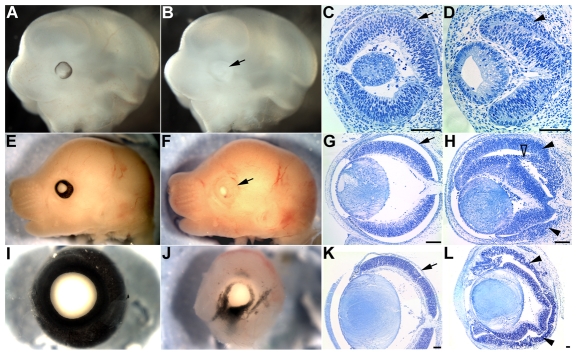
Severe eye defects induced by RPE-specific deletion of β-catenin. Lateral views of control (A,E,I) and Tyrp1-Cretg/0;β-cateninfloxdel/FL mutant (B,F,J) eyes at E11.5 (A,B), E15.5 (E,F) and P0 (I,J). (C,D,G,H,K,L) Toluidine Blue staining of coronal sections of control (C,G,K) and mutant (D,H,L) eyes at E11.5 (C,D), E15.5 (G,H) and P0 (K,L). Note the absence of pigment (B,F,J; arrows) and hypercellularity (arrowheads in D,H,L) of the RPE. The disorganized retina forms bridges to the mutant RPE (open arrowhead in H). Arrows in C,G,K indicate control RPE. (L) At P0, the RPE and retinal layers in mutant eyes are folded extensively. Scale bars: 50 μm.
Fig. 3.
Fig. 3.
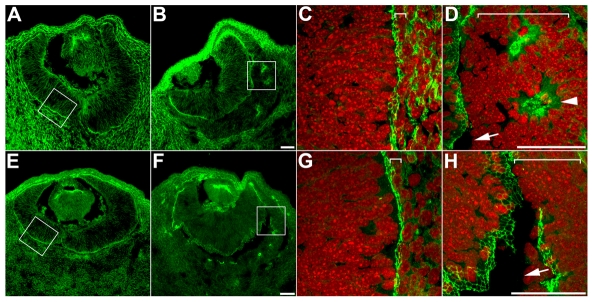
Cell adhesion is perturbed in Tyrp1-Cretg/0;β-cateninfloxdel/FL RPE. At E12.5, F-actin (A-D) and ZO-1 (E-H) are enriched in apical adherens junctions in the retina and RPE in control (A,C,E,G) and in Tyrp1-Cretg/0;β-cateninfloxdel/FL (B,D,F,H) retinas. In mutant RPE, F-actin and ZO-1 are mislocalized to rosette structures (D, arrowhead) and are absent at the apical border (D,H, arrows). Boxes in A,B,E,F mark areas magnified in C,D,G,H, counter-labeled with DAPI (red). Brackets delineate the RPE. Scale bars: 50 μm.
Fig. 4.
Fig. 4.
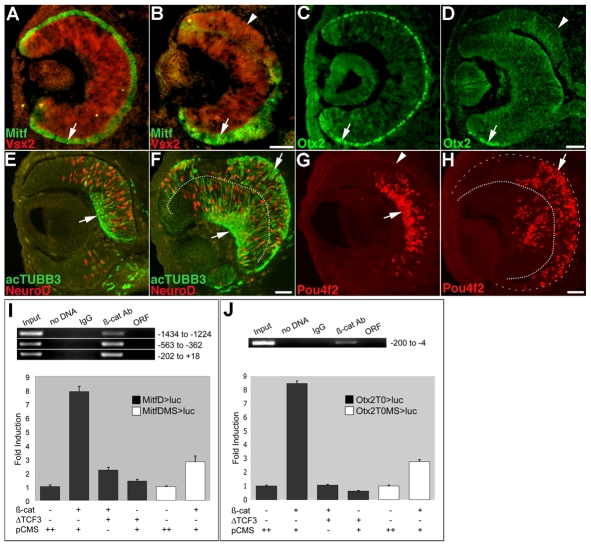
RPE-specific loss of β-catenin induces transdifferentiation into retina. (A,B) Mitf (green) is present throughout the RPE in E11 controls (A, arrow) and in the ventral Tyrp1-Cretg/0;β-cateninfloxdel/FL RPE (B, arrow). The dorsal mutant RPE is devoid of Mitf (B, arrowhead). Vsx2 is normally detected in the retina (A, red) and ectopically expressed in mutant RPE (B, arrowhead). (C,D) At E11.5, Otx2 is expressed throughout the RPE in controls (C, arrow) and in a few cells in the ventral RPE of mutant embryos (D, arrow), but is undetectable in the dorsal portion (D, arrowhead) of the RPE in mutant embryos. (E-H) Retinal neurogenesis occurs in E12.5 Tyrp1-Cretg/0;β-cateninfloxdel/FL RPE. (E) Normally, acTubb3 (green, arrow) is expressed in ganglion cell precursors, and Neurod (red) in amacrine and photoreceptor precursors. (F) Both markers are ectopically expressed in an inverse orientation in the transdifferentiated RPE (arrow). (G,H) Pou4f2 labels ganglion cells at the basal surface (arrows). Arrowhead in G marks the RPE. Dotted lines in F and H indicate the retina and RPE boundary; dashed line indicates the RPE and choroid boundary. (I, top) ChIP was performed on primary E12.5 mouse RPE using a β-catenin antibody (β-cat Ab). β-catenin associates with regions of the Mitf-D enhancer containing putative TCF/LEF sites. Locations of the amplicons are indicated to the right. (Bottom) An Mitf-D pGL3B reporter construct (MitfD>luc) is activated by constitutively active β-catenin (β-cat) in HEK293T cells. Cotransfection with ΔTCF3 or mutation of TCF/LEF sites (MitfDMS>luc) diminishes reporter activation. (J, top) β-catenin associates with the Otx2 T0 enhancer in vivo as shown by ChIP. (Bottom) β-catenin activates an Otx2 pGL3B reporter construct (Otx2T0>luc), whereas ΔTCF3 or mutation of TCF/LEF sites (Otx2T0MS>luc) reduces reporter activation. Input, amplification from non-immunoprecipitated chromatin. Negative controls used were mouse IgG, H2O (no DNA) or open-reading frame primers (ORF). The ChIP assays were independently repeated four times (twice using whole E9.5 embryos and twice using E12.5 RPE). The transactivation assays were repeated a minimum of four times and representative examples are shown. pCMS is an empty vector. Scale bars: 50 μm.

References

    1. Bharti, K., Nguyen, M. T., Skuntz, S., Bertuzzi, S. and Arnheiter, H. (2006). The other pigment cell: specification and development of the pigmented epithelium of the vertebrate eye. Pigment Cell Re.s 19, 380-394. - PMC - PubMed
    1. Bharti, K., Liu, W., Csermely, T., Bertuzzi, S. and Arnheiter, H. (2008). Alternative promoter use in eye development: the complex role and regulation of the transcription factor MITF. Development 135, 1169-1178. - PMC - PubMed
    1. Brault, V., Moore, R., Kutsch, S., Ishibashi, M., Rowitch, D. H., McMahon, A. P., Sommer, L., Boussadia, O. and Kemler, R. (2001). Inactivation of the beta-catenin gene by Wnt1-Cre-mediated deletion results in dramatic brain malformation and failure of craniofacial development. Development 128, 1253-1264. - PubMed
    1. Bumsted, K. M. and Barnstable, C. J. (2000). Dorsal retinal pigment epithelium differentiates as neural retina in the microphthalmia (mi/mi) mouse. Invest. Ophthalmol. Vis. Sci. 41, 903-908. - PubMed
    1. Burmeister, M., Novak, J., Liang, M. Y., Basu, S., Ploder, L., Hawes, N. L., Vidgen, D., Hoover, F., Goldman, D., Kalnins, V. I. et al. (1996). Ocular retardation mouse caused by Chx10 homeobox null allele: impaired retinal progenitor proliferation and bipolar cell differentiation. Nat. Genet. 12, 376-384. - PubMed

Publication types

MeSH terms