. 2009;60(11):3195-202.
doi: 10.1093/jxb/erp160. Epub 2009 Jun 24.

Tobacco plastid transformation using the feedback-insensitive anthranilate synthase [alpha]-subunit of tobacco (ASA2) as a new selectable marker

Affiliations

Tobacco plastid transformation using the feedback-insensitive anthranilate synthase [alpha]-subunit of tobacco (ASA2) as a new selectable marker

Pierluigi Barone et al. J Exp Bot. 2009.

Abstract

Genetic engineering of chloroplasts normally requires the stable introduction of bacterial derived antibiotic or herbicide-resistance genes as selective markers. Ecological and health concerns have been raised due to the presence of such genes within the environment or the food supply. One way to overcome this issue is the use of plant genes able to confer a metabolic or developmental advantage to the transformed cells manipulating the plant's biosynthetic pathways. We explored the feasibility of using, for plastid transformation, the selection system based on the feedback-insensitive anthranilate synthase (AS) alpha-subunit gene of tobacco (ASA2) as a new selective marker and the indole analogue 4-methylindole (4MI) or the tryptophan analogue 7-methyl-DL-tryptophan (7MT) as the selection agents. An expression cassette containing Prrn-ASA2 was effectively integrated into the region between accD and ycf4 of the tobacco plastome by the biolistic process. Plastid transgenic plants were obtained on medium supplemented with 300 microM 7MT or 4MI. Transplastomic plants showed normal phenotype and fertility and the resistance to the selection agents 7MT and 4MI was transmitted maternally. The plastid transformed lines also exhibited a higher level of AS enzyme activity that was less sensitive to Trp-feedback inhibition and, consequently, increased free Trp levels in leaves about 7-fold.


Figures
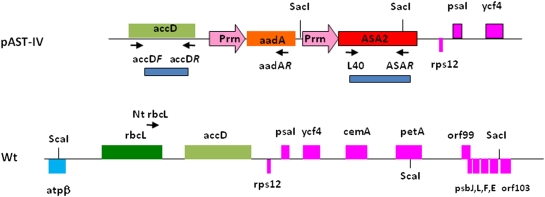
Fig. 1.
Fig. 1.
Structure of the vector pASTIV used for tobacco transformation and its corresponding region of the wild-type tobacco plastid genome based on GenBank Z00044 and NC_001879. Relevant plastid genes and their orientation are presented. Prrn: plastid 16S rRNA operon promoter, aadA: spectinomycin resistance gene with the Chlamydomonas rbcL 3′-untranslated region (500 bp), ASA2, modified version of ASA2 (1671 bp) including its termination sequence (204 bp). The locations of SacI and ScaI used for Southern hybridization are shown. Location and orientation of PCR primers are indicated by arrows. accD probe (accD F–accD R) and ASA2 probe (L40–ASAR) are shown. The figure size is not to scale.
Fig. 2.
Fig. 2.
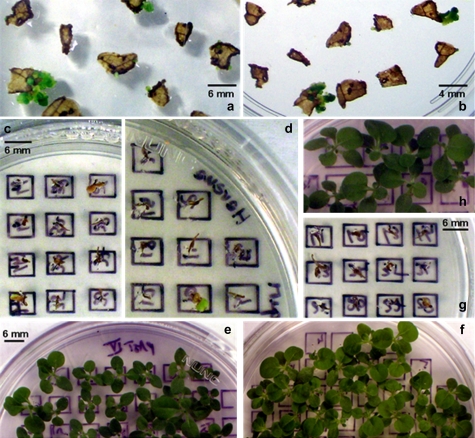
Bombarded tobacco leaf material on RMOP/7MT 300 μM (a) or RMOP/4MI 300 μM (b) with green resistant shoots. Seed germination of WT (N. tabacum, Petit Havana) on either 4MI (c) or 7MT (d) 75 μM. Seedlings from seeds of self-pollinated transplastomic plant 27 on 4MI (e) and plant C on 7MT (f) 75 μM. Germination of seeds on 7 MT 75 μM from either WT plant pollinated with pollen from transplastomic plant C (g) or from transplastomic plant C pollinated with pollen from WT (h).
Fig. 3.
Fig. 3.
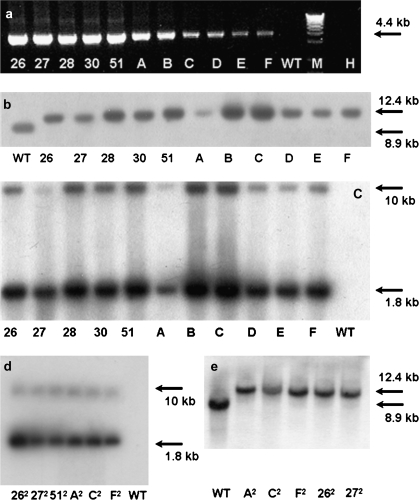
Plastid genomic analysis of site-specific integration of the ASA2 gene: (a) PCR amplification with primer aadAR (aadA-specific) and primer NtrbcL (plastid site-specific-see Fig. 1); for Southern blot DNA was digested with either ScaI and hybridized to the plastid site-specific probe accD (b, e) or SacI and hybridized to an ASA2 probe (c, d). Lines 26–51 selected on 300 μM 7MT and lines A–F selected on 300 μM 4MI. WT, untransformed control; H, blank control/water; M, DNA ladder. Lines 262–512 F1 crosses (male non-transgenic×female transgenic) germinated on 75 μM 7MT and lines A2–F2 F1 crosses (male non-transgenic×female transgenic) germinated on 75 μM 4 MI. WT, untransformed control; H: blank control/water.
Fig. 4.
Fig. 4.
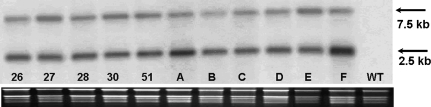
Northern blot analysis of the total RNA probed with ASA2 probe (see Fig. 1). Plants in lanes 26–51 were selected on 300 μM 7MT and plants in lanes A–F were selected on 300 μM 4MI. WT, untransformed control. The ethidium bromide-stained 26S, 18S, 16S, and 23S rRNAs are shown at the bottom to indicate RNA loading.
Fig. 5.
Fig. 5.
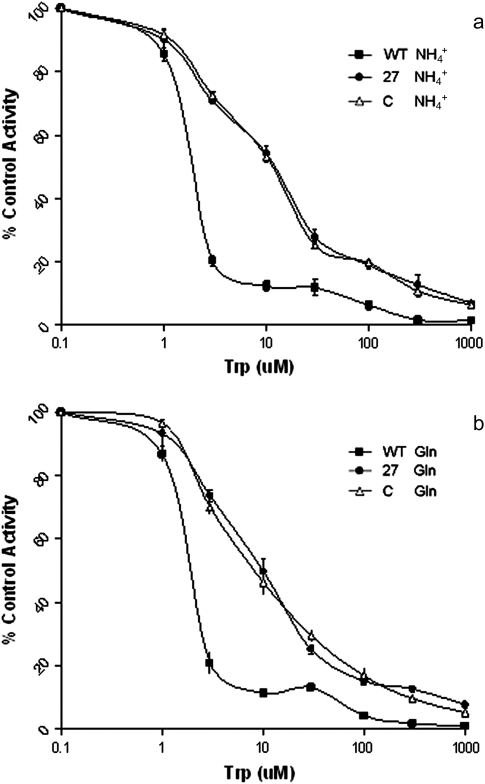
Trp inhibition of AS enzyme activity in total leaf extracts from wild-type (WT) (filled squares) and transplastomic plants 27 selected on 7MT (filled circles) and C selected on 4MI (open triangles), with 100 mM NH4Cl (a) (α-subunit activity) or 10 mM Gln (b) (holoenzyme activity) as substrate. The values are means ±SD of three replicates.
Fig. 6.
Fig. 6.
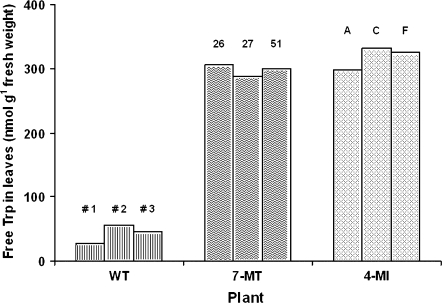
Free Trp content in leaves of three WT plants and three transplastomic plants selected on either 7MT (26, 27, 51) or 4MI (A, C, F).

References

    1. Barone P, Widholm JM. Use of 4-methylindole or 7-methyl-DL -tryptophan in a transformant selection system based on the feedback-insensitive anthranilate synthase α-subunit of tobacco (ASA2) Plant Cell Reports. 2008;27:509–517. - PubMed
    1. Bernasconi P, Walters EW, Woodworth AR, Siehl DL, Stone TE, Subramanian MW. Functional expression of Arabidopsis thaliana anthranilate synthase subunit I in Escherichia coli. Plant Physiology. 1994;106:353–358. - PMC - PubMed
    1. Bock R. Plastid biotechnology: prospects for herbicide and insect resistance, metabolic engineering and molecular farming. Current Opinion in Plant Biology. 2007;18:100–106. - PubMed
    1. Bohlmann J, Lins T, Martin W, Eilert U. Anthranilate synthase from Ruta graveolens. Duplicated ASa genes encode tryptophan-sensitive and tryptophan-insensitive isoenzymes specific to amino acid and alkaloid biosynthesis. Plant Physiology. 1996;111:507–514. - PMC - PubMed
    1. Carrer H, Hockenberry TN, Svab Z, Maliga P. Kanamycin resistance as a selectable marker for plastid transformation in tobacco. Molecular and General Genetics. 1993;241:49–56. - PubMed

Publication types