


APOE mRNA and protein expression in postmortem brain are modulated by an extended haplotype structure
- PMID: 19554612
- PMCID: PMC2829359
- DOI: 10.1002/ajmg.b.30993
APOE mRNA and protein expression in postmortem brain are modulated by an extended haplotype structure
Abstract
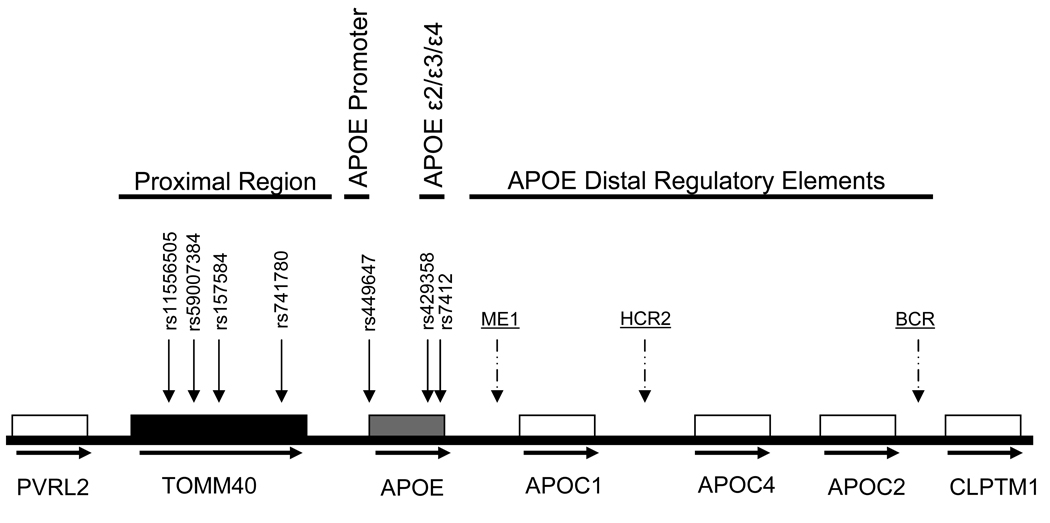
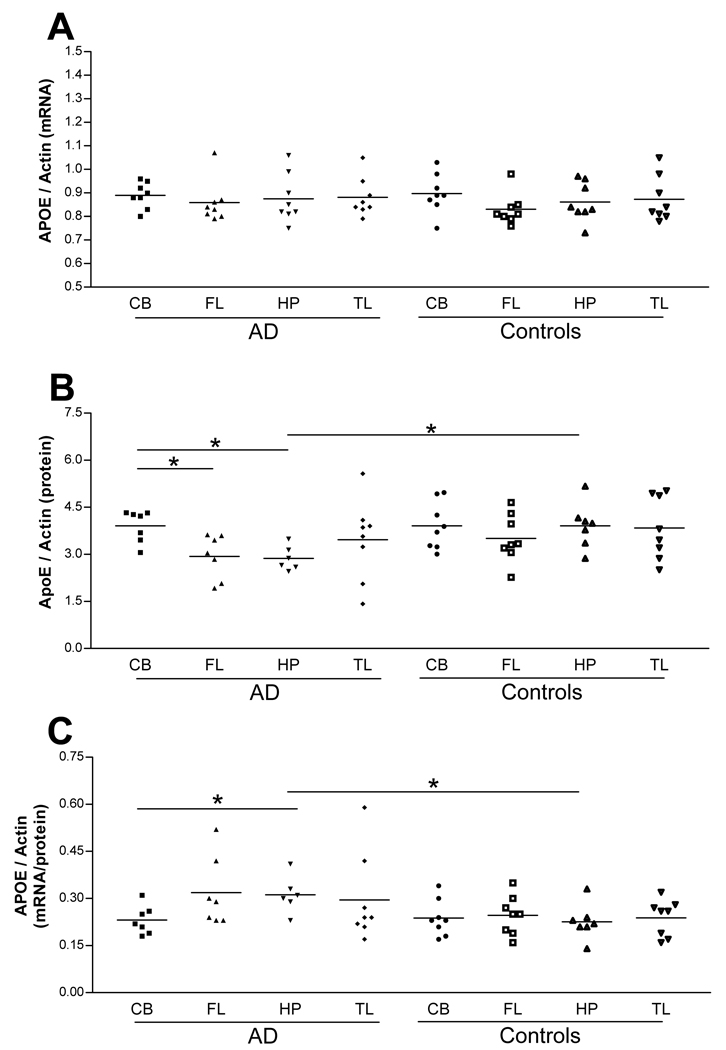
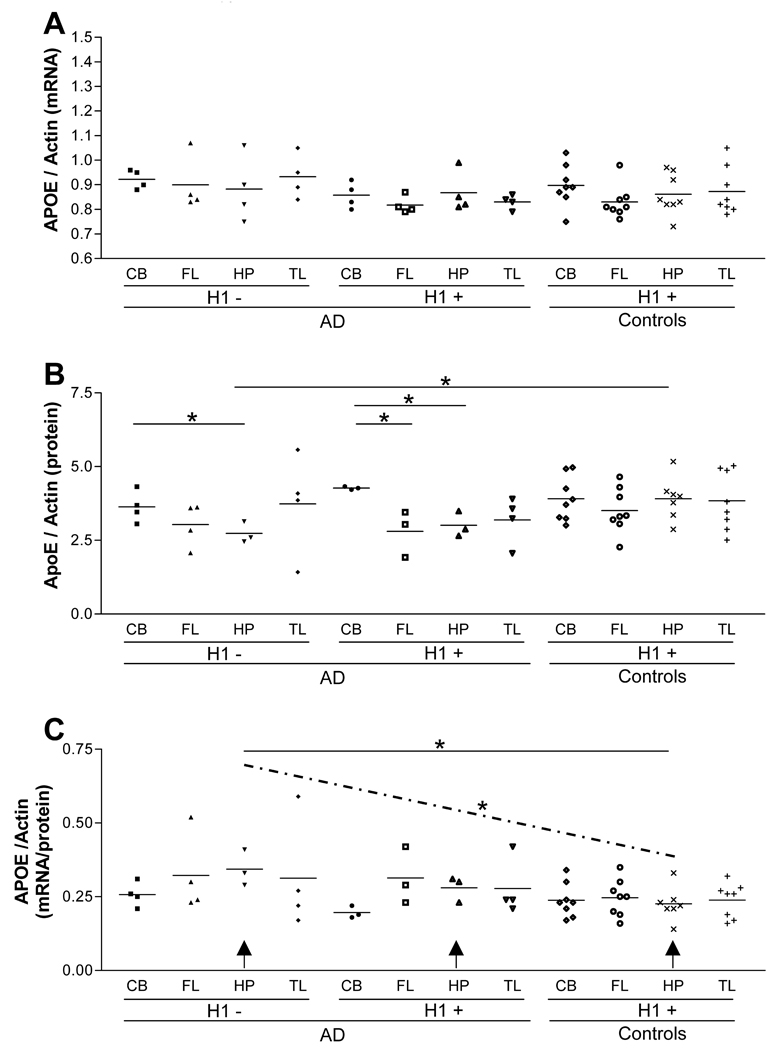
Currently the epsilon4 allele of the apolipoprotein E gene (APOE) is the strongest genetic risk factor for late onset Alzheimer's disease (AD). However, inheritance of the APOE epsilon4 allele is not necessary or sufficient for the development of AD. Genetic evidence suggests that multiple loci in a 70 kb region surrounding APOE are associated with AD risk. Even though these loci could represent surrogate markers in linkage disequilibrium with APOE epsilon4 allele, they could also contribute biological effects independent of the APOE epsilon4 allele. Our previous study identified multiple SNPs upstream from APOE that are associated with cerebrospinal fluid apoE levels, suggesting that a haplotype structure proximal to APOE can influence apoE expression. In this study, we examined apoE expression in human post-mortem brain (PMB), and constructed chromosome-phase-separated haplotypes of the APOE proximal region to evaluate their effect on PMB apoE expression. ApoE protein expression was found to differ among AD brain regions and to differ between AD and control hippocampus. In addition, an extended APOE proximal haplotype structure, spanning from the TOMM40 gene to the APOE promoter, may modulate apoE expression in a brain region-specific manner and may influence AD disease status. In conclusion, this haplotype-phenotype analysis of apoE expression in PMB suggests that either; (1) the cis-regulation of APOE expression levels extends far upstream of the APOE promoter or (2) an APOE epsilon4 allele independent mechanism involving the TOMM40 gene plays a role in the risk of AD.
(c) 2009 Wiley-Liss, Inc.
Figures
References
-
- Allan CM, Walker D, Taylor JM. Evolutionary duplication of a hepatic control region in the human apolipoprotein E gene locus. Identification of a second region that confers high level and liver-specific expression of the human apolipoprotein E gene in transgenic mice. J Biol Chem. 1995;270:26278–26281. - PubMed
-
- Allen G, Barnard H, McColl R, Hester AL, Fields JA, Weiner MF, Ringe WK, Lipton AM, Brooker M, McDonald E, Rubin CD, Cullum CM. Reduced hippocampal functional connectivity in Alzheimer disease. Arch Neurol. 2007;64:1482–1487. - PubMed
-
- Artiga MJ, Bullido MJ, Sastre I, Recuero M, Garcia MA, Aldudo J, Vazquez J, Valdivieso F. Allelic polymorphisms in the transcriptional regulatory region of apolipoprotein E gene. FEBS Lett. 1998;421:105–108. - PubMed
-
- Beffert U, Cohn JS, Petit-Turcotte C, Tremblay M, Aumont N, Ramassamy C, Davignon J, Poirier J. Apolipoprotein E and beta-amyloid levels in the hippocampus and frontal cortex of Alzheimer's disease subjects are disease-related and apolipoprotein E genotype dependent. Brain Res. 1999;843:87–94. - PubMed
Publication types
MeSH terms
Substances
Grants and funding
LinkOut - more resources
Full Text Sources
Other Literature Sources
Medical
Miscellaneous
