


Comment
doi: 10.1016/j.biopsych.2009.05.003.
Stress and addiction: a dynamic interplay of genes, environment, and drug intake
Affiliations
- PMID: 19555787
- PMCID: PMC2730917
- DOI: 10.1016/j.biopsych.2009.05.003
Item in Clipboard
Comment
Stress and addiction: a dynamic interplay of genes, environment, and drug intake
Biol Psychiatry.
.
No abstract available
Figures
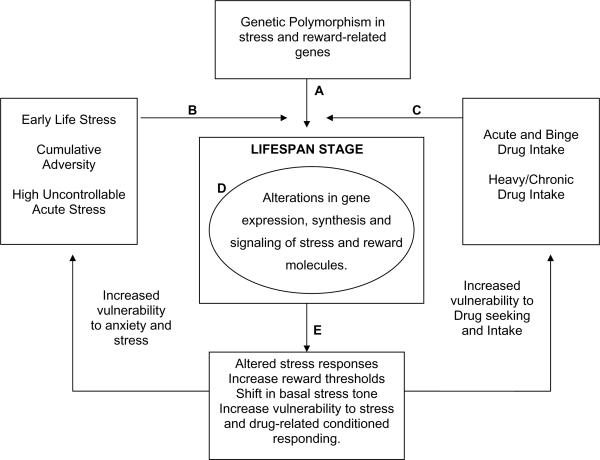
A model depicting the dynamic interplay of individual genetic polymorphisms of stress and reward related genes (A), expressed in the context of the stress environment (B), and/or exposure to substances and level of drug intake (C). A dynamic interplay between these variables affects gene expression, synthesis and transcription of regulatory proteins and molecules with changes in the intracellular and extracellular environment (D), resulting in individual differences in responses to stress and to addictive substances (E). These changes and neuroadapatations are further affected by the lifespan stage of the nervous system. Altered stress responding, changes in reward threshold, increases in anxiety, craving and increased drug taking (E) represent the phenotypes that affect altered stress responses and increased anxiety, and increased vulnerability to drug intake. In the presence of high stress and/or increased drug intake, such phenotypes would increase risk of psychiatric disease onset. At each point in the feed-forward cascade between these variables there exists an opportunity for formal or informal interventions such as social support, education, training/rehabilitation, specific behavioral and pharmacological interventions, change in lifestyle (e.g., exercise) and environmental context/enrichment, which serve as resilience and recovery factors that potentially also affect cellular and molecular signaling with the possibility of redirecting and changing the dynamic interplay of these interactions towards prevention and/or recovery.
Comment on
-
Impact of psychosocial adversity on alcohol intake in young adults: moderation by the LL genotype of the serotonin transporter polymorphism.Biol Psychiatry. 2009 Jul 15;66(2):102-9. doi: 10.1016/j.biopsych.2009.02.010. Epub 2009 Apr 9. Biol Psychiatry. 2009. PMID: 19358979
References
-
- Liu D, Diorio J, Tannenbaum B, Caldji C, Francis D, Freedman A, Sharma S, Pearson D, Plotsky PM, Meaney MJ. Maternal care, hippocampal glucocorticoid receptors, and hypothalamic-pituitary-adrenal responses to stress. Science. 1997;277:1659–1662. - PubMed
-
- Weaver IC. Epigenetic programming by maternal behavior and pharmacological intervention. Nature versus nurture: let's call the whole thing off. Epigenetics. 2007;2:22–28. - PubMed
-
- Olsen CM, Huang Y, Goodwin S, Ciobanu DC, Lu L, Sutter TR, Winder DG. Microarray analysis reveals distinctive signaling between the bed nucleus of the stria terminalis, nucleus accumbens, and dorsal striatum. Physiol Genomics. 2008;32:283–298. - PubMed
