Contrast-induced nephropathy and long-term adverse events: cause and effect?
- PMID: 19556381
- PMCID: PMC2709519
- DOI: 10.2215/CJN.00550109
Contrast-induced nephropathy and long-term adverse events: cause and effect?
Abstract
Background and objectives: The relationship of contrast-induced nephropathy (CIN) to long-term adverse events (AEs) is controversial. Although an association with AEs has been previously reported, it is unclear whether CIN is causally related to these AEs.
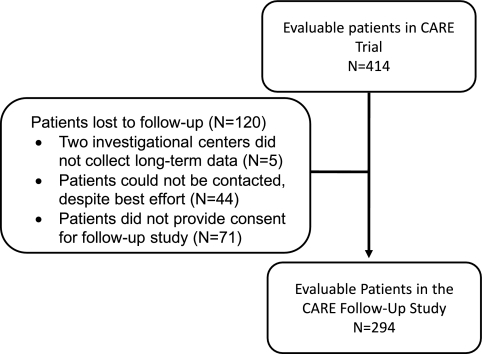
Design, setting, participants, & measurements: We obtained long-term (> or =1 yr) follow-up on 294 patients who participated in a randomized, double-blind comparison of two prevention strategies for CIN (iopamidol versus iodixanol). A difference in the incidence of AEs between patients who had developed CIN and those who had not was performed using a chi(2) test and Poisson regression analysis. A similar statistical approach was used for the differences in AEs between those who received iopamidol or iodixanol. Multiple definitions of CIN were used to strengthen and validate the results and conclusions.
Results: The rate of long-term AEs was higher in individuals with CIN (all definitions of CIN). After adjustment for baseline comorbidities and risk factors, the adjusted incidence rate ratio for AEs was twice as high in those with CIN. Randomization to iopamidol reduced both the incidence of CIN and AEs.
Conclusions: The parallel decrease in the incidence of CIN and AEs in one arm of this randomized trial supports a causal role for CIN.
Trial registration: ClinicalTrials.gov NCT00479024.
Figures
Comment in
-
Defining contrast-induced nephropathy.Clin J Am Soc Nephrol. 2009 Jul;4(7):1151-3. doi: 10.2215/CJN.03410509. Epub 2009 Jun 18. Clin J Am Soc Nephrol. 2009. PMID: 19541810 No abstract available.
References
-
- Dangas G, Iakovou I, Nikolsky E, Aymong ED, Mintz GS, Kipshidze NN, Lansky AJ, Moussa I, Stone GW, Moses JW, Leon MR, Mehran R: Contrast-induced nephropathy after percutaneous coronary interventions in relation to chronic kidney disease and hemodynamic variables. Am J Cardiol 95: 13–19, 2005 - PubMed
-
- Gruberg L, Mintz GS, Mehran R, Gangas G, Lansky AJ, Kent KM, Pichard AD, Satler LF, Leon MB: The prognostic implications of further renal function deterioration within 48 h of interventional coronary procedures in patients with pre-existent chronic renal insufficiency. J Am Coll Cardiol 36: 1542–1548, 2000 - PubMed
-
- Gupta R, Gurm HS, Bhatt DL, Chew DP, Ellis SG: Renal failure after percutaneous coronary intervention is associated with high mortality. Catheter Cardiovasc Interv 64: 442–448, 2005 - PubMed
-
- McCullough PA, Wolyn R, Rocher LL, Levin RN, O'Neill WW: Acute renal failure after coronary intervention: Incidence, risk factors, and relationship to mortality. Am J Med 103: 368–375, 1997 - PubMed
-
- Rihal CS, Textor SC, Grill DE, Berger PB, Ting HH, Best PJ, Singh M, Bell MR, Barsness GW, Mathew V, Garratt KN, Holmes DR Jr: Incidence and prognostic importance of acute renal failure after percutaneous coronary intervention. Circulation 105: 2259–2264, 2002 - PubMed
Publication types
MeSH terms
Substances
Associated data
LinkOut - more resources
Full Text Sources
Medical
Miscellaneous