Relationship of depressive symptoms to the impact of physical symptoms on functional status in women with heart failure
- PMID: 19556413
- PMCID: PMC2935267
- DOI: 10.4037/ajcc2009450
Relationship of depressive symptoms to the impact of physical symptoms on functional status in women with heart failure
Abstract
Background: Among patients with heart failure, women have worse functional status than do men, but little research has focused on determining factors that influence functional status in either sex.
Objectives: To compare factors that influence functional status in men and women with heart failure and to test whether depressive symptoms mediate the relationship between physical symptoms and functional status.
Methods: A cross-sectional, descriptive study design was used. A total of 231 patients, 133 men and 98 women, were recruited from an inpatient heart failure clinic in South Korea. Functional status (the Korean Activity Scale/Index), physical symptoms (the Symptom Status Questionnaire), depressive symptoms (the Beck Depression Inventory), and situational factors (living status, socioeconomic status) were measured. Hierarchical multiple regression and mediation analysis were used for data analysis.
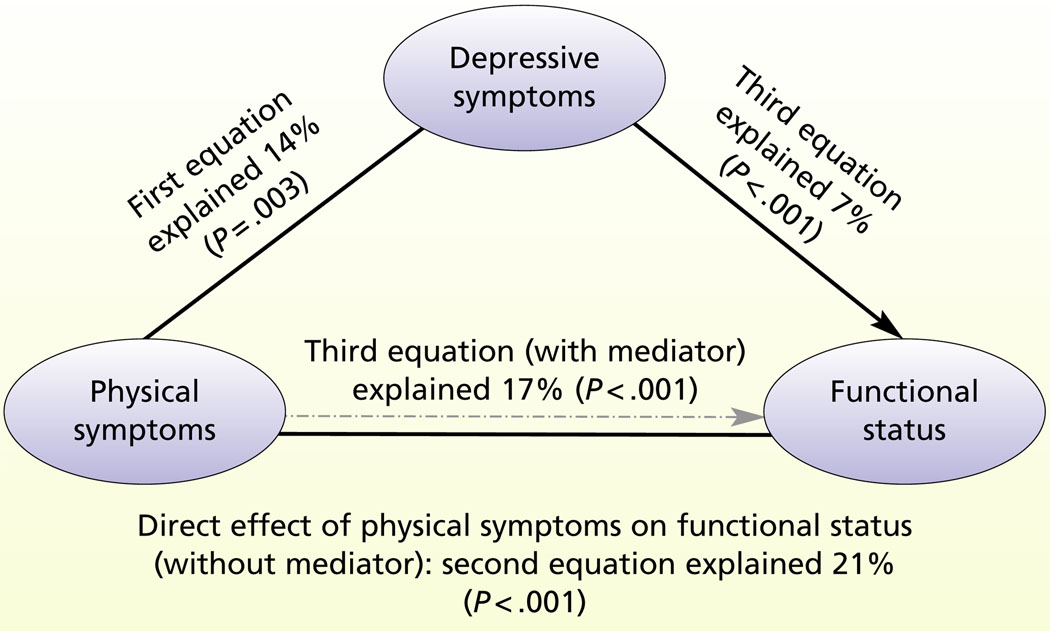
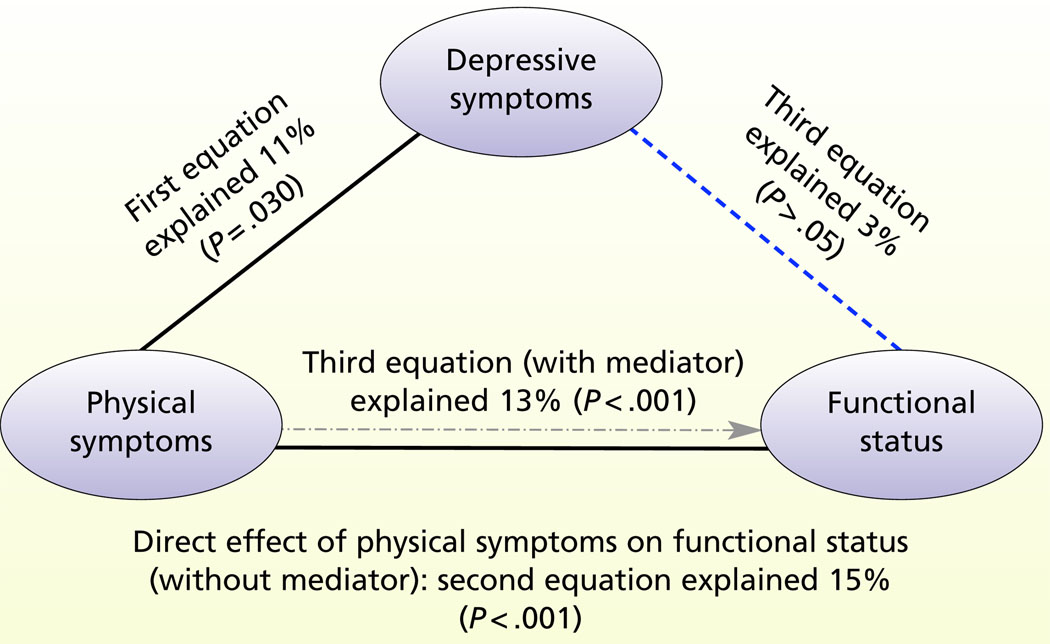
Results: Women (mean score, 24.5; SD, 17.3) had worse functional status than did men (mean score, 31.9; SD, 20.1; P = .004). Dyspnea on exertion (beta = -0.16), ankle swelling (beta = -0.19), fatigue (beta = -0.20), and depressive symptoms (beta = -0.19) were independently associated with functional status in women, whereas only dyspnea on exertion (beta = -0.30) influenced functional status of men in hierarchical multiple regression analysis. Mediation analysis indicated that depressive symptoms mediated the relationship between physical symptoms and functional status in women with heart failure, but not in men.
Conclusions: Distinct physical and psychological symptoms influence functional status in women with heart failure. A systematic multidimensional intervention may be required to target depressive symptoms to improve functional status in women with heart failure.
Figures
References
-
- Thom T, Haase N, Rosamond W, et al. American Heart Association Statistics Committee and Stroke Statistics Subcommittee. Heart disease and stroke statistics — 2006 update: a report from the American Heart Association Statistics Committee and Stroke Statistics Subcommittee [published corrections in Circulation. 2006;113(14):e696 and 2006;114(23):e630] Circulation. 2006;113(6):e85–e151. - PubMed
-
- Ha JW. Diastolic dysfunction and heart failure: a new paradigm [in Korean] Korean J Med. 2003;65(6):631–637.
-
- Han SW, Ryu KH, Chae SC, et al. Multicenter analysis of clinical characteristics and prognostic factors of patients with congestive heart failure in Korea [in Korean] Korean Circ J. 2005;35:357–361.
-
- Lee MM, Oh BH, Park HS, et al. Multicenter analysis of clinical characteristics of the patients with congestive heart failure in Korea [in Korean] Korean Circ J. 2003;33(6):533–541.
-
- Richardson LG, Rocks M. Women and heart failure. Heart Lung. 2001;30(2):87–97. - PubMed
Publication types
MeSH terms
Grants and funding
LinkOut - more resources
Full Text Sources
Medical