


Review
doi: 10.1126/science.1171837.
The increasing complexity of the cancer stem cell paradigm
Affiliations
- PMID: 19556499
- PMCID: PMC2873047
- DOI: 10.1126/science.1171837
Item in Clipboard
Review
The increasing complexity of the cancer stem cell paradigm
Science.
.
Abstract
The investigation and study of cancer stem cells (CSCs) have received enormous attention over the past 5 to 10 years but remain topics of considerable controversy. Opinions about the validity of the CSC hypothesis, the biological properties of CSCs, and the relevance of CSCs to cancer therapy differ widely. In the following commentary, we discuss the nature of the debate, the parameters by which CSCs can or cannot be defined, and the identification of new potential therapeutic targets elucidated by considering cancer as a problem in stem cell biology.
Figures
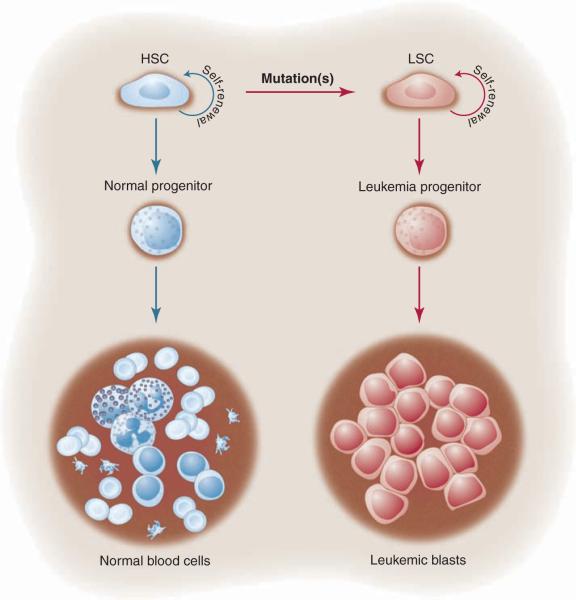
Initial studies in leukemia provided the paradigm for the general CSC model. As shown on the left side of the figure, a hematopoietic stem cell (HSC) gives rise to normal progenitors and mature blood cells. The original model suggests that the HSC undergoes mutation(s) that give rise to its malignant counterpart, the leukemia stem cell (LSC). The LSC retains some degree of developmental potential, generating the leukemia progenitor and leukemic blast cells, which differ in their biological properties from the parent LSC. As in normal hematopoiesis, the stem cell maintains the ability to undergo self-renewal and thereby perpetuate the leukemia population.
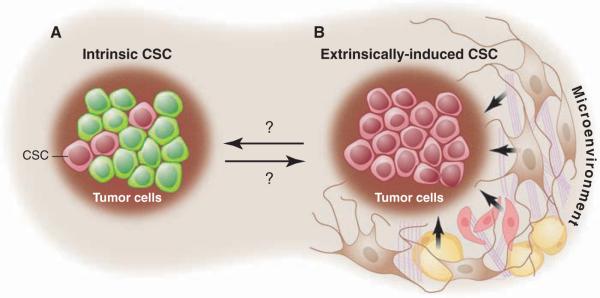
CSC models. (A) The intrinsic model suggests that specific subpopulations within a tumor (pink cells) possess the functional properties of CSCs. (B) The extrinsic model proposes that all tumor cells are functionally equivalent and display heterogeneous behaviors as a function of extrinsic (microenviron-mental) cues.
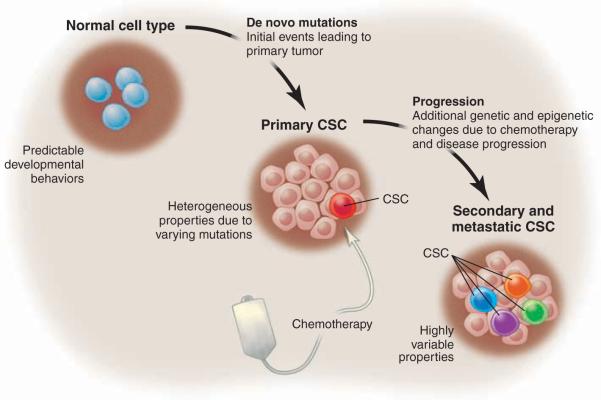
Stages of CSC evolution. For many tumor types, the de novo mutations leading to primary CSC are varied. Thus, one would expect that the biology of primary CSCs may also be heterogeneous. Properties such as CSC frequency, cell-surface phenotype, and drug sensitivity may vary as a function of the specific mutations as well as the nature of the normal cell type in which the primary events occur. Next, neoplastic progression may occur either as a consequence of intrinsic tumor pathogenesis and/or challenge with chemotherapy. Selective pressures associated with neoplastic progression may lead to a higher frequency of functionally defined CSC in secondary or metastatic stages as well inter-patient and intra-patient variability of CSC properties.
References
Publication types
MeSH terms
Grants and funding
LinkOut - more resources
Full Text Sources
Other Literature Sources
Miscellaneous
