Quantitative analysis of mechanisms that govern red blood cell age structure and dynamics during anaemia
- PMID: 19557192
- PMCID: PMC2694369
- DOI: 10.1371/journal.pcbi.1000416
Quantitative analysis of mechanisms that govern red blood cell age structure and dynamics during anaemia
Abstract
Mathematical modelling has proven an important tool in elucidating and quantifying mechanisms that govern the age structure and population dynamics of red blood cells (RBCs). Here we synthesise ideas from previous experimental data and the mathematical modelling literature with new data in order to test hypotheses and generate new predictions about these mechanisms. The result is a set of competing hypotheses about three intrinsic mechanisms: the feedback from circulating RBC concentration to production rate of immature RBCs (reticulocytes) in bone marrow, the release of reticulocytes from bone marrow into the circulation, and their subsequent ageing and clearance. In addition we examine two mechanisms specific to our experimental system: the effect of phenylhydrazine (PHZ) and blood sampling on RBC dynamics. We performed a set of experiments to quantify the dynamics of reticulocyte proportion, RBC concentration, and erythropoietin concentration in PHZ-induced anaemic mice. By quantifying experimental error we are able to fit and assess each hypothesis against our data and recover parameter estimates using Markov chain Monte Carlo based Bayesian inference. We find that, under normal conditions, about 3% of reticulocytes are released early from bone marrow and upon maturation all cells are released immediately. In the circulation, RBCs undergo random clearance but have a maximum lifespan of about 50 days. Under anaemic conditions reticulocyte production rate is linearly correlated with the difference between normal and anaemic RBC concentrations, and their release rate is exponentially correlated with the same. PHZ appears to age rather than kill RBCs, and younger RBCs are affected more than older RBCs. Blood sampling caused short aperiodic spikes in the proportion of reticulocytes which appear to have a different developmental pathway than normal reticulocytes. We also provide evidence of large diurnal oscillations in serum erythropoietin levels during anaemia.
Conflict of interest statement
The authors have declared that no competing interests exist.
Figures
 .
.
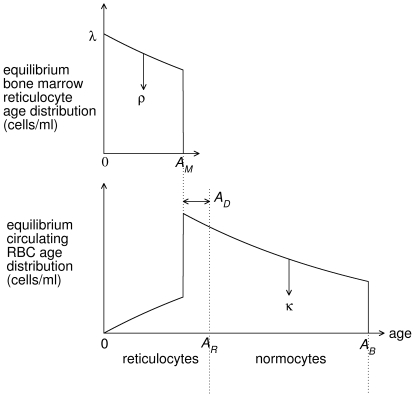
 in bone marrow. These are released into the circulation at a rate
  . All reticulocytes are released by age
  , and have a maturation time of
  hours. RBCs are randomly cleared at a rate
  and have a maximum lifespan of
  days. Not to scale.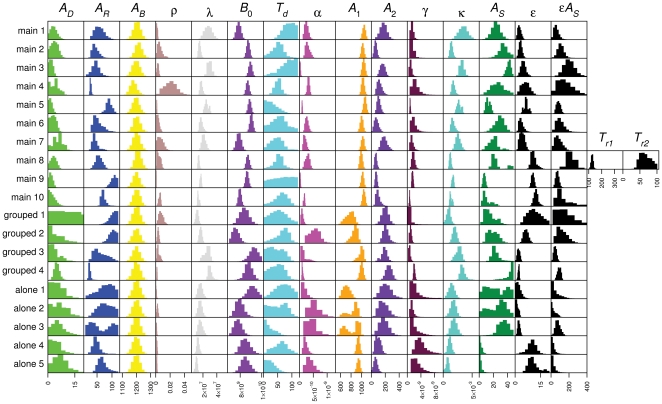
References
-
- Mackey MC. Unified hypothesis of the origin of aplastic anaemia and periodic hematopoiesis. Blood. 1978;51:941–956. - PubMed
-
- Bélair J, Mackey MC, Mahaffy JM. Age-structured and two-delay models for erythropoiesis. Math Biosci. 1995;128:317–346. - PubMed
-
- Mahaffy JM, Bélair J, Mackey MC. Hematopoietic model with moving boundary condition and state dependent delay: applications in erythropoiesis. J Theor Biol. 1998;190:135–146. - PubMed
-
- Pujo-Menjouet L, Mackey MC. Contribution to the study of periodic chronic myelogenous leukemia. C R Biol. 2004;327:235–244. - PubMed
-
- Colijn C, Mackey MC. A mathematical model of hematopoiesis I. Periodic chronic myelogenous leukemia. J Theor Biol. 2005;237:117–132. - PubMed
Publication types
MeSH terms
Substances
Grants and funding
LinkOut - more resources
Full Text Sources
Medical