. 2009 Sep;100(9):1612-22.
doi: 10.1111/j.1349-7006.2009.01230.x. Epub 2009 May 28.

Antibody-based proteomics for esophageal cancer: Identification of proteins in the nuclear factor-kappaB pathway and mitotic checkpoint

Affiliations

Antibody-based proteomics for esophageal cancer: Identification of proteins in the nuclear factor-kappaB pathway and mitotic checkpoint

Norihisa Uemura et al. Cancer Sci. 2009 Sep.

Abstract

To identify the molecular background of esophageal cancer, we conducted a proteomics study using an antibody microarray consisting of 725 antibodies and surgical specimens from three cases. The microarray analysis identified 24 proteins with aberrant expression in esophageal cancer compared with the corresponding normal mucosa. The overexpression of 14 of the 24 proteins was validated by western blotting analysis of the same samples. These 14 proteins were examined by immunohistochemistry, in which nine proteins showed consistent results with those obtained by western blotting. Among the nine proteins, seven were localized in tumor cells, and two in infiltrating cells. The former included proteins associated with mitotic checkpoint control and the nuclear factor (NF)-kappaB pathway. Although mitotic checkpoint gene products (budding uninhibited by benzidazoles 1 homolog beta (BubR1) and mitotic arrest deficient-like 1 (Mad2)) have previously been reported to be involved in esophageal cancer, the association of NF-kappaB-activating kinase, caspase 10, and activator protein-1 with esophageal cancer has not been previously reported. These proteins play a key role in the NF-kappaB pathway, and NF-kappaB is a signal transduction factor that has emerged as an important modulator of altered gene programs and malignant phenotype in the development of cancer. The association of these proteins with esophageal cancer may indicate that mitotic checkpoint gene products and NF-kappaB play an important part in the carcinogenesis of esophageal cancer.


Figures
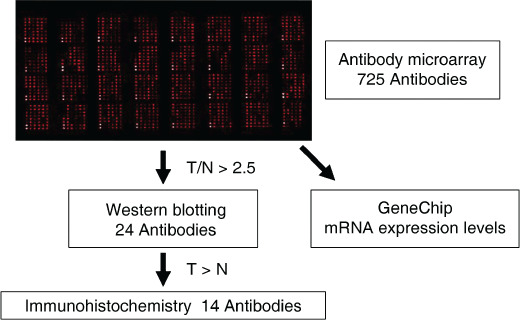
Figure 1
Figure 1
Scheme showing the experimental flow: the antibody microarray analysis results were validated using western blotting and immunohistochemistry. N, normal; T, tumor.
Figure 2
Figure 2
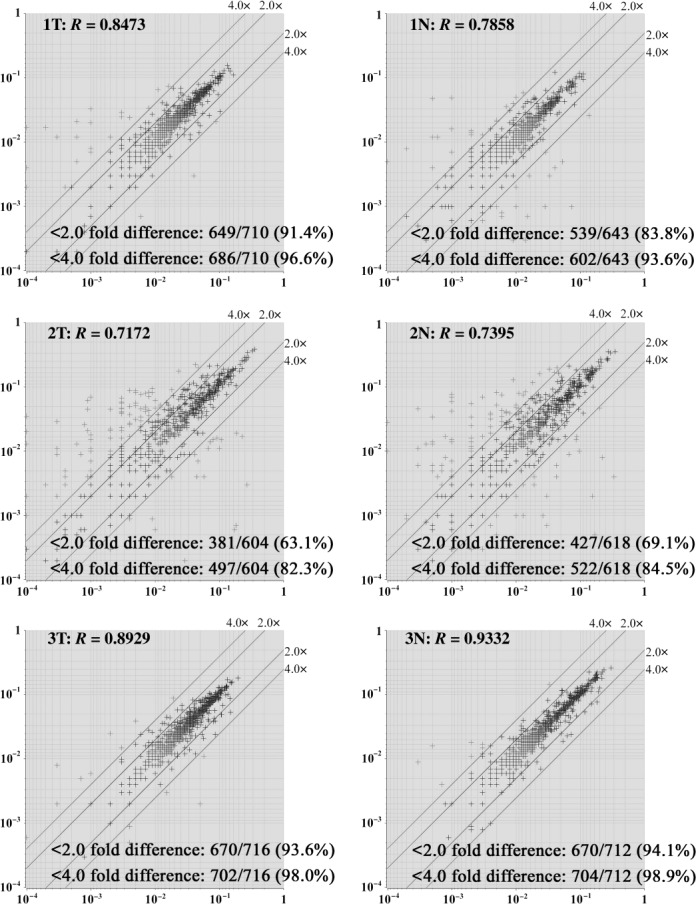
Reproducibility of the antibody microarray analysis. The scatter plot shows that the intensity values of 63.1–94.1% of the antibodies contained in the microarrays used were scattered within a twofold difference, and that the correlation coefficient (R) was 0.7172–0.9332. X‐axis, intensity of one spot of duplicate spots; Y‐axis, intensity of other spot of duplicate spots.
Figure 3
Figure 3
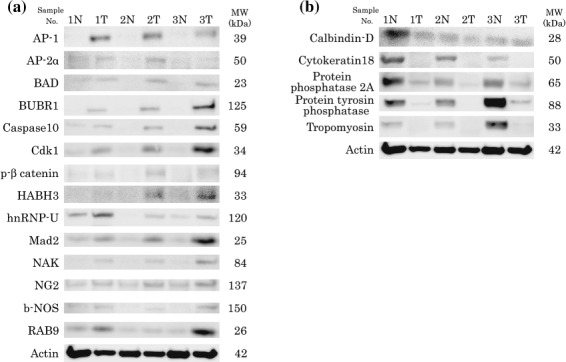
Western blotting results. (a) Fourteen of the 24 proteins identified in the microarray analysis as being overexpressed in tumor tissues showed concordant results in western blotting analysis. (b) Five proteins showed discordant results.
Figure 4
Figure 4
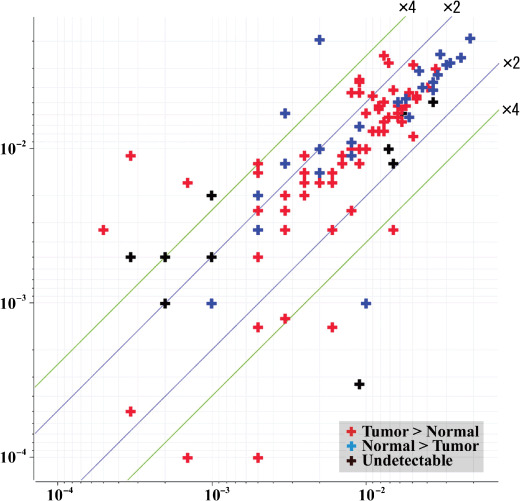
The scattergram demonstrates the correlation between the intensity of duplicate antibody signals of the 24 proteins found to be overexpressed in the microarray analysis. The intensity values of the proteins found to be overexpressed in tumor tissues in the microarrays showed high reproducibility, irrespective of whether these microarray results were discordant (R = 0.7666) or concordant (R = 0.6921) with western blotting results, or whether these proteins were not detected by western blotting (R = 0.6317). X‐axis, intensity of one spot of duplicate spots; Y‐axis, intensity of other spot of duplicate spots.
Figure 5
Figure 5
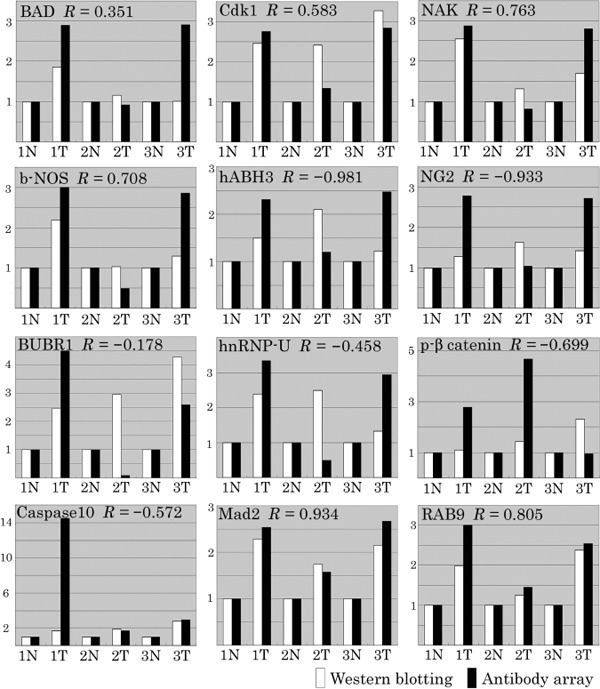
Comparison of the microarray with the western blotting data. The correlation coefficient of the 14 proteins found to be overexpressed in tumor tissues in western blotting was calculated. Normalization of each tumor tissue's data was carried out using the normal counterpart's data.
Figure 6
Figure 6
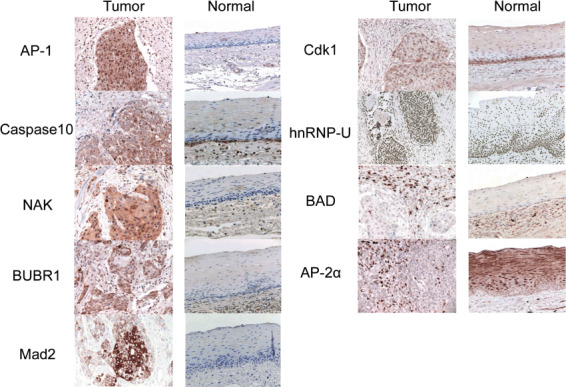
Immunohistochemistry. The expression of six proteins (activator protein [AP]‐1, BUBR1, caspase 10, cyclin‐dependent kinase [Cdk] 1, nuclear factor‐κB‐activating kinase [NAK], and Mad2), either cytoplasmic or nuclear, was stronger in esophageal squamous cell carcinoma compared with normal epithelium. Nuclear expression of hn‐RNP‐U was observed in all tumor and normal tissues. The expression of BAD and AP‐2α was higher in infiltrating inflammatory cells compared with the tumor stroma. BUBR, budding uninhibited by benzidazoles 1 homolog beta; Mad, mitotic arrest deficient‐like 1; hn‐RNP‐U, heterogeneous nuclear ribonucleoprotein U; BAD, Bcl‐associated death promoter.
Figure 7
Figure 7
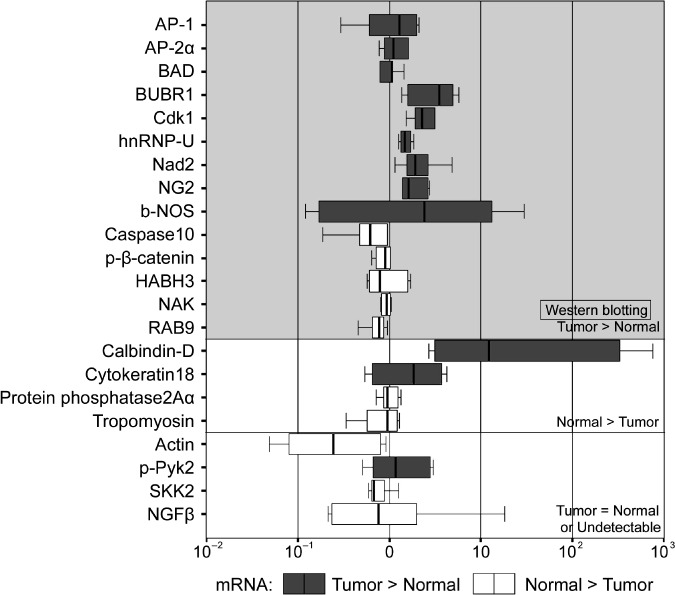
The mRNA expression levels of the 22 identified proteins. Among the 14 proteins overexpressed in esophageal squamous cell carcinoma (ESCC) by western blotting analysis, nine were also found to be overexpressed at the mRNA level. The expression of two of four proteins found to be lower in ESCC in western blotting was also lower at the mRNA level.

References

    1. Parkin DM, Pisani P, Ferlay J. Estimates of the worldwide incidence of 25 major cancers in 1990. Int J Cancer 1999; 80: 827–41. - PubMed
    1. Pisani P, Parkin DM, Bray F, Ferlay J. Estimates of the worldwide mortality from 25 cancers in 1990. Int J Cancer 1999; 83: 18–29. - PubMed
    1. Ilson DH. Oesophageal cancer: new developments in systemic therapy. Cancer Treat Rev 2003; 29: 525–32. - PubMed
    1. Enzinger PC, Mayer RJ. Esophageal cancer. N Engl J Med 2003; 349: 2241–52. - PubMed
    1. Mariette C, Balon JM, Piessen G, Fabre S, Van Seuningen I, Triboulet JP. Pattern of recurrence following complete resection of esophageal carcinoma and factors predictive of recurrent disease. Cancer 2003; 97: 1616–23. - PubMed

Publication types

MeSH terms