


Adjustment Disorder: epidemiology, diagnosis and treatment
- PMID: 19558652
- PMCID: PMC2710332
- DOI: 10.1186/1745-0179-5-15
Adjustment Disorder: epidemiology, diagnosis and treatment
Abstract
Background: Adjustment Disorder is a condition strongly tied to acute and chronic stress. Despite clinical suggestion of a large prevalence in the general population and the high frequency of its diagnosis in the clinical settings, there has been relatively little research reported and, consequently, very few hints about its treatments.
Methods: the authors gathered old and current information on the epidemiology, clinical features, comorbidity, treatment and outcome of adjustment disorder by a systematic review of essays published on PUBMED.
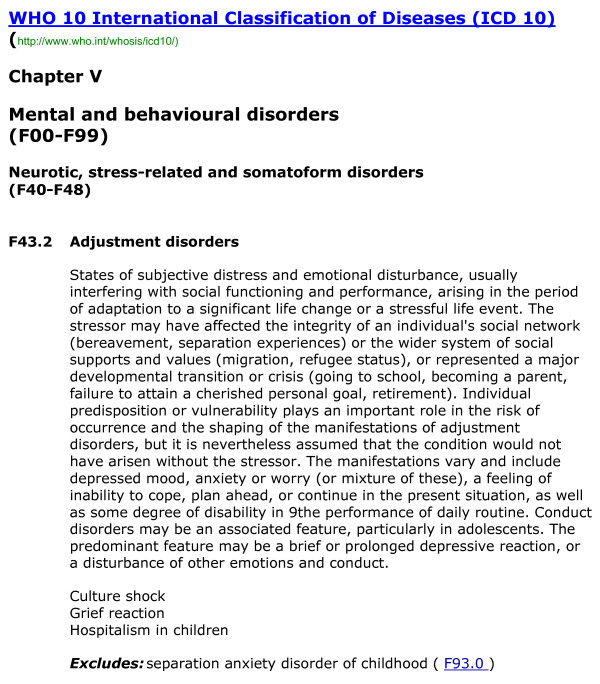
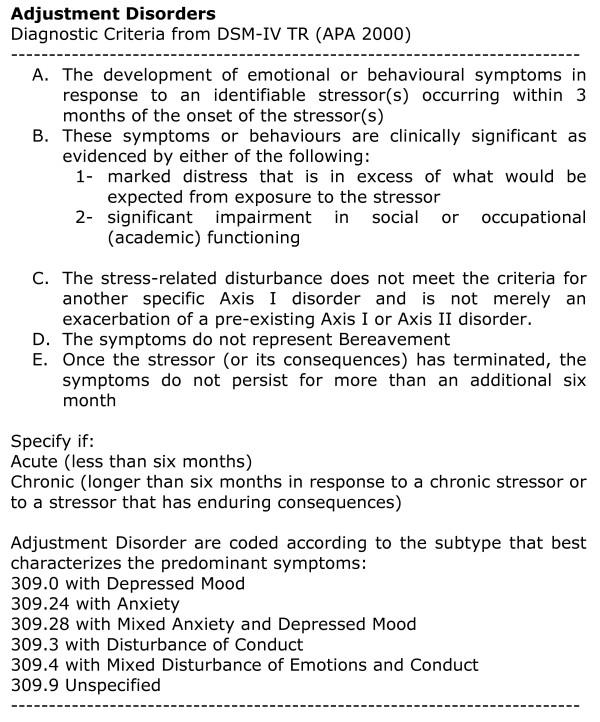
Results: After a first glance at its historical definition and its definition in the DSM and ICD systems, the problem of distinguishing AD from other mood and anxiety disorders, the difficulty in the definition of stress and the implied concept of 'vulnerability' are considered. Comorbidity of AD with other conditions, and outcome of AD are then analyzed. This review also highlights recent data about trends in the use of antidepressant drugs, evidence on their efficacy and the use of psychotherapies.
Conclusion: AD is a very common diagnosis in clinical practice, but we still lack data about its rightful clinical entity. This may be caused by a difficulty in facing, with a purely descriptive methods, a "pathogenic label", based on a stressful event, for which a subjective impact has to be considered. We lack efficacy surveys concerning treatment. The use of psychotropic drugs such as antidepressants, in AD with anxious or depressed mood is not properly supported and should be avoided, while the usefulness of psychotherapies is more solidly supported by clinical evidence. To better determine the correct course of therapy, randomized-controlled trials, even for the combined use of drugs and psychotherapies, are needed vitally, especially for the resistant forms of AD.
Figures
References
-
- American Psychiatric Association. Diagnostic and Statistical Manual of Mental Disorders. 4. Washington DC: APA; 1994.
-
- World Health Organisation (WHO) The ICD-10 classification of mental and behavioral disorders: Clinical description and diagnostic guidelines (ICD-10) Geneva: WHO; 1992.
-
- American Psychiatric Association. Diagnostic and Statistical Manual of Mental Disorders. Washington DC: APA; 1952.
-
- American Psychiatric Association. Diagnostic and Statistical Manual of Mental Disorders. 3. Washington DC: APA; 1980.
-
- Fabrega H Jr, Mezzich JE, Mezzich AC. Adjustment disorder as a marginal or transitional illness category in DSM-III. Arch Gen Psychiatry. 1987;44(6):567–72. - PubMed
LinkOut - more resources
Full Text Sources
