


doi: 10.1186/1750-1326-4-27.
Neurodegeneration in Alzheimer's disease: caspases and synaptic element interdependence
Affiliations
- PMID: 19558683
- PMCID: PMC2709109
- DOI: 10.1186/1750-1326-4-27
Item in Clipboard
Neurodegeneration in Alzheimer's disease: caspases and synaptic element interdependence
Mol Neurodegener.
.
Abstract
Extensive genetic, biochemical, and histological evidence has implicated the amyloid-beta peptide (Abeta) in Alzheimer's disease pathogenesis, and several mechanisms have been suggested, such as metal binding, reactive oxygen species production, and membrane pore formation. However, recent evidence argues for an additional role for signaling mediated by the amyloid precursor protein, APP, in part via the caspase cleavage of APP at aspartate 664. Here we review the effects and implications of this cleavage event, and propose a model of Alzheimer's disease that focuses on the critical nature of this cleavage and its downstream effects.
Figures
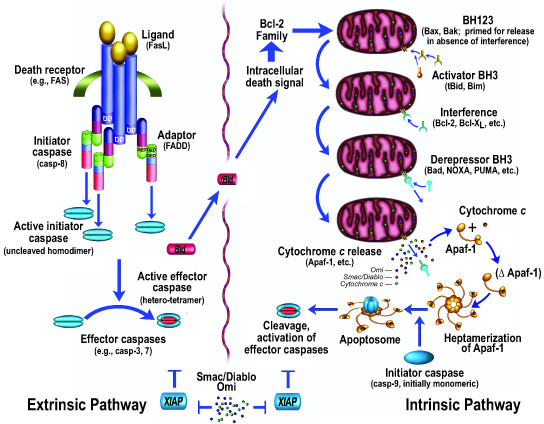
Programmed cell death pathways may be divided generally into intrinsic and extrinsic pathways.
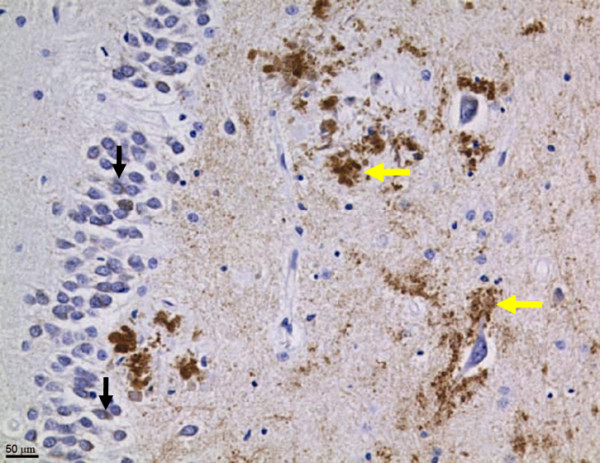
Caspase cleavage of APP, indicated by immunohistochemical detection of the APP664 neo-epitope, in the brain of a patient with Alzheimer's disease. Note perinuclear cytoplasmic staining in the granular cell layer of the hippocampus (black vertical arrows) as well as intense, apparently extracellular plaque-like deposits (yellow horizontal arrows).
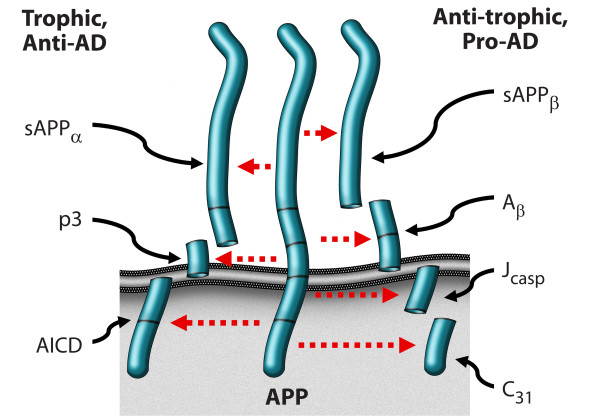
Alternative cleavage of APP to produce four peptides that mediate synaptic loss, neurite retraction, and ultimately programmed cell death ("the four horsemen"); or three peptides that mediate synaptic maintenance and inhibit programmed cell death ("the wholly trinity"). Among the factors that mediate the decision between these two pathways are included trophic effects such as netrin-1 and anti-trophic effects such as Aβ peptide.
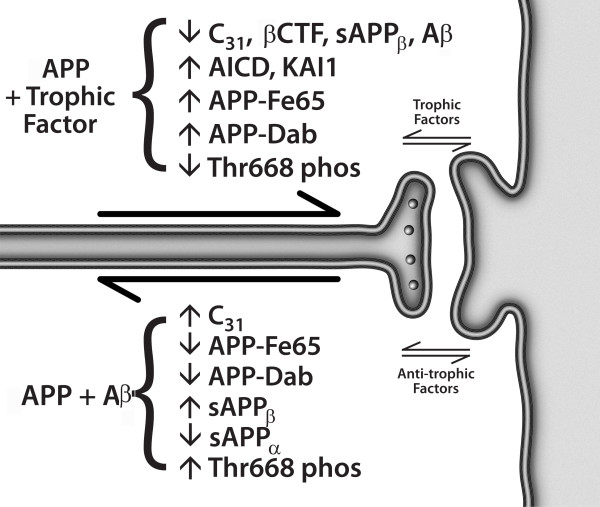
Synaptic element interdependence model of synaptic maintenance, reorganization, and Alzheimer's disease. The pre-synaptic and post-synaptic elements are interdependent, and provide both trophic influences (e.g., neurotrophins, netrin-1, laminin, collagen, and synaptic activity itself) and anti-trophic influences (e.g., amyloid-β peptide). Trophic support leads to the processing of APP into three peptides that support synaptic maintenance, whereas the withdrawal of trophic support leads to alternative processing, to four peptides that mediate synaptic inhibition, synaptic loss, neurite retraction, and ultimately, programmed cell death. In this model, the Aβ peptide functions as an anti-trophin, and, since it leads to APP processing that produces additional Aβ peptide, it is "prionic", i.e., Aβ begets additional Aβ.
References
-
- Graham RK, Deng Y, Slow EJ, Haigh B, Bissada N, Lu G, Pearson J, Shehadeh J, Bertram L, Murphy Z, Warby SC, Doty CN, Roy S, Wellington CL, Leavitt BR, Raymond LA, Nicholson DW, Hayden MR. Cleavage at the caspase-6 site is required for neuronal dysfunction and degeneration due to mutant huntingtin. Cell. 2006;125:1179–1191. doi: 10.1016/j.cell.2006.04.026. - DOI - PubMed
-
- Galvan V, Gorostiza OF, Banwait S, Ataie M, Logvinova AV, Sitaraman S, Carlson E, Sagi SA, Chevallier N, Jin K, Greenberg DA, Bredesen DE. Reversal of Alzheimer's-like pathology and behavior in human APP transgenic mice by mutation of Asp664. Proc Natl Acad Sci USA. 2006;103:7130–7135. doi: 10.1073/pnas.0509695103. - DOI - PMC - PubMed
LinkOut - more resources
Full Text Sources
Other Literature Sources
