


Metals in anticancer therapy: copper(II) complexes as inhibitors of the 20S proteasome
- PMID: 19559507
- PMCID: PMC2759842
- DOI: 10.1016/j.ejmech.2009.05.019
Metals in anticancer therapy: copper(II) complexes as inhibitors of the 20S proteasome
Abstract
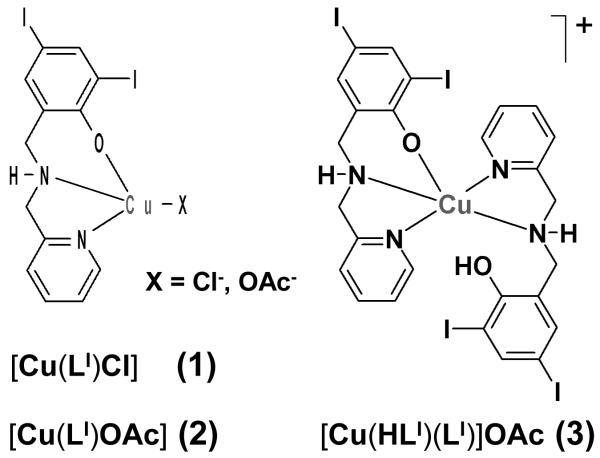
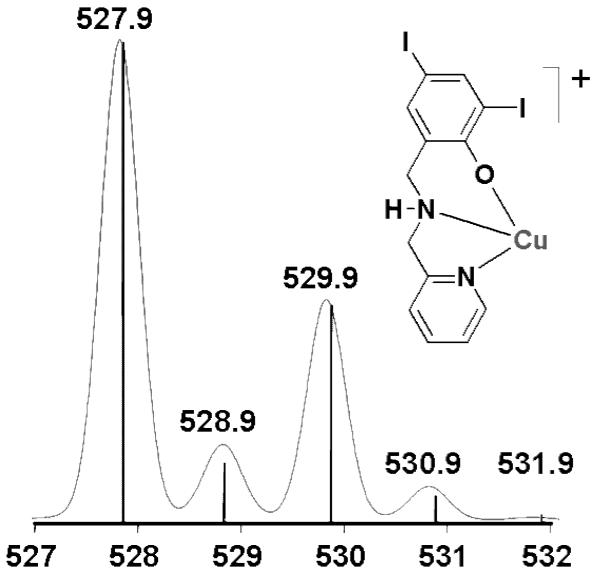
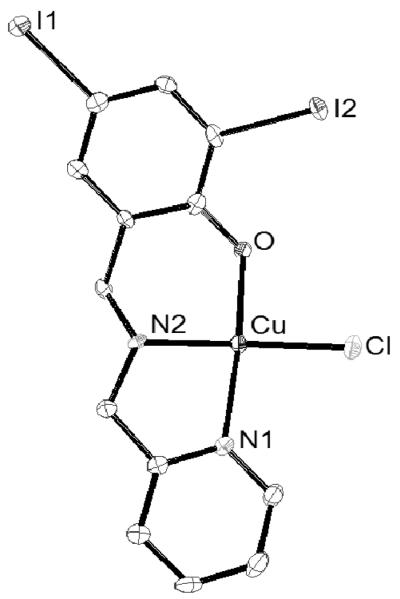
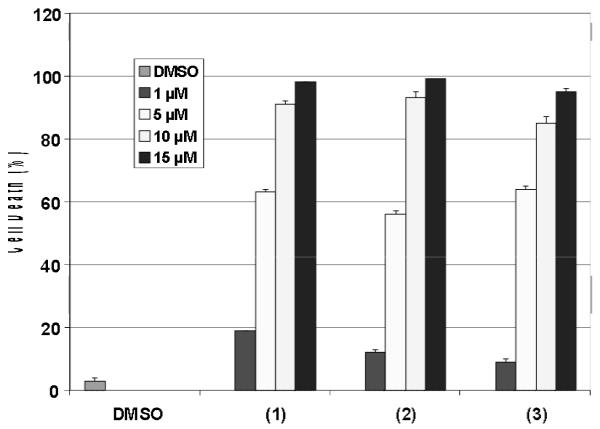
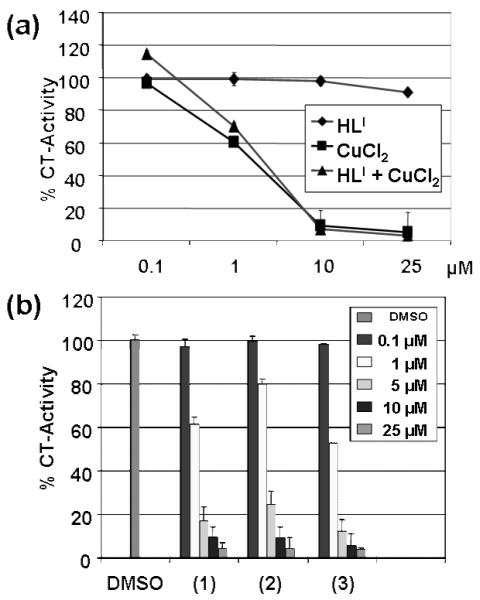
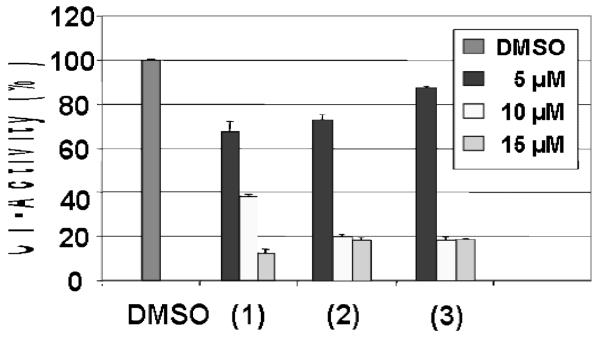
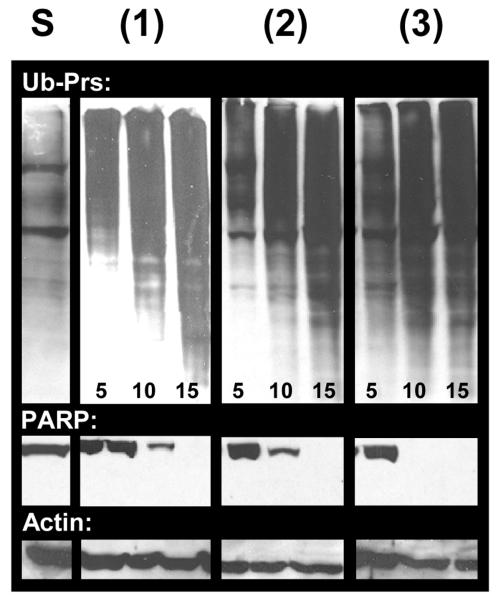
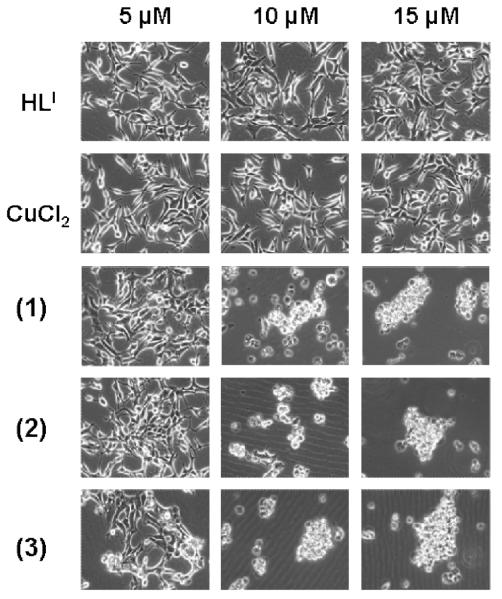
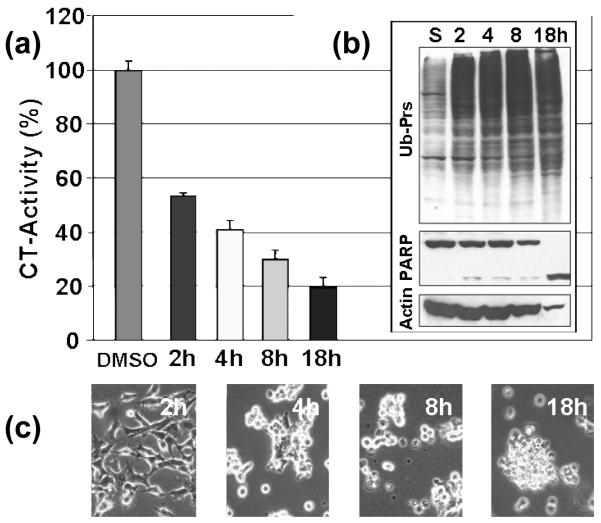
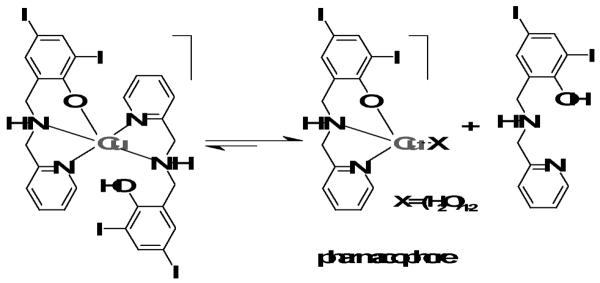
Selective 20S proteasomal inhibition and apoptosis induction were observed when several lines of cancer cells were treated with a series of copper complexes described as [Cu(L(I))Cl] (1), [Cu(L(I))OAc] (2), and [Cu(HL(I))(L(I))]OAc (3), where HL(I) is the ligand 2,4-diiodo-6-((pyridine-2-ylmethylamino)methyl)phenol. These complexes were synthesized, characterized by means of ESI spectrometry, infrared, UV-visible and EPR spectroscopies, and X-ray diffraction when possible. After full characterization species 1-3 were evaluated for their ability to function as proteasome inhibitors and apoptosis inducers in C4-2B and PC-3 human prostate cancer cells and MCF-10A normal cells. With distinct stoichiometries and protonation states, this series suggests the assignment of species [CuL(I)](+) as the minimal pharmacophore needed for proteasomal chymotryspin-like activity inhibition and permits some initial inference of mechanistic information.
Figures
References
-
- Kelland L. Nature Rev. Cancer. 2007;7:573. - PubMed
-
- Pavelka M, Lucas MFA, Russo N. Chem. Eur. J. 2007;13:10108. - PubMed
- Todd RC, Lovejoy KS, Lippard SJ. J. Am. Chem. Soc. 2007;129:6370. - PMC - PubMed
- Beljanski V, Villanueva JM, Doetsch PW, Natile G, Marzilli LG. J. Am. Chem. Soc. 2005;127:15833. - PubMed
- Fuertes MA, Alonso C, Pérez JM. Chem. Rev. 2003;103:645. - PubMed
- Deubel DV. J. Am. Chem. Soc. 2002;124:5834. - PubMed
- Jamieson ER, Lippard SJ. Chem. Rev. 1999;99:2467. - PubMed
-
- Zhang CX, Lippard SJ. Curr. Opin. Chem. Biol. 2003;7:481. - PubMed
- Kelland LR, Farrell N, editors. Platinum-based Drugs in Cancer Therapy. Humana Press; Totowa: 2000.
-
- Jakupec MA, Galanski M, Arion VB, Hartinger CG, Keppler BK. Dalton Trans. 2008:183. - PubMed
- Fricker SP. Dalton Trans. 2007;43:4903. - PubMed
- Kalinowski DS, Sharpe PC, Bernhardt PV, Richardson DR. J. Med. Chem. 2007;50:6212. - PubMed
- Tardito S, Bussolati O, Maffini M, Tegoni M, Giannetto M, Dall'Asta V, Franchi-Gazzola R, Lanfranchi M, Pellinghelli MA, Mucchino C, Mori G, Marchio L. J. Med. Chem. 2007;50:1916. - PubMed
- Schatzschneider U, Metzler-Nolte N. Angew. Chem., Int. Ed. 2006;45:1504. - PubMed
Publication types
MeSH terms
Substances
Grants and funding
LinkOut - more resources
Full Text Sources
Medical
Miscellaneous
