


Extracellular matrix turnover and signaling during cardiac remodeling following MI: causes and consequences
- PMID: 19559709
- PMCID: PMC2823838
- DOI: 10.1016/j.yjmcc.2009.06.012
Extracellular matrix turnover and signaling during cardiac remodeling following MI: causes and consequences
Abstract
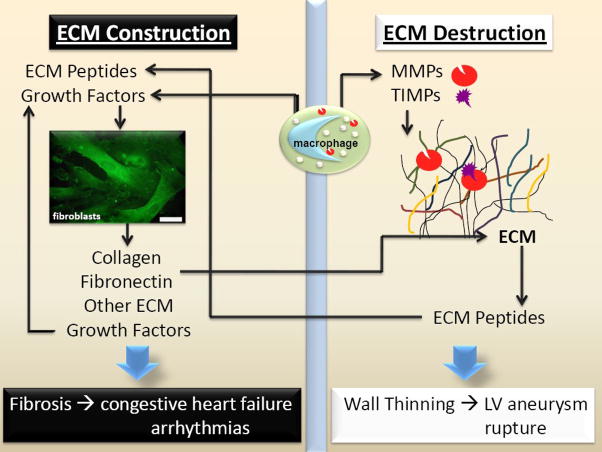
The concept that extracellular matrix (ECM) turnover occurs during cardiac remodeling is a well-accepted paradigm. To date, a multitude of studies document that remodeling is accompanied by increases in the synthesis and deposition of ECM components as well as increases in extracellular proteases, especially matrix metalloproteinases (MMPs), which break down ECM components. Further, soluble ECM fragments generated from enzymatic action serve to stimulate cell behavior and have been proposed as candidate plasma biomarkers of cardiac remodeling. This review briefly summarizes our current knowledge base on cardiac ECM turnover following myocardial infarction (MI), but more importantly extends discussion by defining avenues that remain to be explored to drive the ECM remodeling field forward. Specifically, this review will discuss cause and effect roles for the ECM changes observed following MI and the potential role of the ECM changes that may serve as trigger points to regulate remodeling. While the pattern of remodeling following MI is qualitatively similar but quantitatively different from various types of injury, the basic theme in remodeling is repeated. Therefore, while we use the MI model as the prototype injury model, the themes discussed here are also relevant to cardiac remodeling due to other types of injury.
2009 Elsevier Ltd. All rights reserved.
Figures

References
-
- Coats WD, Whittaker P, Cheung DT, Currier JW, Han B, Faxon DP. Collagen Content Is Significantly Lower in Restenotic Versus Nonrestenotic Vessels After Balloon Angioplasty in the Atherosclerotic Rabbit Model. Circulation. 1997 March 4;95(5):1293–300. - PubMed
-
- Cohn JN, Ferrari R, Sharpe N. Cardiac Remodeling- Concepts and Clinical Implications: A Consensus Paper From an International Forum on Cardiac Remodeling. J Am Coll Cardiol. 2000;35(3):569–82. - PubMed
-
- Pfeffer MA, Braunwald E. Ventricular Remodeling After Myocardial Infarction. Experimental observations and clinical implications. Circulation. 1990;81:1161–72. - PubMed
-
- Cohn JN, Ferrari R, Sharpe N. Cardiac remodeling--concepts and clinical implications: a consensus paper from an international forum on cardiac remodeling. Journal of the American College of Cardiology. 2000;35(3):569–82. - PubMed
-
- Lindsey ML. MMP induction and inhibition in myocardial infarction. Heart Fail Rev. 2004 Jan;9(1):7–19. - PubMed
Publication types
MeSH terms
Substances
Grants and funding
LinkOut - more resources
Full Text Sources
Medical
