


Review
doi: 10.1016/j.semcdb.2009.01.005.
Epub 2009 Jan 22.
Histone acetylation in drug addiction
Affiliations
- PMID: 19560043
- PMCID: PMC2704458
- DOI: 10.1016/j.semcdb.2009.01.005
Item in Clipboard
Review
Histone acetylation in drug addiction
Semin Cell Dev Biol.
2009 Jun.
Abstract
Regulation of chromatin structure through post-translational modifications of histones (e.g., acetylation) has emerged as an important mechanism to translate a variety of environmental stimuli, including drugs of abuse, into specific changes in gene expression. Since alterations in gene expression are thought to contribute to the development and maintenance of the addicted state, recent efforts are aimed at identifying how drugs of abuse alter chromatin structure and the enzymes which regulate it. This review discusses how drugs of abuse alter histone acetylation in brain reward regions, through which enzymes this occurs, and ultimately what role histone acetylation plays in addiction-related behaviors.
Figures
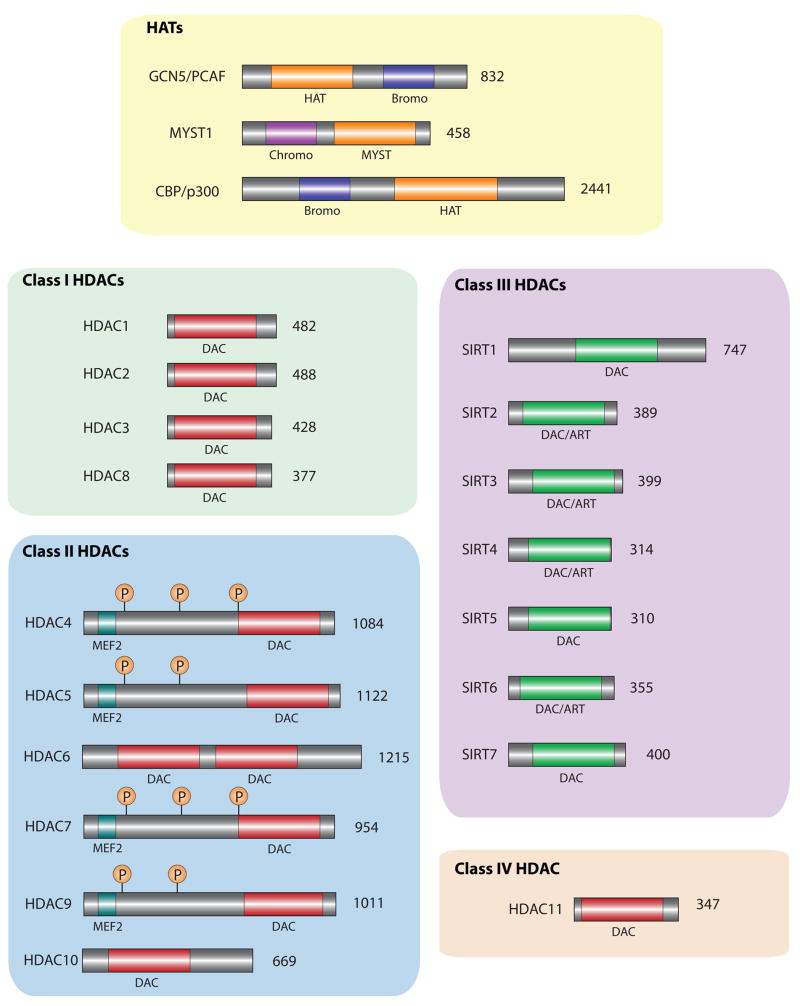
The domain organization of three major families of histone acetyltransferases (HATs) is shown, GCN5/PCAF, MYST, and CBP/p300. Conserved members of these families are found in yeast. The GCN5/PCAF and CBP/p300 families share a similar catalytic domain (HAT) while the MYST family uses the distinct but functionally similar MYST catalytic domain. The MYST family is much more diverse and the example depicted does not represent all family members. The GCN5/PCAF and CBP/p300 families contain bromodomains, which can bind to acetylated lysine residues on histone proteins. The function of chromodomains in MYST family members is still unclear, but, in other proteins, these domains can recognize methylated histones. Histone deacetylases (HDACs) are divided into four major classes, Class I-IV, based on structural homology to yeast proteins. Class I and II use zinc as a cofactor, and have similar catalytic domains (DAC). Class II HDACs are distinguished from Class I by their large N-terminal regulatory region, which recognizes transcription factors (e.g., MEF2) and are phosphorylated to control subcellular localization. The Class IV HDAC, HDAC11, is structurally similar to both Class I and Class II but has not been well studied. The catalytic deacetylase domain on Class III HDACs requires NAD+ as a cofactor and, in addition to deacetylating proteins, this domain has also been reported to have ADP ribosyltransferase activity (ART).
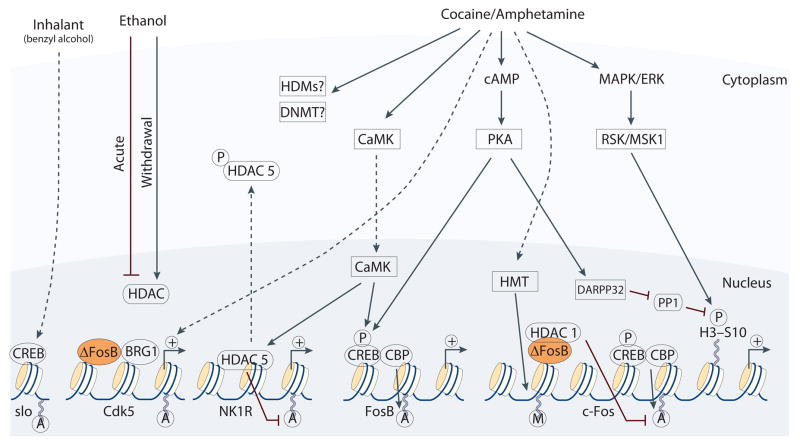
Drug-induced signaling events are depicted for cocaine/amphetamine, ethanol, and an inhalant, benzyl alcohol. Cocaine and amphetamine can increase cAMP levels in striatum, which activates protein kinase A (PKA) and leads to phosphorylation of its targets. This includes the cAMP response element binding protein (CREB), the phosphorylation of which induces its association with the histone acetyltransferase, CREB binding protein (CBP) to acetylate histones and facilitate gene activation. This is known to occur on many genes including fosB and c-fos in response to psychostimulant exposure. ΔFosB is also upregulated by chronic psychostimulant treatments, and is known to activate certain genes (e.g., cdk5) where it recruits the SWI-SNF chromatin remodeling enzyme, BRG1, and represses others (e.g., c-fos) where it recruits HDAC1. This repression of c-fos also involves increased repressive histone methylation, which is thought to occur via the induction of specific histone methyltransferases. It is not yet known how cocaine regulates histone demethylases (HDM) or DNA methyltransferases (DNMTs). Cocaine also activates the mitogen activated protein kinase (MAPK) cascade, which through MSK1 can phosphorylate CREB and histone H3 at serine 10. Cocaine promotes H3 phosphorylation via a distinct pathway, whereby PKA activates protein phosphatase 2A, leading to the dephosphorylation of serine 97 of DARPP32. This causes DARPP32 to accumulate in the nucleus and inhibit protein phosphatase 1 (PP1) which normally dephosphorylates H3. Chronic exposure to psychostimulants is also known to increase glutamatergic stignaling from the prefrontal cortex to the NAc. Glutamatergic signaling elevates Ca2+ levels in NAc synapses and activates CaMK (calcium/calmodulin protein kinases) signaling, which, in addition to phosphorylating CREB, also phosphorylates HDAC5. This results in nuclear export of HDAC5 and increased histone acetylation on its target genes (e.g., NK1R [NK1 or substance P receptor). Acute ethanol has been shown to reduce histone acetylation by increasing HDAC activity, while withdrawal from chronic ethanol increases histone acetylation by reducing HDAC activity. The organic solvent, benzyl alcohol, which is used to study the tolerance effects of inhalants, rapidly induces histone acetylation on the Ca2+-activated K+ channel, slo, to facilitate CREB-dependent transcription. Figure was modified with permission from [20].
References
-
- Hyman SE, Malenka RC, Nestler EJ. Neural mechanisms of addiction: the role of reward-related learning and memory. Annu Rev Neurosci. 2006;29:565–98. - PubMed
-
- Kalivas PW, Volkow N, Seamans J. Unmanageable motivation in addiction: a pathology in prefrontal-accumbens glutamate transmission. Neuron. 2005;45:647–50. - PubMed
-
- Nestler EJ. Molecular basis of long-term plasticity underlying addiction. Nat Rev Neurosci. 2001;2:119–28. - PubMed
Publication types
MeSH terms
Substances
Grants and funding
LinkOut - more resources
Full Text Sources
Other Literature Sources
Medical
