. 2009 Jul 14;106(28):11776-81.
doi: 10.1073/pnas.0903304106. Epub 2009 Jun 26.

ANO2 is the cilial calcium-activated chloride channel that may mediate olfactory amplification

Affiliations

ANO2 is the cilial calcium-activated chloride channel that may mediate olfactory amplification

Aaron B Stephan et al. Proc Natl Acad Sci U S A. .

Abstract

For vertebrate olfactory signal transduction, a calcium-activated chloride conductance serves as a major amplification step. However, the molecular identity of the olfactory calcium-activated chloride channel (CaCC) is unknown. Here we report a proteomic screen for cilial membrane proteins of mouse olfactory sensory neurons (OSNs) that identified all the known olfactory transduction components as well as Anoctamin 2 (ANO2). Ano2 transcripts were expressed specifically in OSNs in the olfactory epithelium, and ANO2::EGFP fusion protein localized to the OSN cilia when expressed in vivo using an adenoviral vector. Patch-clamp analysis revealed that ANO2, when expressed in HEK-293 cells, forms a CaCC and exhibits channel properties closely resembling the native olfactory CaCC. Considering these findings together, we propose that ANO2 constitutes the olfactory calcium-activated chloride channel.


Conflict of interest statement

The authors declare no conflict of interest.

Figures
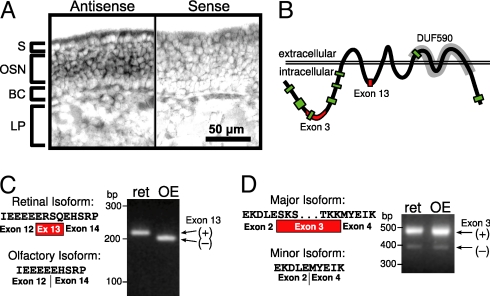
Fig. 1.
Fig. 1.
Analysis of ANO2 transcripts. (A) In situ hybridization for Ano2 in mouse OE. BC, basal cells; LP, lamina propria; OSN, olfactory sensory neurons; S, sustentacular cells. (B) Schematic of ANO2 predicted transmembrane topology. Green boxes indicate segments identified by mass spectrometry. Red boxes indicate segments encoded by exon 3 and the retinal exon 13. Gray highlights a conserved domain (DUF590) in all Anoctamin family members. (C) Exon 13 is present in the retinal isoform of Ano2 but is absent in the olfactory isoform. (Right) RT-PCR analysis with primers spanning the Exon 13 site. ret, retinal cDNA; OE, olfactory epithelial cDNA. (D) The major Ano2 isoforms in both retinal cells and OSNs contain exon 3, which is spliced out in a minor isoform. (Right) RT-PCR analysis with primers spanning the exon 3 site.
Fig. 2.
Fig. 2.
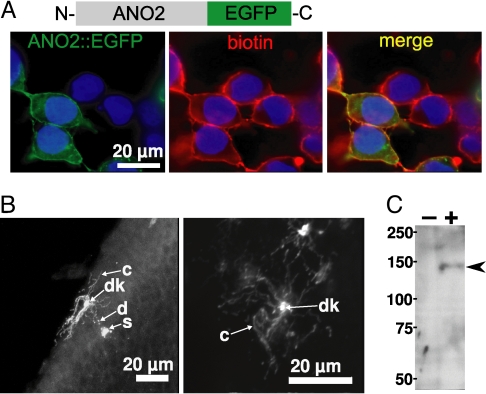
Subcellular localization of ANO2::EGFP fusion proteins. (A) Anti-GFP immunostaining of HEK-293 cells transfected with the ANO2::EGFP plasmid. (Left) GFP staining shown in green. (Center) Cell surface labeling by biotinylation shown in red. (Right) The merge. Cell nuclei were counterstained with DAPI shown in blue. (B) Immunostaining of OE infected with an adenovirus expressing ANO2::EGFP using an anti-GFP antibody. (Left) Side view of a virus-infected OSN. (Right) En face view of a virus-infected OSN. c, cilia; d, dendrite; dk, dendritic knob; s, soma. (C) Western blot analysis using an anti-GFP antibody on olfactory mucosal tissues either infected with the ANO2::EGFP adenovirus (+) or not infected (−). Arrowhead points to the sole ≈130-kDa band present in the infected tissue.
Fig. 3.
Fig. 3.
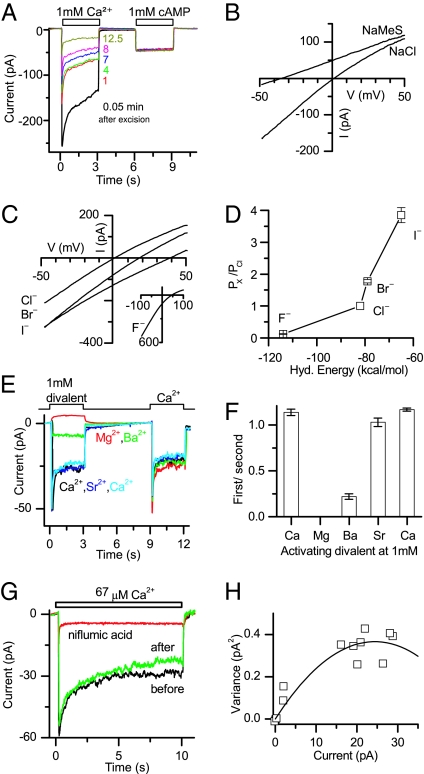
Biophysical properties of ANO2 channel. (A) Heterologously expressed ANO2 confers a Ca2+-activated conductance that runs down over time. Recording of an inside-out patch exposed to 1 mM Ca2+ followed by 1 mM cAMP. Repeated Ca2+ and cAMP application demonstrates the progressive reduction (“rundown”) of the Ca2+-activated current while the CNG current remains constant. The times beside each trace denote the minutes after patch excision. Holding potential was −40 mV. For quantification of the rundown, see Fig. S5. (B) I−V relationships of ANO2. The channel was activated with 67 μM and 100 μM Ca2+, respectively. NaCl trace, symmetrical NaCl solutions; NaMeS trace, methanesulfonate-negative replacement of Cl in bath. (C and D) Halide permeability of the ANO2 channel. (C) I−V relationships from a patch where the bath solution contained 140 mM NaCl, NaBr, or NaI. The pipette contained 140 mM NaCl. (Inset) I–V relationships from a patch where the pipette solution contained 130 mM NaF and 10 mM NaCl. The bath contained 140 mM NaCl and 67 μM Ca2+. (D) Halide permeability as a function of hydration energy. (E and F) Activation of ANO2 by divalent cations. (E) Current traces of ANO2-containing patches activated by 1 mM Ca2+, Mg2+, Ba2+ and Sr2+. The small shift in current observed during Mg2+ application is not understood but might be caused by a change in seal resistance. (F) The ratio of the first peak response to the second. The current elicited by each test divalent was normalized to the Ca2+-elicited current recorded in close time proximity to minimize the effect of the rundown. (G) Niflumic acid (300 μM) greatly reduces ANO2 Ca2+-activated current. This inhibition is reversible. (H) Noise analysis of the data in Fig. 4A. The variance (see Material and Methods) was plotted against the current and fitted with σ2 = iI − I2/N, with i = 0.03 pA and n = 1640.
Fig. 4.
Fig. 4.
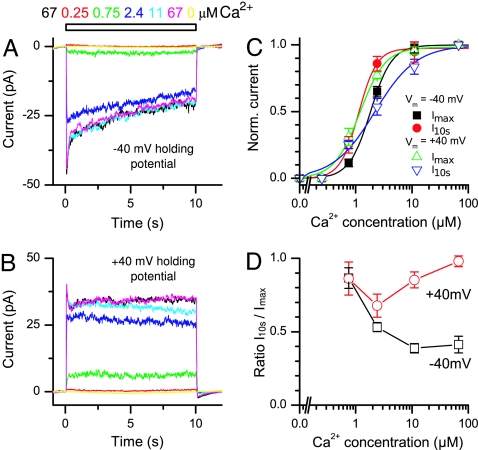
Ca2+ Dose dependency and inactivation kinetics of the ANO2 channel. (A and B) A patch was exposed for 10 s to a series of Ca2+ concentrations at −40 mV (A) and +40 mV (B). (C) The peak current and the current at 10 s were plotted against the Ca2+ concentration for both −40-mV and +40-mV holding voltages and fitted with Hill functions. (D) The ratio of the current at 10 s to the peak current showed a marked decline at −40 mV with increasing Ca2+ concentration but not at +40 mV.

References

    1. Firestein S. How the olfactory system makes sense of scents. Nature. 2001;413:211–218. - PubMed
    1. Kleene SJ. The electrochemical basis of odor transduction in vertebrate olfactory cilia. Chem Senses. 2008;33:839–859. - PubMed
    1. Kaneko H, Putzier I, Frings S, Kaupp UB, Gensch T. Chloride accumulation in mammalian olfactory sensory neurons. J Neurosci. 2004;24:7931–7938. - PMC - PubMed
    1. Reisert J, Lai J, Yau KW, Bradley J. Mechanism of the excitatory Cl− response in mouse olfactory receptor neurons. Neuron. 2005;45:553–561. - PMC - PubMed
    1. Nickell WT, Kleene NK, Kleene SJ. Mechanisms of neuronal chloride accumulation in intact mouse olfactory epithelium. J Physiol (Paris) 2007;583:1005–1020. - PMC - PubMed

Publication types