Review
. 2009;48(30):5418-29.
doi: 10.1002/anie.200900441.

Nanogels as pharmaceutical carriers: finite networks of infinite capabilities

Affiliations
Review

Nanogels as pharmaceutical carriers: finite networks of infinite capabilities

Alexander V Kabanov et al. Angew Chem Int Ed Engl. 2009.

Abstract

Nanogels are swollen nanosized networks composed of hydrophilic or amphiphilic polymer chains. They are developed as carriers for the transport of drugs, and can be designed to spontaneously incorporate biologically active molecules through formation of salt bonds, hydrogen bonds, or hydrophobic interactions. Polyelectrolyte nanogels can readily incorporate oppositely charged low-molecular-mass drugs and biomacromolecules such as oligo- and polynucleotides (siRNA, DNA) as well as proteins. The guest molecules interact electrostatically with the ionic polymer chains of the gel and become bound within the finite nanogel. Multiple chemical functionalities can be employed in the nanogels to introduce imaging labels and to allow targeted drug delivery. The latter can be achieved, for example, with degradable or cleavable cross-links. Recent studies suggest that nanogels have a very promising future in biomedical applications.


Figures

Figure 1
Figure 1
Physical self-assembly of nanogels in aqueous media. (a) Aggregation of hydrophobically-modified polymer, cholesterol-pullulan, in the presence of insulin molecules results in nanogels containing entrapped protein. (b) Mixing of lauryl-modified dextran and β-cyclodextrin polymer results in formation of nanogels stabilized through the guest-host binding of the lauryl and β-cyclodextrin moieties.
Figure 2
Figure 2
Chemical synthesis of nanogels by copolymerization in colloidal environments. (a) Copolymerization of monomers (1) and bifunctional cross-linkers (2) in w/o microemulsions stabilized by surfactants (3) produces nanogels that can be then transferred in aqueous media after removal of surfactants and organic solvent. (b) Copolymerization reactions can be also carried out in o/w emulsions that can be additionally stabilized by surfactants.
Figure 3
Figure 3
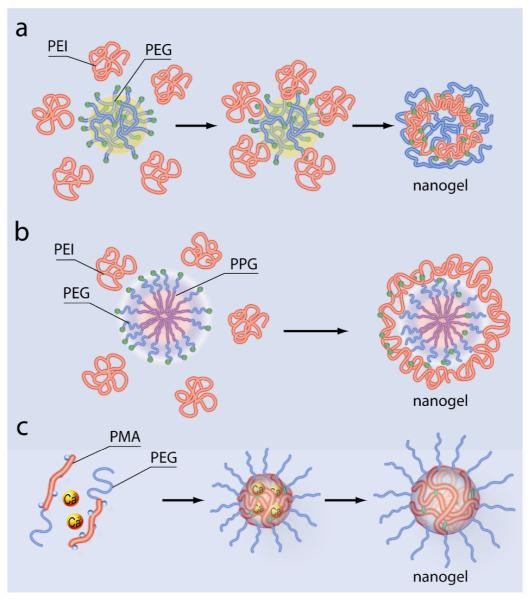
Synthesis of nanogels by cross-linking of the preformed polymer chains or self-assembled polymeric aggregates. (a) Cross-linking of double-end activated PEG and PEI chains in o/w emulsion followed by evaporation of the organic solvent. (b) Conjugation of PEI to double end activated Pluronic block copolymer (PEG-PPG-PEG), which is self-assembled in polymeric micelles in aqueous solution, results in nanogels containing hydrophobic PPG domains and cross-linked PEI-PEG network. (c) PEG-b-PMA diblock copolymer is condensed in presence of divalent metal cations in aqueous solution into a micelle with a polyion-metal core and PEG corona. This is followed by cross-linking of the micelle core and removal of the condensing metal cations, which results in nanogels with cross-linked polyanion (PMA) core and PEG corona.
Figure 4
Figure 4
Photolithographic technique PRINT uses non-wetting elastomeric perfluoropolyether molds to produce monodisperse, shape-specific nanoparticles from various organic precursors.
Figure 5
Figure 5
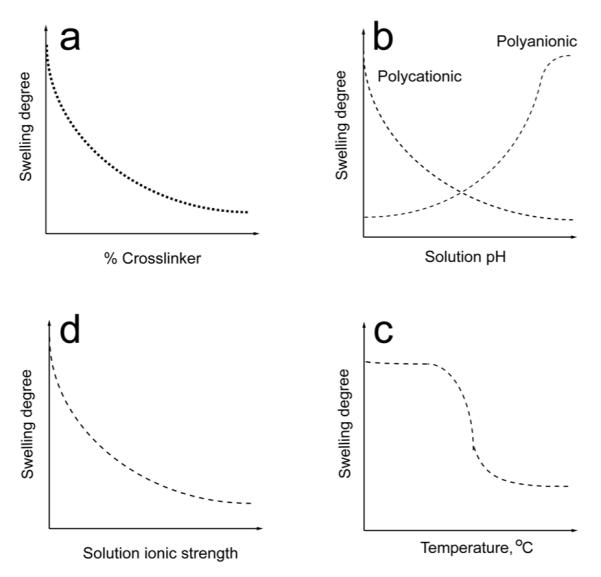
Factors affecting nanogel swelling. (a) Increase of the content of a cross-linker decreases swelling of nanogels composed of a hydrophilic polymer. (b) Increase of pH results in collapse of a nanogel composed of weak polybase chains and swelling of a nanogels composed of a weak polyacid due to deionization/ionization of these polymers. (c) Increase in the ionic strength decreases swelling of a polyelectrolyte nanogel. (d) Nanogels composed of polymers exhibiting LCST behavior collapse as the temperature increases above the LCST.
Figure 6
Figure 6
Loading and release of biomacromolecules in a cross-linked polymer hydrogel. A cross-linked gel composed of nonionic PEG and anionic PAA polymer chains is immersed in a solution of a cationic protein cytochrome C. The initial solution has a red color is due to the presence of the cytochrome C. The cytochrome C is spontaneously loaded in a gel due to a polyion complex formation between the protein and PAA chains. The gel collapses and acquires red color of cytochrome C while the external solution becomes clear. Acidification or addition of Ca2+ ion results in the protein release due to either deprotonation of the carboxylic groups of the PAA (acidification) or competitive binding of Ca2+ ions with the carboxylic groups of the PAA. In both cases the external solution acquired the red color of cytochrome C, while the gel further collapses.
Figure 7
Figure 7
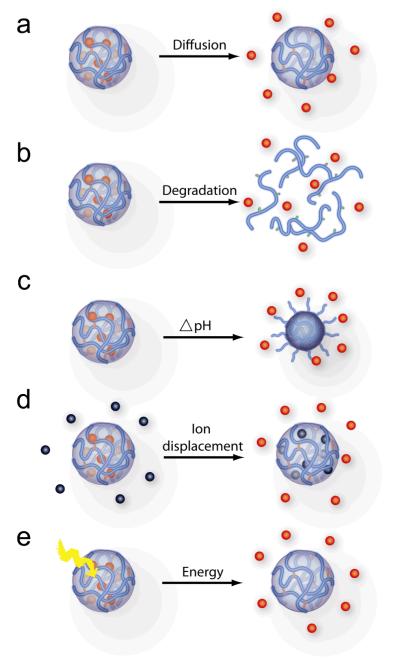
Drug release from nanogels. (a) Diffusion of the drug from nanogels. (b) Drug release due to degradation of biodegradable polymer chains or cross-links. (c) Change in pH results in deionization of polymer network and release of electrostatically bound drug. (d) Multivalent low-molecular cations or polyions of either charge can displace drugs having the same charge sign from electrostatic complexes with ionic nanogel. (e) Drug release can be induced by external energy applied to nanogels that induces degradation or structural transition of the nanogel polymer chains.

References

    1. Vinogradov SV, Batrakova EV, Kabanov AV. Coll. Surf. B: Biointerfaces. 1999;16:291–304.
    1. Lemieux P, Vinogradov SV, Gebhart CL, Guerin N, Paradis G, Nguyen HK, Ochietti B, Suzdaltseva YG, Bartakova EV, Bronich TK, St-Pierre Y, Alakhov VY, Kabanov AV. J. Drug Target. 2000;8:91–105. - PubMed
    1. Sunamoto J, Akiyoshi K. Macromolecules. 1993;26:3062–3068.
    1. Morimoto N, Hasegawa U, Sugawara A, Yamane S, Akiyoshi K. In: Nanotechnology in Carbohydrate Chemistry. Yuassa H, editor. Transworld Research Network; Trivandrum, India: 2006. pp. 67–85.
    1. Vinogradov SV, Bronich TK, Kabanov AV. Adv Drug Deliv Rev. 2002;54:135–147. - PubMed

Publication types

MeSH terms

LinkOut - more resources