Comparative Study
. 2009 Sep;215(3):320-34.
doi: 10.1111/j.1469-7580.2009.01113.x. Epub 2009 Jun 26.

Facial musculature in the rhesus macaque (Macaca mulatta): evolutionary and functional contexts with comparisons to chimpanzees and humans

Affiliations
Comparative Study

Facial musculature in the rhesus macaque (Macaca mulatta): evolutionary and functional contexts with comparisons to chimpanzees and humans

Anne M Burrows et al. J Anat. 2009 Sep.

Abstract

Facial expression is a common mode of visual communication in mammals but especially so in primates. Rhesus macaques (Macaca mulatta) have a well-documented facial expression repertoire that is controlled by the facial/mimetic musculature as in all mammals. However, little is known about the musculature itself and how it compares with those of other primates. Here we present a detailed description of the facial musculature in rhesus macaques in behavioral, evolutionary and comparative contexts. Formalin-fixed faces from six adult male specimens were dissected using a novel technique. The morphology, attachments, three-dimensional relationships and variability of muscles were noted and compared with chimpanzees (Pan troglodytes) and with humans. The results showed that there was a greater number of facial muscles in rhesus macaques than previously described (24 muscles), including variably present (and previously unmentioned) zygomaticus minor, levator labii superioris alaeque nasi, depressor septi, anterior auricularis, inferior auricularis and depressor supercilii muscles. The facial muscles of the rhesus macaque were very similar to those in chimpanzees and humans but M. mulatta did not possess a risorius muscle. These results support previous studies that describe a highly graded and intricate facial expression repertoire in rhesus macaques. Furthermore, these results indicate that phylogenetic position is not the primary factor governing the structure of primate facial musculature and that other factors such as social behavior are probably more important. The results from the present study may provide valuable input to both biomedical studies that use rhesus macaques as a model for human disease and disorder that includes assessment of facial movement and studies into the evolution of primate societies and communication.


Figures
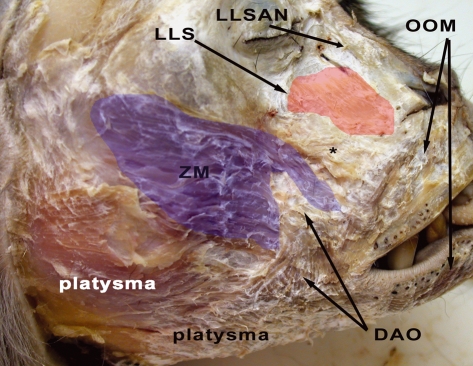
Fig. 2
Fig. 2
Right side of M. mulatta head with superficially located facial musculature indicated. ZM, zygomaticus major muscle (m.); LLS, levator labii superioris m.; LLSAN, levator labii superioris alaeque nasi m.; OOM, orbicularis oris m.; DAO, depressor anguli oris m. *Position of the caninus m., which is located deeply. The blue coloration on the ZM and red coloration on the LLS are used to indicate the approximate boundaries of these muscles.
Fig. 1
Fig. 1
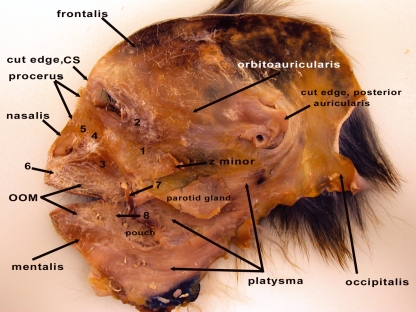
Deep view of a facial mask from the right side of the head from an adult male M. mulatta. 1, zygomaticus major muscle (m.); 2, orbicularis occuli m.; 3, caninus m.; 4, levator labii superioris m.; 5, levator labii superioris alaeque nasi m.; 6, depressor septi m.; 7, cut edge of buccinator m.; 8, depressor labii inferioris m. OOM, orbicularis oris m.; CS, corrugator supercilii m.; z minor, zygomaticus minor m.; ‘pouch’, cheek pouch.
Fig. 7
Fig. 7
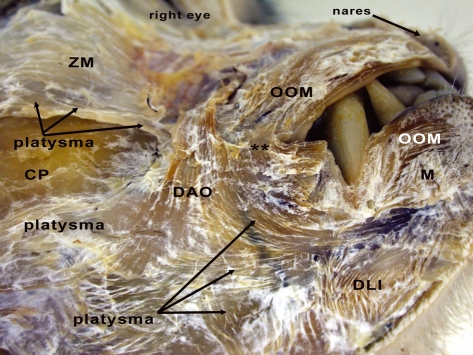
Right side of M. mulatta with a close-up of the inferolateral aspect of the oral region. ZM, zygomaticus major muscle (m.); OOM, orbicularis oris m.; DAO, depressor anguli oris m.; DLI, depressor labii inferioris m.; M, mentalis m.; CP, region of the cheek pouch. **Modiolar region.
Fig. 5
Fig. 5
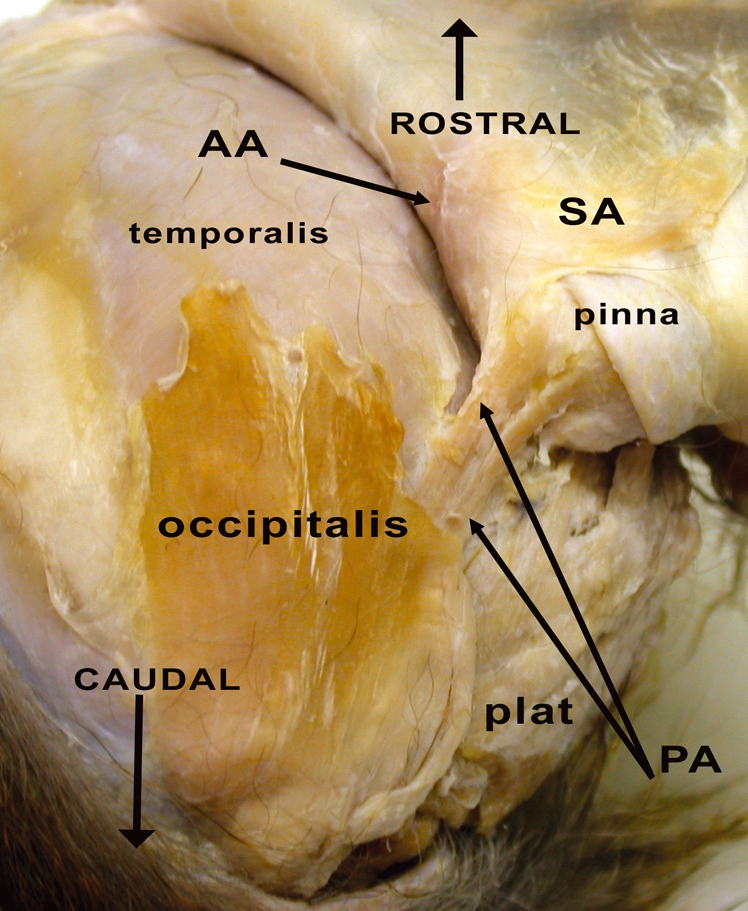
Right side of M. mulatta head with a posterior view of the skin covering the calvaria and pinna. plat, platysma muscle (m.); PA. posterior auricularis m.; AA, anterior auricularis m.; SA, superior auricularis m.
Fig. 8
Fig. 8
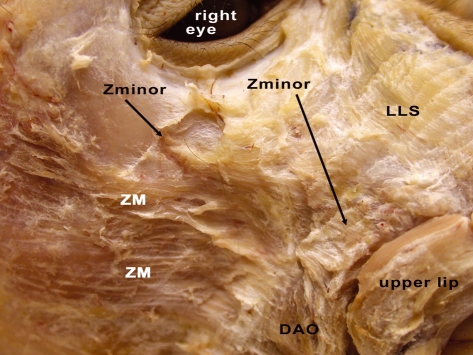
Right side of M. mulatta head with a close-up of the midface showing the appearance and position of the variable zygomaticus minor muscle (m.) (Zminor). ZM, zygomaticus major m.; DAO, depressor anguli oris m.; LLS, levator labii superioris m.
Fig. 4
Fig. 4
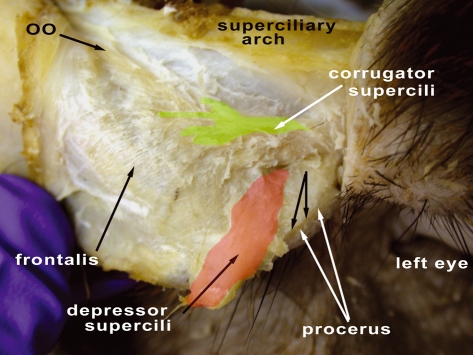
Right side of M. mulatta head with a close-up of the superciliary region. OO, orbicularis occuli muscle (m.). The green coloration on the corrugator supercilii m. and the red coloration on the depressor supercilii m. are used to indicate the approximate boundaries of these muscles. The unlabeled black arrows are used to indicate, with the white arrows labeled ‘procerus’, the boundaries of the procerus m.
Fig. 6
Fig. 6
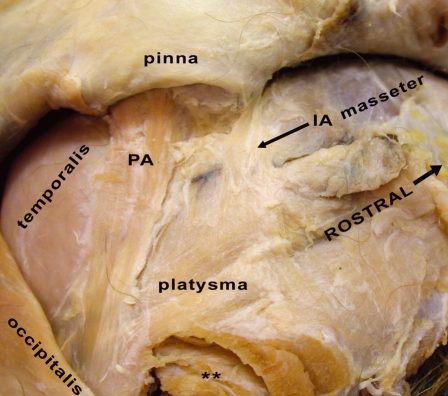
Right side of M. mulatta head with an inferolateral view of the skin covering the pinna. PA, posterior auricularis muscle (m.); IA, inferior auricularis m. **Musculature of the cervical region.
Fig. 3
Fig. 3
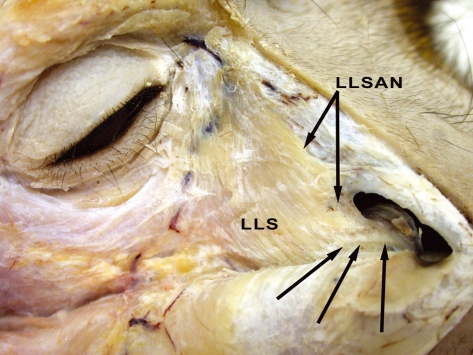
Right side of M. mulatta head with a close-up of the midfacial region showing the specific attachments of the levator labii superioris alaeque nasi muscle (m.) (LLSAN), indicated by the black arrows. Note that the LLSAN is congruent with the levator labii superioris m. (LLS) at its superior attachment but diverges approaching the inferior attachment to the alar region of the nose.

References

    1. Abel K. The rhesus macaque pediatric SIV infection model – a valuable tool in understanding infant HIV-1 pathogenesis and for designing pediatric HIV-1 prevention strategies. Curr HIV Res. 2009;7:2–11. - PMC - PubMed
    1. Amici F, Aureli F, Call J. Fission-fusion dynamics, behavioral flexibility, and inhibitory control in primates. Curr Biol. 2008;18:1415–1419. - PubMed
    1. Andrew RJ. The origin and evolution of the calls and facial expressions of the primates. Behaviour. 1963;20:1–109.
    1. Aureli F, Schino G. The role of emotions in social relationships. In: Thierry B, Singh M, Kaumanns W, editors. Macaque Societies: A Model for the Study of Social Organization. Cambridge: Cambridge University Press; 2004. pp. 38–55.
    1. Bauman MD, Toscano JE, Babineau BA, Mason WA, Amaral DG. Emergence of stereotypes in juvenile monkeys (Macaca mulatta) with neonatal amygdala or hippocampus lesions. Behav Neurosci. 2008;122:1005–1015. - PMC - PubMed

Publication types