. 2009 Aug;157(7):1291-300.
doi: 10.1111/j.1476-5381.2009.00305.x. Epub 2009 Jun 25.

Osteoblasts play key roles in the mechanisms of action of strontium ranelate

Affiliations

Osteoblasts play key roles in the mechanisms of action of strontium ranelate

T C Brennan et al. Br J Pharmacol. 2009 Aug.

Abstract

Background and purpose: Strontium ranelate reduces fracture risk in postmenopausal women with osteoporosis. Evidence from non-clinical studies and analyses of bone markers in phase III trials indicate that this is due to an increase in osteoblast formation and a decrease of osteoclastic resorption. The aim of this work was to investigate, in human cells, the mechanisms by which strontium ranelate is able to influence the activities of osteoblasts and osteoclasts.

Experimental approach: Human primary osteoblasts were used to examine effects of strontium ranelate on replication (thymidine incorporation), differentiation (Runx2 and alkaline phosphatase) and cell survival (cell counts and caspase activity). Osteoprotegerin (OPG) was measured by quantitative reverse transcription PCR (qRT-PCR) and elisa and receptor activator of NFkappaB ligand (RANKL) by qRT-PCR and Western blot. As strontium ranelate has been proposed as an agonist of the calcium-sensing receptor (CaSR), the involvement of CaSR in the effects of strontium ranelate on OPG and RANKL expression, and cell replication was examined using siRNA.

Key results: Strontium ranelate increased mRNA and protein levels of OPG and suppressed those of RANKL. Strontium ranelate also stimulated osteoblast replication and differentiation and increased cell survival under stress. Knocking down CaSR suppressed strontium ranelate-induced stimulation of OPG mRNA, reduction of RANKL mRNA, and increase in replication, indicating the involvement of CaSR in these responses.

Conclusions and implications: Our results demonstrate that osteoblasts play a key role in the mechanism of action of the anti-fracture agent, strontium ranelate by mediating both its anabolic and anti-resorptive actions, at least in part, via activation of CaSR.


Figures
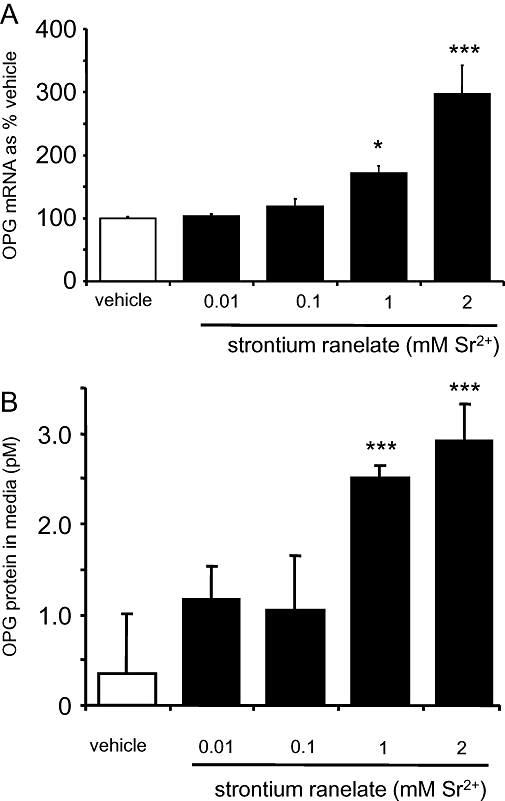
Figure 1
Figure 1
Strontium ranelate increases osteoprotegerin (OPG) mRNA and protein expression in human osteoblasts (HOBs). Cells were exposed for 24 h to vehicle or: 0.01, 0.1, 1 and 2 mM strontium ranelate, before RNA was extracted, converted to cDNA and then analysed by real-time reverse transcription PCR. (A) OPG mRNA expression was quantified and expressed as % of the value after treatment with vehicle (% vehicle). The results are presented as means ± SEM from four experiments. (B) OPG protein was measured by elisa according to manufacturer's instructions. The results are representative of three experiments ± SD each with triplicates. Concentrations are expressed as added to the vehicle, which contains 1 mM Ca2+. ***P < 0.001 compared with vehicle; *P < 0.05 compared with vehicle.
Figure 2
Figure 2
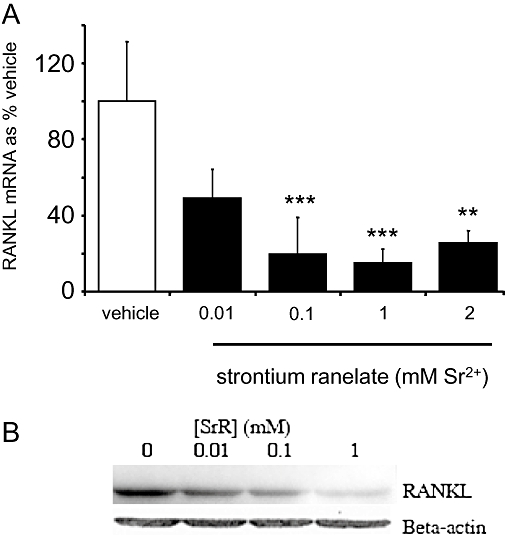
Strontium ranelate decreases receptor activator of NFκB ligand (RANKL) mRNA and protein expression in human osteoblasts. Cells were exposed for 24 h to vehicle or: 0.01, 0.1, 1 and 2 mM strontium ranelate, before RNA was extracted, converted to cDNA and then analysed by real-time reverse transcription PCR. (A) RANKL mRNA expression was quantified and expressed as % of the value after treatment with vehicle (% vehicle). The results are presented as means ± SEM from three experiments, each with triplicates. (B) RANKL protein was detected by Western blotting after cells were exposed to treatments for 24 h. One blot is shown, representative of two experiments. Concentrations are expressed as added to the vehicle, which contains 1 mM Ca2+. ***P < 0.001 compared with vehicle; **P < 0.01 compared with vehicle.
Figure 3
Figure 3
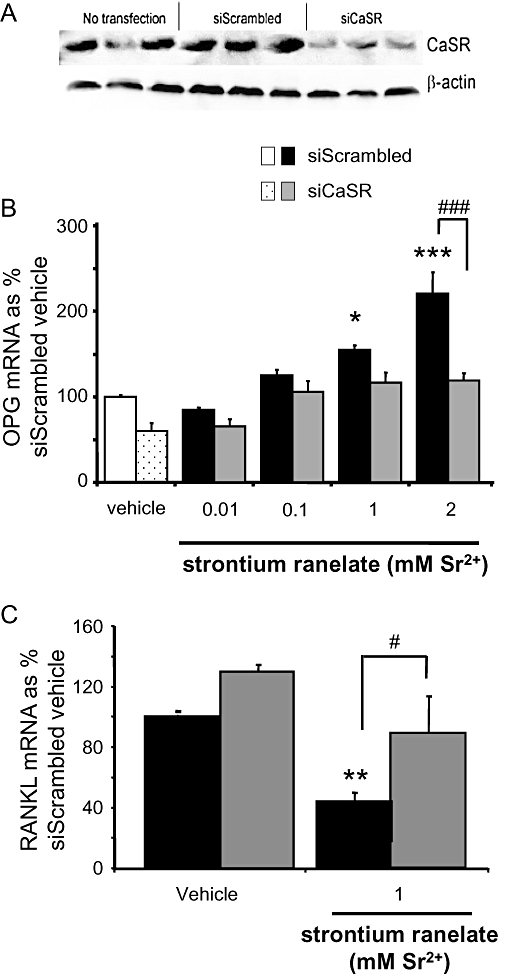
Calcium-sensing receptor (CaSR) is involved in strontium ranelate-induced changes in osteoprotegerin (OPG) and receptor activator of NFκB ligand (RANKL) mRNA expression. (A) Protein blots from human osteoblasts (HOBs) transfected with siRNA directed at the CaSR (siCaSR), scrambled siRNA (siScrambled) and without transfection. siCaSR inhibited the expression of the CaSR in HOBs by around 50% compared with both HOBs transfected with siScrambled and without transfection. β-Actin was used as the loading control. (B and C) siRNA directed against the CaSR was transfected into cells prior to the addition of strontium ranelate. Total RNA was extracted, converted to cDNA and then analysed by real-time reverse transcription PCR (A: OPG, B: RANKL). The results are presented as means ± SEM from three experiments, each with triplicates. Concentrations are expressed as added to the vehicle, which contains 1 mM Ca2+. ***P < 0.001 compared with vehicle; **P < 0.01 compared with vehicle; *P < 0.05 compared with vehicle; #P < 0.05 compared with same treatment with addition of siRNA; ###P < 0.001 compared with same treatment with addition of siRNA.
Figure 4
Figure 4
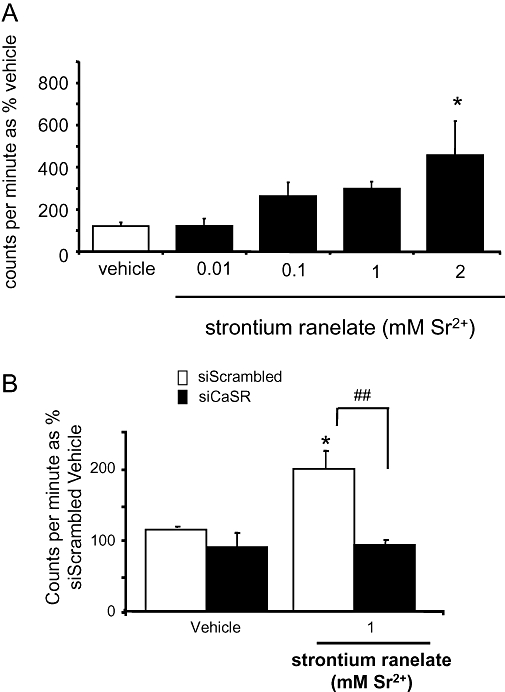
Strontium ranelate increases human osteoblast (HOB) cell replication via the calcium-sensing receptor (CaSR) as measured by [3H] thymidine incorporation. [3H] thymidine incorporation was measured in HOBs treated for 24 h with vehicle or: 0.01, 0.1, 1 and 2 mM strontium ranelate (A). siRNA directed against the CaSR was transfected into cells prior to the addition of strontium ranelate for 24 h and the increased [3H] thymidine incorporation seen with strontium was blunted in cells transfected with siRNA directed towards the CaSR (B). *P < 0.05 compared with vehicle.
Figure 5
Figure 5
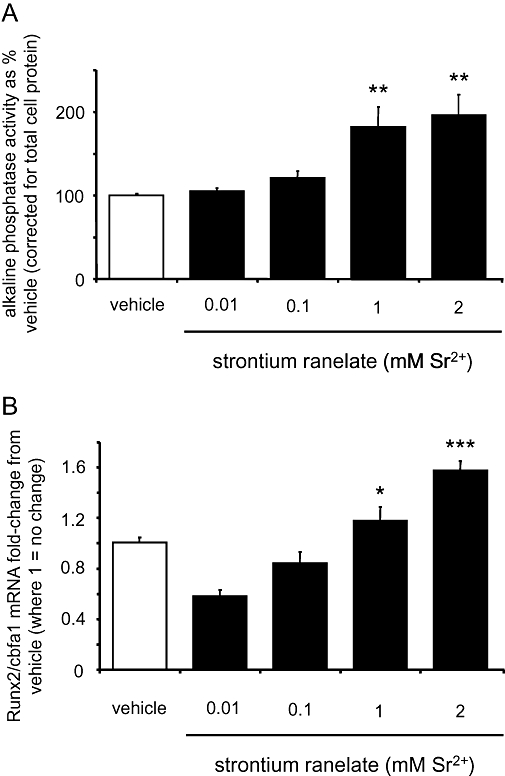
Strontium ranelate increases human osteoblast cell differentiation assessed by Runx2/Cbfa1 mRNA expression and alkaline phosphatase activity. Alkaline phosphatase activity was measured after 72-h treatments of 0.01, 0.1, 1 and 2 mM strontium ranelate and corrected for total cellular protein (A). Cells were exposed for 10 days to vehicle or: 0.01, 0.1, 1 and 2 mM strontium ranelate, before RNA was extracted, converted to cDNA and then analysed by real-time reverse transcription PCR. Runx2/Cbfa1 expression was quantified and expressed as fold-change from the value after treatment with vehicle (B). Concentrations are expressed as added to the vehicle, which contains 1 mM Ca2+. ***P < 0.001 compared with vehicle; **P < 0.01 compared with vehicle; *P < 0.05 compared with vehicle.
Figure 6
Figure 6
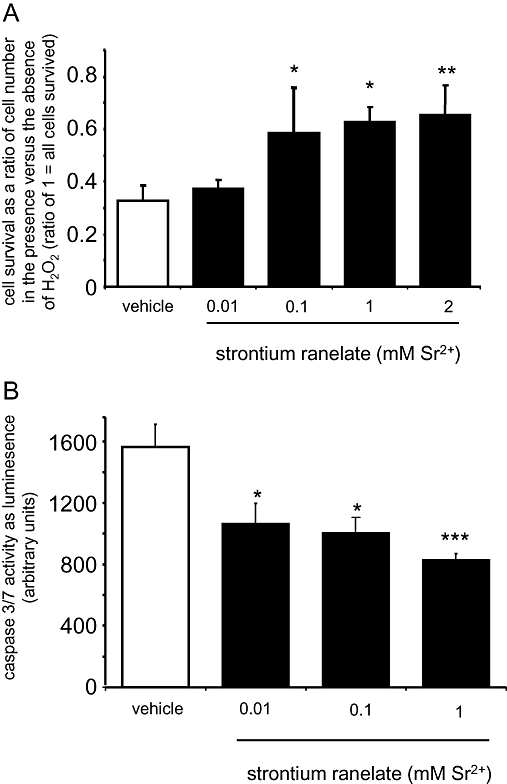
Strontium ranelate increases human osteoblast survival. Cell survival was measured as live cell counts post H2O2-induced oxidative stress after 48-h strontium ranelate treatment (A) or caspase 3/7 was measured with a commercial kit after 6 days' serum deprivation (B). Concentrations are expressed as added to the vehicle, which contains 1 mM Ca2+. ***P < 0.001 compared with vehicle; **P < 0.01 compared with vehicle; *P < 0.05 compared with vehicle.

References

    1. Almeida M, Han L, Martin-Millan M, Plotkin LI, Stewart SA, Roberson PK, et al. Skeletal involution by age-associated oxidative stress and its acceleration by loss of sex steroids. J Biol Chem. 2007;282:27285–27297. - PMC - PubMed
    1. Ammann P, Shen V, Robin B, Mauras Y, Bonjour JP, Rizzoli R. Strontium ranelate improves bone resistance by increasing bone mass and improving architecture in intact female rats. J Bone Miner Res. 2004;20:548. - PubMed
    1. Ammann P, Badoud I, Barraud S, Dayer R, Rizzoli R. Strontium ranelate treatment improves trabecular and cortical intrinsic bone tissue quality, a determinant of bone strength. J Bone Miner Res. 2007;22:1419–1425. - PubMed
    1. Anderson P, O'Loughlin P, May B, Morris H. Quantification of mRNA for the vitamin D metabolizing enzymes CYP27B1 and CYP24 and vitamin D receptor in kidney using real-time reverse transcriptase-polymerase chain reaction. J Mol Endocrinol. 2003;31:123–132. - PubMed
    1. Arlot ME, Jiang Y, Genant HK, Zhao J, Burt-Pichat B, Roux J-P, et al. Histomorphometric and microCT analysis of bone biopsies from postmenopausal osteoporotic women treated with strontium ranelate. J Bone Miner Res. 2008;23:215–222. - PubMed

Publication types

MeSH terms