


Continued impact of pneumococcal conjugate vaccine on carriage in young children
- PMID: 19564254
- PMCID: PMC2782668
- DOI: 10.1542/peds.2008-3099
Continued impact of pneumococcal conjugate vaccine on carriage in young children
Abstract
Objectives: The goals were to assess serial changes in Streptococcus pneumoniae serotypes and antibiotic resistance in young children and to evaluate whether risk factors for carriage have been altered by heptavalent pneumococcal conjugate vaccine (PCV7).
Methods: Nasopharyngeal specimens and questionnaire/medical record data were obtained from children 3 months to <7 years of age in primary care practices in 16 Massachusetts communities during the winter seasons of 2000-2001 and 2003-2004 and in 8 communities in 2006-2007. Antimicrobial susceptibility testing and serotyping were performed with S pneumoniae isolates.
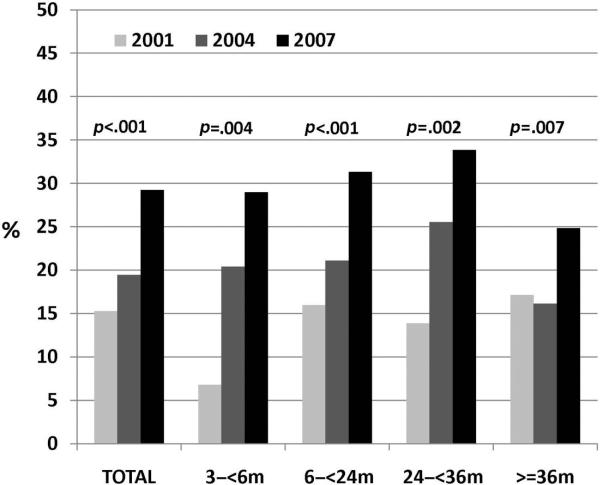
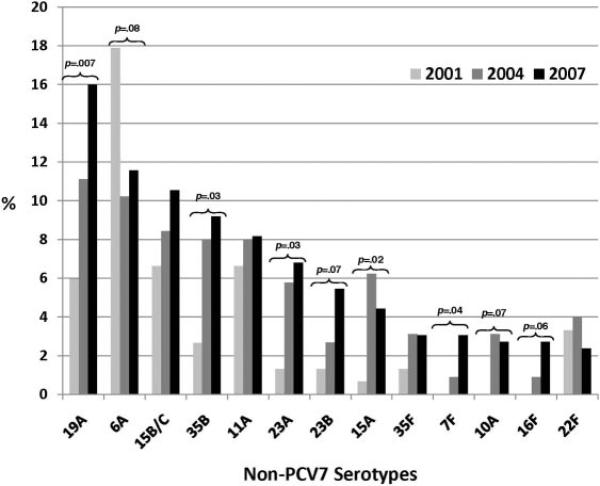
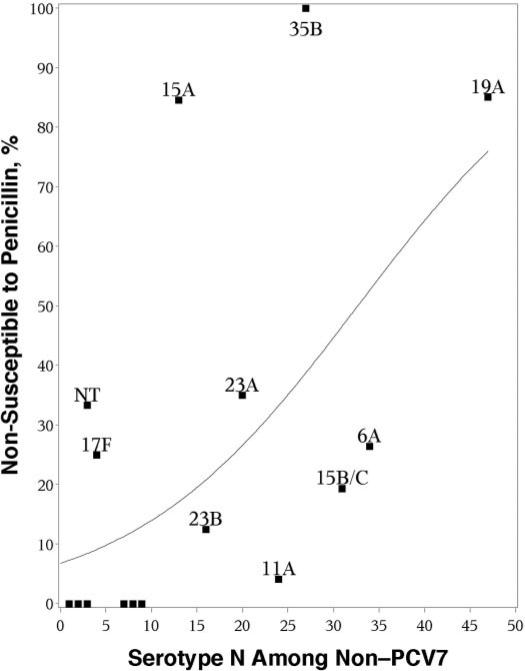
Results: We collected 678, 988, and 972 specimens during the sampling periods in 2000-2001, 2003-2004, and 2006-2007, respectively. Carriage of non-PCV7 serotypes increased from 15% to 19% and 29% (P < .001), with vaccine serotypes decreasing to 3% of carried serotypes in 2006-2007. The relative contribution of several non-PCV7 serotypes, including 19A, 35B, and 23A, increased across sampling periods. By 2007, commonly carried serotypes included 19A (16%), 6A (12%), 15B/C (11%), 35B (9%), and 11A (8%), and high-prevalence serotypes seemed to have greater proportions of penicillin nonsusceptibility. In multivariate models, common predictors of pneumococcal carriage, such as child care attendance, upper respiratory tract infection, and the presence of young siblings, persisted.
Conclusions: The virtual disappearance of vaccine serotypes in S pneumoniae carriage has occurred in young children, with rapid replacement with penicillin-nonsusceptible nonvaccine serotypes, particularly 19A and 35B. Except for the age group at highest risk, previous predictors of carriage, such as child care attendance and the presence of young siblings, have not been changed by the vaccine.
Figures
References
-
- Hicks LA, Harrison LH, Flannery B, et al. Incidence of pneumococcal disease due to nonpneumococcal conjugate vaccine (PCV7) serotypes in the United States during the era of widespread PCV7 vaccination, 1998 –2004. J Infect Dis. 2007;196(9):1346–1354. - PubMed
-
- Whitney CG, Farley MM, Hadler J, et al. Decline in invasive pneumococcal disease after the introduction of protein-polysaccharide conjugate vaccine. N Engl J Med. 2003;348(18):1737–1746. - PubMed
-
- Black S, Shinefield H, Baxter R, et al. Postlicensure surveillance for pneumococcal invasive disease after use of heptavalent pneumococcal conjugate vaccine in Northern California Kaiser Permanente. Pediatr Infect Dis J. 2004;23(6):485–489. - PubMed
-
- Poehling KA, Talbot TR, Griffin MR, et al. Invasive pneumococcal disease among infants before and after introduction of pneumococcal conjugate vaccine. JAMA. 2006;295(14):1668–1674. - PubMed
-
- Centers for Disease Control and Prevention Direct and indirect effects of routine vaccination of children with 7-valent pneumococcal conjugate vaccine on incidence of invasive pneumococcal disease: United States, 1998 –2003. MMWR Morb Mortal Wkly Rep. 2005;54(36):893–897. - PubMed
Publication types
MeSH terms
Substances
Grants and funding
LinkOut - more resources
Full Text Sources
Other Literature Sources
Medical
