


Risk factors affecting school readiness in premature infants with respiratory distress syndrome
- PMID: 19564308
- PMCID: PMC2737343
- DOI: 10.1542/peds.2008-1771
Risk factors affecting school readiness in premature infants with respiratory distress syndrome
Abstract
Objective: With advances in neonatal care, more children born prematurely are successfully reaching school age. It is unknown how many will be ready for school and what factors affect school readiness. Our objective was to assess readiness of children born prematurely for entry into public school, and determine risk factors associated with lack of school readiness in this population.
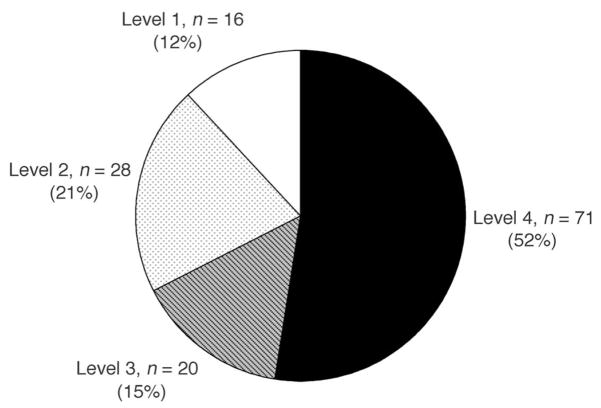
Methods: This was a single-center prospective cohort study. Follow- up data were collected for 135 of 167 (81%) surviving premature infants with RDS requiring surfactant-replacement therapy. The children were seen between July 2005 and September 2006 (average age: 5.7 +/- 1.0 years) and underwent standardized neurodevelopmental and health assessments and socioeconomic status classification. A 4-level school-readiness score was constructed by using each child's standardized scores on assessments of basic concepts (Bracken School-Readiness Assessment), perceptual skills (Visual-Motor Integration Test), receptive vocabulary (Peabody Picture Vocabulary Test, Third Edition), daily living functional skills (Pediatric Functional Independence Measure), and presence of sensory impairments or autism. Proportional odds models were used to identify risk factors predicting lower school-readiness levels.
Results: Mean birth weight was 1016 +/- 391 g, and mean gestational age was 27.5 +/- 2.6 weeks. Ninety-one (67%) children were school-ready. Using multivariate analysis, male gender, chronic lung disease, and severe intraventricular hemorrhage or periventricular leukomalacia were associated with lower school-readiness levels. However, the most powerful factor determining school-readiness level was low socioeconomic status.
Conclusion: Interventions targeting neonatal morbidities may be much less effective at improving overall performance at school age compared with the effect of the impoverished social environment.
Figures
References
-
- National Center for Health Statistics. Final natality data, 2004. [Accessed October 16, 2007]. Available at: www.cdc.gov/nchs.
-
- Hack M, Taylor HG, Drotar D, et al. Chronic conditions, functional limitations, and special health care needs of school-aged children born with extremely low-birth-weight in the 1990s. JAMA. 2005;294(3):318–325. - PubMed
-
- Hack M, Taylor HG, Klein N, Eiben R, Schatschneider C, Mercuri-Minich N. School-age outcomes in children with birthweights under 750g. N Engl J Med. 1994;331(12):753–759. - PubMed
-
- Kilbride HW, Thorstad K, Daily D. Preschool outcome of less than 801-gram preterm infants compared with full-term siblings. Pediatrics. 2004;113(4):742–747. - PubMed
