. 2009 Jul 14;106(28):11546-51.
doi: 10.1073/pnas.0905222106. Epub 2009 Jun 29.

High-resolution profiling and discovery of planarian small RNAs

Affiliations

High-resolution profiling and discovery of planarian small RNAs

Marc R Friedländer et al. Proc Natl Acad Sci U S A. .

Abstract

Freshwater planarian flatworms possess uncanny regenerative capacities mediated by abundant and collectively totipotent adult stem cells. Key functions of these cells during regeneration and tissue homeostasis have been shown to depend on PIWI, a molecule required for Piwi-interacting RNA (piRNA) expression in planarians. Nevertheless, the full complement of piRNAs and microRNAs (miRNAs) in this organism has yet to be defined. Here we report on the large-scale cloning and sequencing of small RNAs from the planarian Schmidtea mediterranea, yielding altogether millions of sequenced, unique small RNAs. We show that piRNAs are in part organized in genomic clusters and that they share characteristic features with mammalian and fly piRNAs. We further identify 61 novel miRNA genes and thus double the number of known planarian miRNAs. Sequencing, as well as quantitative PCR of small RNAs, uncovered 10 miRNAs enriched in planarian stem cells. These miRNAs are down-regulated in animals in which stem cells have been abrogated by irradiation, and thus constitute miRNAs likely associated with specific stem-cell functions. Altogether, we present the first comprehensive small RNA analysis in animals belonging to the third animal superphylum, the Lophotrochozoa, and single out a number of miRNAs that may function in regeneration. Several of these miRNAs are deeply conserved in animals.


Conflict of interest statement

The authors declare no conflict of interest.

Figures
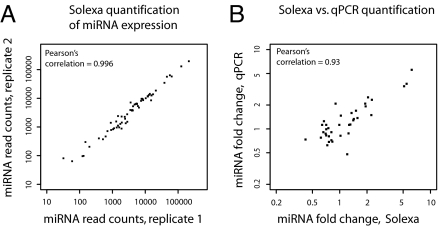
Fig. 1.
Fig. 1.
Reproducible and quantitative sequencing of small RNAs. (A) Reproducibility of Solexa quantitation of miRNA expression. Each data point represents 1 miRNA. Samples are independent biological replicates of irradiated planarians. (B) Solexa vs. qPCR quantitation of miRNA fold-changes. Each data point represents 1 miRNA. Independent biological replicates were used for the Solexa and the qPCR quantitation.
Fig. 2.
Fig. 2.
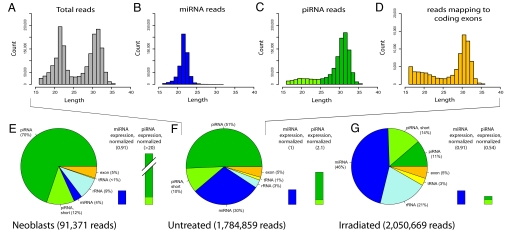
Small RNA contents in planarian neoblasts and whole-body samples. (A–D) Length profiles of Solexa reads from sequencing of the untreated whole-body sample. Only reads successfully mapped to the genome are considered. (A) All reads, (B) miRNA reads, (C) piRNA reads, and (D) reads mapping to coding exons are shown. Note that D is on a different scale. piRNA reads >25 nt (dark green) have features characteristic for piRNAs (see sections on piRNAs). These features were still present but weaker (70–80%, see SI Text) for the remaining piRNA reads (light green, length 17–25 nt). (E–G, pie charts) Contents of RNA species in the three Solexa datasets: (E) neoblasts, (F) untreated planarians, and (G) irradiated planarians. Dark green, piRNAs; light green, short piRNAs; dark blue, miRNAs; light blue, rRNA; yellow, tRNA; orange, mRNA. (E–G, bar graphs) miRNA (blue), piRNA (dark green), and short piRNA (light green) expression. The 454 data, produced by sequencing RNAs that were 18–25-nt long, were used to estimate miRNA expression, whereas the Solexa data were used for piRNA expression. Total miRNA and piRNA read counts were normalized to miR-71c. miRNA expression of the untreated sample was set to 1, and the other expression bars were scaled accordingly (numbers in parentheses above each bar). Note that piRNA expression in the neoblast sample is out of scale.
Fig. 3.
Fig. 3.
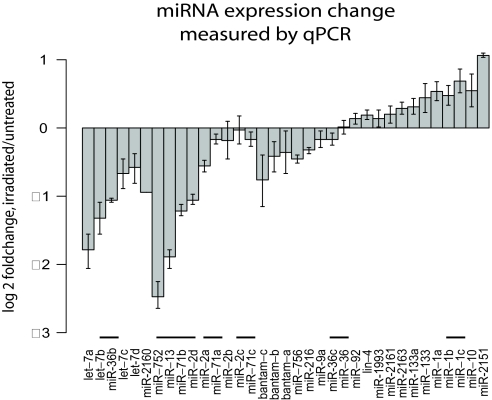
miRNA expression fold-changes measured by qPCR. Total RNA from untreated and irradiated animals was used to quantify expression fold-changes of 35 miRNAs by qPCR. Data are relative to expression detected for the ubiquitously expressed control ura4 (see Methods). Each miRNA is grouped with its family members. Horizontal bars indicate miRNA gene clusters.
Fig. 4.
Fig. 4.
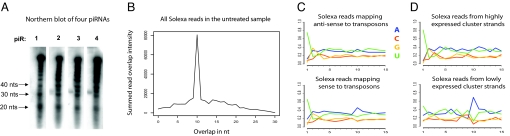
Features of planarian piRNAs. (A) Northern blot analysis of 4 annotated piRNAs. Bands ≈32-nt long are visible for 3 of these piRNAs. (B) Summed overlap intensities for Solexa reads in the untreated sample. The horizontal axis is the length of overlap in nucleotides between the 5′ ends of reads mapping to the same genomic locus on opposite strands. The vertical axis shows the intensity of the overlap, summed over the entire dataset. (C and D) Sequence biases of piRNAs. The horizontal axis shows nucleotide positions from the 5′ end, the vertical axis represents nucleotide fractions. (E) piRNAs mapping antisense (Top) and sense (Bottom) to transposons. (F) piRNAs from highly (Top) and lowly (Bottom) expressed cluster strands.
Fig. 5.
Fig. 5.
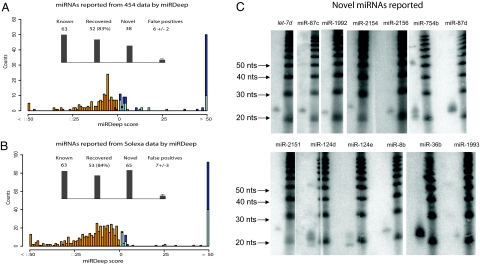
Novel planarian miRNAs. (A) miRNAs reported from 454 data by miRDeep. miRDeep scores are shown as a color-encoded histogram (score cut-off: 1). Known miRNAs, dark blue; novel miRNAs, light blue. Known miRNAs below the cut-off are plotted in red (false negatives). The number of false positives was estimated by miRDeep (20). (B) miRNAs reported from Solexa data by miRDeep; legend same as A. (C) Validation of novel miRNAs. 13 miRNAs were validated by Northern blot analysis, 11 by qPCR (Fig. 3). In some cases, miRNA precursors are also detected.

References

    1. Reddien PW, Sanchez Alvarado A. Fundamentals of planarian regeneration. Annu Rev Cell Dev Biol. 2004;20:725–757. - PubMed
    1. Randolph H. The regeneration of the tail in lumbriculus. J Morphol. 1892;7:317–344.
    1. Robb SM, Ross E, Sanchez Alvarado A. SmedGD: The Schmidtea mediterranea genome database. Nucleic Acids Res. 2008;36:D599–D606. - PMC - PubMed
    1. Eisenhoffer GT, Kang H, Sanchez Alvarado A. Molecular analysis of stem cells and their descendants during cell turnover and regeneration in the planarian Schmidtea mediterranea. Cell Stem Cell. 2008;3:327–339. - PMC - PubMed
    1. Reddien PW, Bermange AL, Murfitt KJ, Jennings JR, Sanchez Alvarado A. Identification of genes needed for regeneration, stem cell function, and tissue homeostasis by systematic gene perturbation in planaria. Dev Cell. 2005;8:635–649. - PMC - PubMed

Publication types

Associated data