Gait dynamics in Parkinson's disease: common and distinct behavior among stride length, gait variability, and fractal-like scaling
- PMID: 19566273
- PMCID: PMC2719464
- DOI: 10.1063/1.3147408
Gait dynamics in Parkinson's disease: common and distinct behavior among stride length, gait variability, and fractal-like scaling
Abstract
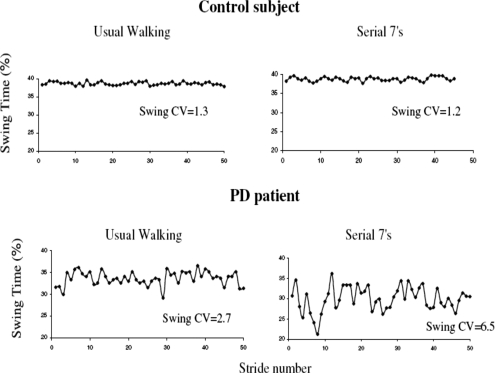
Parkinson's disease (PD) is a common, debilitating neurodegenerative disease. Gait disturbances are a frequent cause of disability and impairment for patients with PD. This article provides a brief introduction to PD and describes the gait changes typically seen in patients with this disease. A major focus of this report is an update on the study of the fractal properties of gait in PD, the relationship between this feature of gait and stride length and gait variability, and the effects of different experimental conditions on these three gait properties. Implications of these findings are also briefly described. This update highlights the idea that while stride length, gait variability, and fractal scaling of gait are all impaired in PD, distinct mechanisms likely contribute to and are responsible for the regulation of these disparate gait properties.
Figures
References
-
- Orr-Urtreger A., Shifrin C., Rozovski U., Rosner S., Bercovich D., Gurevich T., Yagev-More H., Bar-Shira A., and Giladi N., “The LRRK2 G2019S mutation in Ashkenazi Jews with Parkinson disease: Is there a gender effect?,” Neurology NEURAI 69, 1595 (2007).10.1212/01.wnl.0000277637.33328.d8 - DOI - PubMed
Publication types
MeSH terms
Substances
Grants and funding
LinkOut - more resources
Full Text Sources
Other Literature Sources
Medical