Review
. 2009 Jul;84(7):643-62.
doi: 10.1016/S0025-6196(11)60754-4.

Contemporary management of atrial fibrillation: update on anticoagulation and invasive management strategies

Affiliations
Review

Contemporary management of atrial fibrillation: update on anticoagulation and invasive management strategies

Mark A Crandall et al. Mayo Clin Proc. 2009 Jul.

Abstract

Atrial fibrillation (AF) is the most common arrhythmia encountered in clinical practice. Its increasing prevalence, particularly among the elderly, renders it one of the most serious current medical epidemics. Several management questions confront the clinician treating a patient with AF: Should the condition be treated? Is the patient at risk of death or serious morbidity as a result of this diagnosis? If treatment is necessary, is rate control or rhythm control superior? Which patients need anticoagulation therapy, and for how long? This review of articles obtained by a search of the PubMed and MEDLINE databases presents the available evidence that can guide the clinician in answering these questions. After discussing the merits of available therapy, including medications aimed at controlling rate, rhythm, or both, we focus on the present status of ablative therapy for AF. Catheter ablation, particularly targeting the pulmonary veins, is being increasingly performed, although the precise indications for this approach and its effectiveness and safety are being actively investigated. We briefly discuss other invasive options that are less frequently used, such as pacemakers, defibrillators, left atrial appendage closure devices, and the surgical maze procedure.


Figures
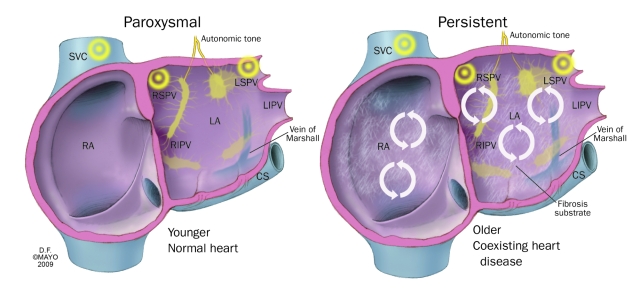
FIGURE 1.
FIGURE 1.
Important differences between the paroxysmal and persistent forms of atrial fibrillation. These differences have implications for management and for outcome expectations. Circular arrows represent rotors. CS = coronary sinus; LA = left atrium; LIPV = left inferior pulmonary vein; LSPV = left superior pulmonary vein; RA = right atrium; RIPV = right inferior pulmonary vein; RSPV = right superior pulmonary vein; SVC = superior vena cava.
FIGURE 2.
FIGURE 2.
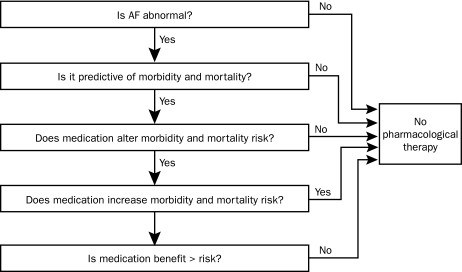
Criteria for treating atrial fibrillation (AF). The primary criterion for treating AF is symptom relief. Currently, no conclusive evidence suggests that maintaining sinus rhythm decreases the rates of mortality or severe morbidity. This absence of evidence is probably due to the fact that minimal or no risk of mortality is associated with AF alone, that previously studied methods of maintaining sinus rhythm have been ineffective, and that both pharmacological therapy and invasive therapy are themselves associated with particular risks.
FIGURE 3.
FIGURE 3.
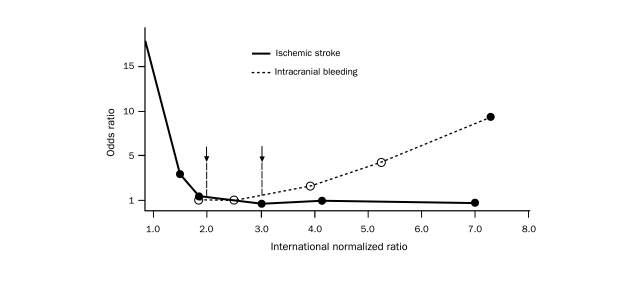
Odds ratios for stroke and intracranial bleeding according to the international normalized ratio (INR) for patients with atrial fibrillation. The risk of ischemic stroke is higher for patients with an INR lower than 2, and the risk of intracranial bleeding is higher when the INR is higher than 3 (arrows). Adapted from Ann Intern Med, with permission.
FIGURE 4.
FIGURE 4.
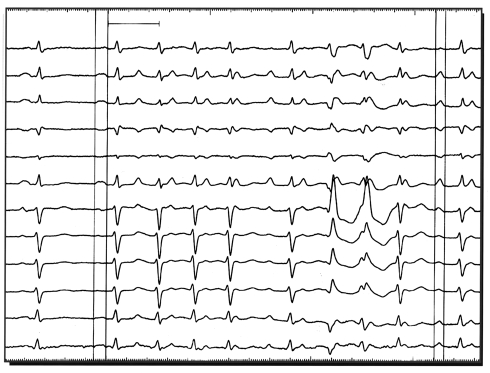
Most antiarrhythmic medications have a proarrhythmic potential. Pictured here is the proarrhythmia of concern when potassium channel blockers such as sotalol are used. Cause-dependent premature ventricular contractions triggering polymorphic ventricular tachycardia are seen.
FIGURE 5.
FIGURE 5.
Although the electrocardiography of atrial fibrillation is generally straightforward, the onset of arrhythmia (premature atrial contractions or monomorphic atrial tachycardia) should be determined because of the importance of triggers for atrial fibrillation. Such a determination may help guide physicians in counseling patients about atrial fibrillation ablation.
FIGURE 6.
FIGURE 6.
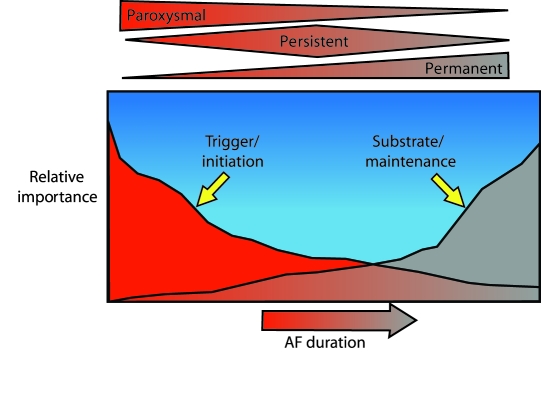
Paroxysmal atrial fibrillation (AF) can be a very different disease from permanent or chronic AF. Triggers are important for initiating paroxysmal AF, whereas substrate abnormalities are necessary for maintaining permanent AF. Although the natural history of paroxysmal AF is not exactly known, many patients will progress to the more permanent form.
FIGURE 7.
FIGURE 7.
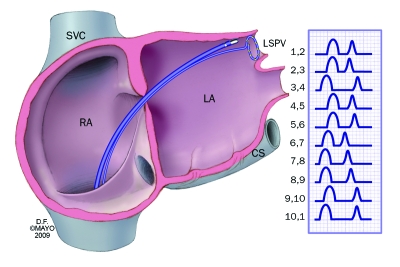
Pulmonary vein isolation is currently the most common ablation technique used for atrial fibrillation. The typical placement of a circular mapping catheter within the pulmonary vein is shown. Importantly, the ablation catheter and the delivery of energy are placed outside the vein within the left atrium. Also pictured are the characteristic intracardiac electrograms from an arrhythmogenic vein. After successful isolation of the vein, these electrographic abnormalities will disappear. CS = coronary sinus; LA = left atrium; LSPV = left superior pulmonary vein; RA = right atrium; SVC = superior vena cava.
FIGURE 8.
FIGURE 8.
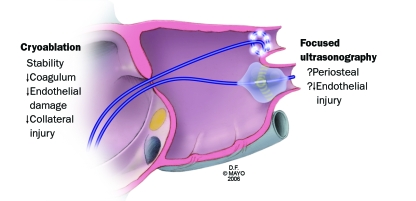
Newer techniques for atrial fibrillation ablation include the use of cryoablation rather than the thermal injury from radiofrequency energy. Balloon catheters and focused ultrasonography are also being investigated to facilitate faster, more effective, and safer left atrial ablation for atrial fibrillation. ↓ = decreased;? = potential.
FIGURE 9.
FIGURE 9.
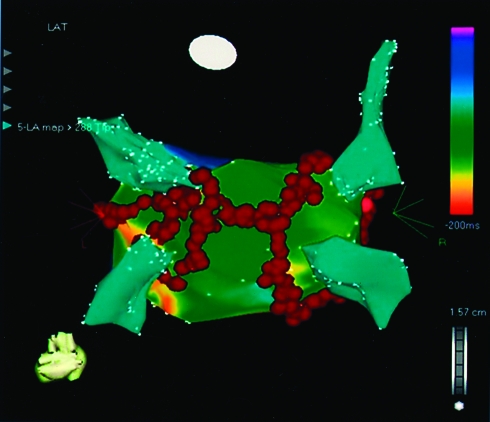
Current ablation approaches for patients with persistent atrial fibrillation include pulmonary vein isolation and linear ablation in the atrium, which connects ablation sites from the vein with each other and with the mitral annulus (red dots). Thus, a combined approach aimed at modifying abnormal substrate and eliminating common triggers is used. Linear ablation is primarily performed to prevent macroreentrant atrial tachycardia, including atypical atrial flutter.
FIGURE 10.
FIGURE 10.
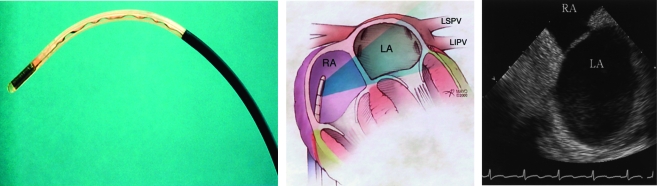
Intracardiac ultrasonography has substantially facilitated radiofrequency ablation procedures. Left, Linear phased array probe. Middle, Placement of the probe in the right atrium (RA) allows visualization of the left atrial pulmonary vein orifices (right) without the need for placing another catheter in the left atrium (LA) itself. LIPV = left inferior pulmonary vein; LSPV = left superior pulmonary vein.
FIGURE 11.
FIGURE 11.
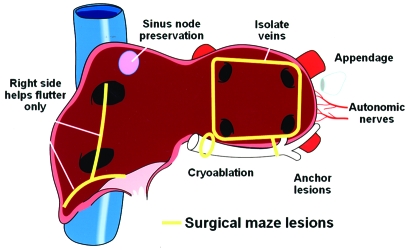
Atrial fibrillation (AF): lessons from the operating room. Current endovascular AF ablation has in many ways benefitted from the surgical experience with managing AF. Isolating the pulmonary veins, anchoring lesions (linear ablation), and understanding the role of eliminating the left atrial appendage or modifying the autonomic nerves are lessons learned directly from surgical experience.

References

    1. Go AS, Hylek EM, Phillips KA, et al. Prevalence of diagnosed atrial fibrillation in adults: national implications for rhythm management and stroke prevention: the AnTicoagulation and Risk Factors in Atrial Fibrillation (ATRIA) Study. JAMA 2001;285(18):2370-2375 - PubMed
    1. Jahangir A, Lee V, Friedman PA, et al. Long-term progression and outcomes with aging in patients with lone atrial fibrillation: a 30-year follow-up study. Circulation 2007;115(24):3050-3056 Epub 2007 Jun 4. - PubMed
    1. European Heart Rhythm Association. Heart Rhythm Society. Fuster V, Rydén LE, Cannom DS, et al. American College of Cardiology. American Heart Association Task Force on Practice Guidelines. European Society of Cardiology Committee for Practice Guidelines. Writing Committee to Revise the 2001 Guidelines for the Management of Patients With Atrial Fibrillation ACC/AHA/ESC 2006 guidelines for the management of patients with atrial fibrillation—executive summary: a report of the American College of Cardiology/American Heart Association Task Force on Practice Guidelines and the European Society of Cardiology Committee for Practice Guidelines (Writing Committee to Revise the 2001 Guidelines for the Management of Patients With Atrial Fibrillation) [published correction appears in J Am Coll Cardiol. 2007;50(6):562] J Am Coll Cardiol. 2006;48(4):854-906 - PubMed
    1. Al-Khatib SM, Wilkinson WE, Sanders LL, McCarthy EA, Pritchett EL. Observations on the transition from intermittent to permanent atrial fibrillation. Am Heart J. 2000;140(1):142-145 - PubMed
    1. Kerr CR, Humphries KH, Talajic M, et al. Progression to chronic atrial fibrillation after the initial diagnosis of paroxysmal atrial fibrillation: results from the Canadian Registry of Atrial Fibrillation. Am Heart J. 2005;149(3):489-496 - PubMed