. 2009 Jul;7(7):1021-32.
doi: 10.1158/1541-7786.MCR-08-0582. Epub 2009 Jun 30.

Hsp90 is an essential regulator of EphA2 receptor stability and signaling: implications for cancer cell migration and metastasis

Affiliations

Hsp90 is an essential regulator of EphA2 receptor stability and signaling: implications for cancer cell migration and metastasis

Balasubramaniam Annamalai et al. Mol Cancer Res. 2009 Jul.

Abstract

A subset of Eph receptors and their corresponding ligands are commonly expressed in tumor cells where they mediate biological processes such as cell migration and adhesion, whereas their expression in endothelial cells promotes angiogenesis. In particular, the tumor-specific up-regulation of EphA2 confers properties of increased cellular motility, invasiveness, tumor angiogenesis, and tumor progression, and its overexpression correlates with poor prognosis in several cancer types. The cellular chaperone Hsp90 also plays a significant role in regulating cell migration and angiogenesis, although the full repertoire of motility driving proteins dependent on Hsp90 function remain poorly defined. We explored the hypothesis that Hsp90 may regulate the activity of EphA2 and examined the potential relationship between EphA2 receptor signaling and chaperone function. We show that geldanamycin, an Hsp90 antagonist, dramatically destabilizes newly synthesized EphA2 protein and diminishes receptor levels in a proteasome-dependent pathway. In addition, geldanamycin treatment impairs EphA2 signaling, as evidenced by a decrease in ligand-dependent receptor phosphorylation and subsequent cell rounding. Therefore, Hsp90 exerts a dual role in regulating the stability of nascent EphA2 protein and maintaining the signaling capacity of the mature receptor. Our findings also suggest that the geldanamycin-dependent mitigation of EphA2 signaling in receptor-overexpressing cancer cells may be sufficient to recapitulate the antimotility effects of this drug. Finally, the identification of a pharmacologic approach to suppress EphA2 expression and signaling highlights the attractive possibility that Hsp90 inhibitors may have clinical utility in antagonizing EphA2-dependent tumorigenic progression.


Figures
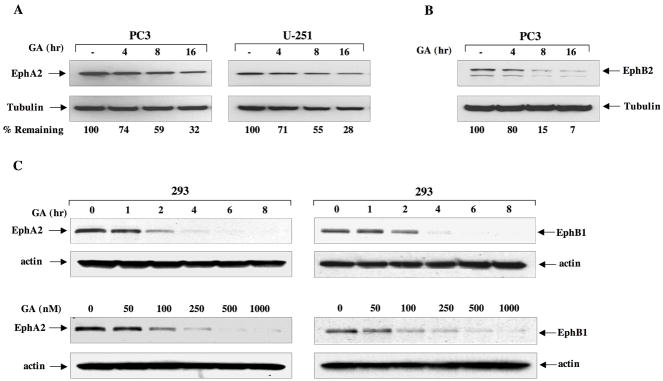
Fig 1
Fig 1. Eph proteins are sensitive to Hsp90 inhibition
(A) PC3 and U251 cells were seeded in 6 well plates and treated with 1 μM GA for the indicated times. Cells were then lysed and equivalent protein subjected to SDS-PAGE and immunoblot analysis with EphA2 antibody. Tubulin was used as control for protein loading. (B) PC3 cells were treated with 1 μM GA, lysed as in A, and blots were probed for EphB2. (C) HEK293 cells were transfected with plasmids encoding either HA-tagged EphA2 or EphB1. Cells were treated with 1 uM GA for the indicated times and drug concentrations and lysates were probed with anti-HA antibody. For the dose response, cells were treated for 16 h. Band intensities were quantitated with NIH Image J software and normalized to tubulin levels. The receptor levels from untreated cells were considered 100% and the percentage of remaining receptor from drug treated cells was determined relative to the control expression.
Fig 2
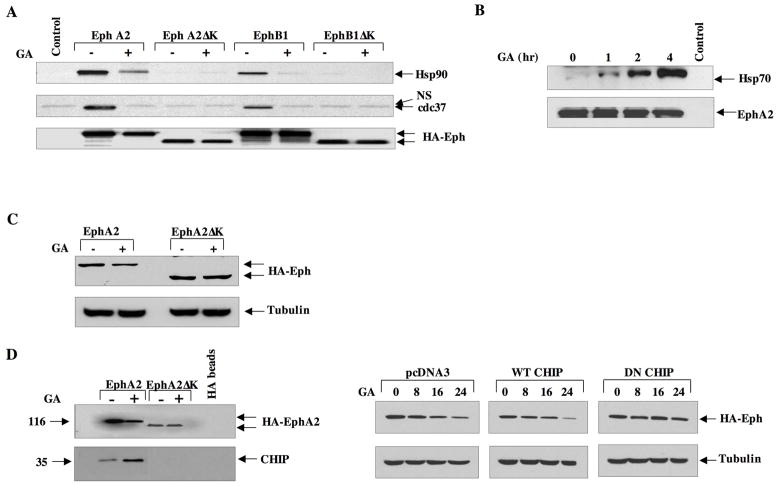
Fig 2. The kinase domain of EphA2 is required for chaperone recruitment and drug sensitivity
(A) HEK293 cells were cultured in 10 cm dishes and transfected with 5 ug of the indicated plasmids. Following lysis, 1 mg total lysate was immunoprecipitated with HA-conjugated protein G beads and the blots probed for the indicated proteins. (B) PC3 cells were treated with 1 μM GA for the indicated times, EphA2 was immunoprecipitated as in A, and resultant blots were incubated with antibodies to either Hsp70 or EphA2. C) HEK293 cells were transfected with either full length or kinase deleted HA-tagged EphA2, treated for 16 h with GA, and equivalent protein was immunoblotted with HA antibody. D) (Left panel) HEK293 cells were transfected as in C, treated with GA for 8 h, and 1 mg total protein was immunoprecipiated as in A. Resultant blots were probed for CHIP and EphA2 expression (anti-HA). (Right panel) HEK293 cells were transfected with either pcDNA3.1 control vector, wild type CHIP, or dominant negative CHIP, and EphA2 levels were immunodetected as indicated.
Fig 3
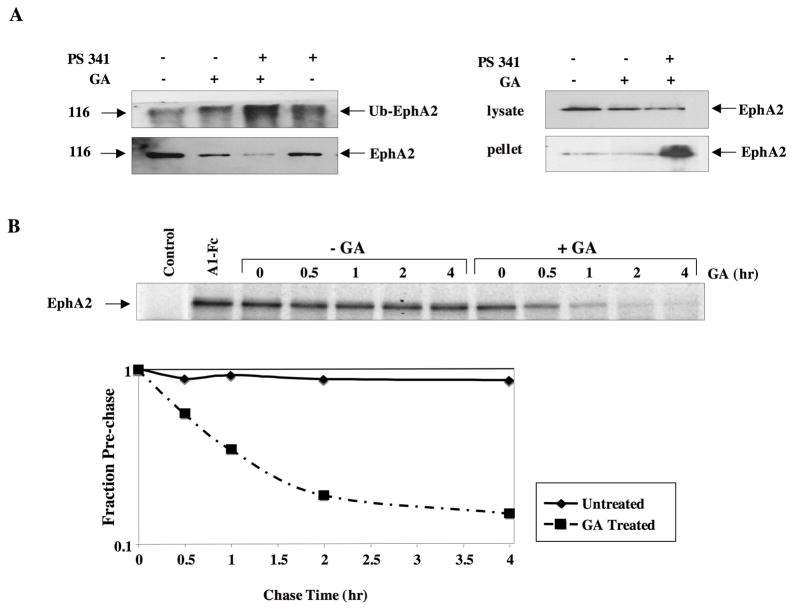
Fig 3. Hsp90 inhibition facilitates EphA2 ubiquitination and degradation
(A) (Left panel) HEK293 cells were transfected with 5 ug HA tagged EphA2 and treated for 6 h with 1 μM GA and/or 1 μM proteasomal inhibitor PS-341 for the last 3 h. Following lysis, 1 mg of total protein was immunoprecipitated with anti-HA antibody and ubiquitinylated protein was immunodetected. The blot was then stripped and reprobed with anti-HA antibody for analysis of total EphA2 levels. (Right panel) HEK293 cells were similarly transfected and treated with GA alone or with PS341 and EphA2 levels were dected from insoluble cell pellets following centrifugation, and from soluble protein lysate. B) Logarithmically growing PC3 cells were starved in methionine-free medium 1 h, pulse labeled for 1 h in the presence of 1 uM GA, and then chased for the indicated times in nonradioactive complete medium either lacking or containing 1 uM GA. Endogenous EphA2 was immunoprecipitated from equivalent protein and resultant gels were exposed to film and subject to densitometric analysis.
Fig 4
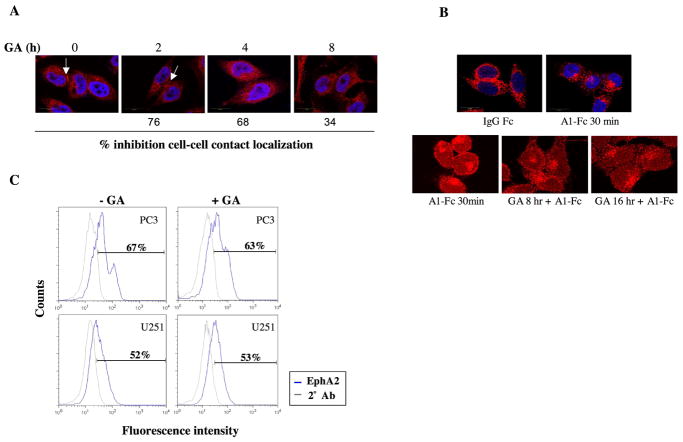
Fig 4. Hsp90 inhibition impairs EphA2 localization but not ligand binding and internalization
(A) PC3 cells were cultured on fibronectin and treated with GA for the indicated times. The cells were then fixed and prepared for EphA2 immunofluorescence staining. The numbers correspond to the percentage of cells exhibiting EphA2 localization at cell-cell contacts relative to untreated cells, as calculated from the average of 4 fields per coverslip, in duplicate. (B) PC3 cells were pretreated with GA for the indicated times and then stimulated by A1-Fc (1 ug/ml) 30 min prior to fixation. (C) PC3 and U251 cells were either untreated or treated for 8 h with 1 uM GA and subsequently processed for flow cytometry as described. Values represent percentage of cells expressing surface expression of EphA2. Representative data from duplicate experiments is shown.
Fig 5
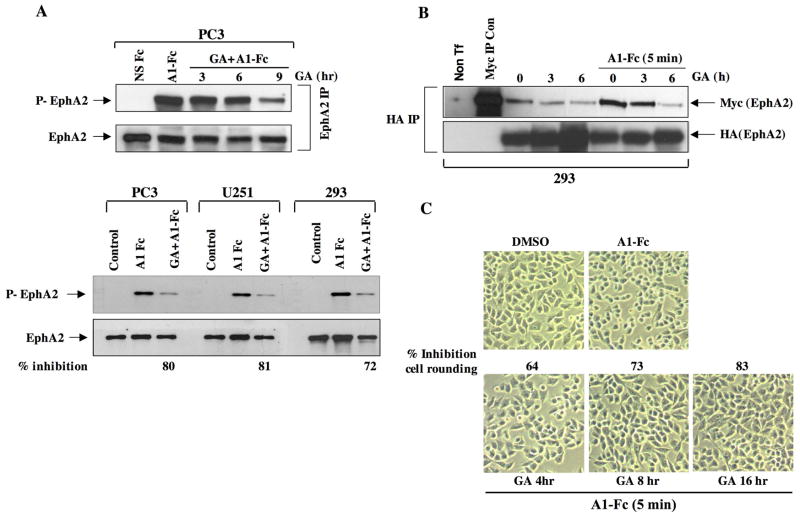
Fig 5. Hsp90 regulates EphA2 receptor dimerization and phosphorylation
(A) PC3 cells were treated with GA for the indicated times, EphA2 was immunoprecipitated from 1 mg cell lysate, and resultant blots were probed for phosphotyrosine and reprobed for EphA2 to assess total receptor levels. (B) HEK 293 cells were cotransfected with myc-EphA2 and HA-EphA2 plasmids, treated as indicated, and HA-EphA2 was immunoprecipitated from lysates. Receptor dimerization was determined by visualization of myc-EphA2 co-purifying with anti-HA immunoprecipitates. A control Myc IP was also performed from myc-EphA2 transfected cells to validate signal specificity. Total levels of immunoprecipitated EphA2 were detected by anti-HA immunoblotting. (C) To assess the effects of GA on receptor phosphorylation, the indicated cell lines were treated with GA for 9 h, EphA2 was immunoprecipitated from 500 ug cell lysate, and resultant blots were probed for phosphotyrosine. The percentage decrease in phosphorylation was calculated from the quantitation of receptor phosphorylation (ImageJ), normalized to total receptor levels. (D) To assess whether GA affects ligand-dependent cell rounding, cells were grown on fibronectin coated cover slips and treated with A1-Fc for 10 min in either the presence or absence of a pretreatment with GA. The cells were then fixed with paraformaldehyde and prepared for viewing. The percentage of rounded cells in response to ligand was determined from 4 fields, in duplicate, relative to the total number of cells per field, and normalized to the percentage of rounded cells in untreated samples.
Fig 6
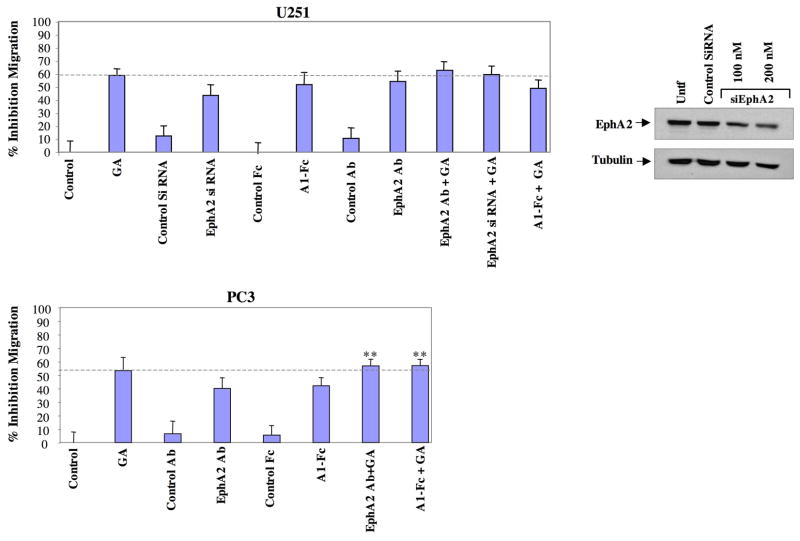
Fig 6. EphA2 impairment potently inhibits cell migration to an extent similar to GA
(Upper panel) U251 cells were pretreated with EphA2 antibody (10 ug/ml) or GA (1 uM) 8 h prior to plating in Boyden chambers (ligand was added at time of plating), and cells were transfected with siRNAs 48 h prior to plating. Following a 16 h incubation period, migrating cells were counted as described and normalized to the number of migrating cells from DMSO treated cells. Values corresponding to the normalized mean were converted to percent inhibition and subjected to statistical analysis. Representative siRNA-mediated knockdown of EphA2 is shown. PC3 cells (lower panel) were treated as above and the percent migration was similarly calculated.

References

    1. Zijlstra A, Lewis J, Degryse B, Stuhlmann H, Quigley JP. The inhibition of tumor cell intravasation and subsequent metastasis via regulation of in vivo tumor cell motility by the tetraspanin CD151. Cancer Cell. 2008;13:221–234. - PMC - PubMed
    1. Lauffenburger DA, Horwitz AF. Cell migration: a physically integrated molecular process. Cell. 1996;84:359–369. - PubMed
    1. Pasquale EB. Eph-ephrin bidirectional signaling in physiology and disease. Cell. 2008;133:38–52. - PubMed
    1. Pasquale EB. Eph receptor signalling casts a wide net on cell behaviour. Nat Rev Mol Cell Biol. 2005;6:462–475. - PubMed
    1. Gale NW, Holland SJ, Valenzuela DM, Flenniken A, Pan L, Ryan TE, et al. Eph receptors and ligands comprise two major specificity subclasses and are reciprocally compartmentalized during embryogenesis. Neuron. 1996;17:9–19. - PubMed

Publication types