


GNRH1 mutations in patients with idiopathic hypogonadotropic hypogonadism
- PMID: 19567835
- PMCID: PMC2710623
- DOI: 10.1073/pnas.0903449106
GNRH1 mutations in patients with idiopathic hypogonadotropic hypogonadism
Abstract
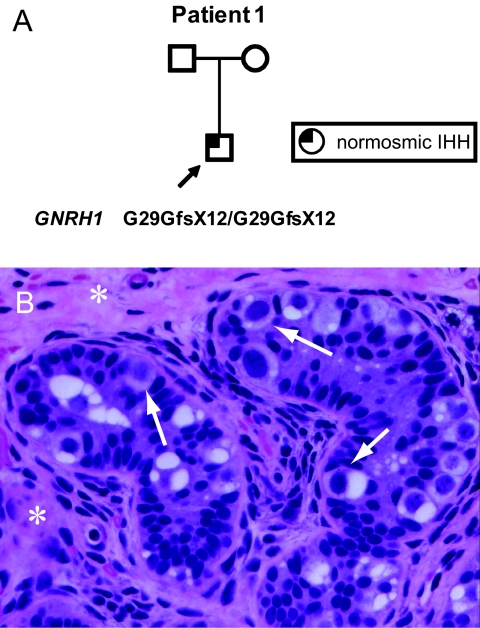
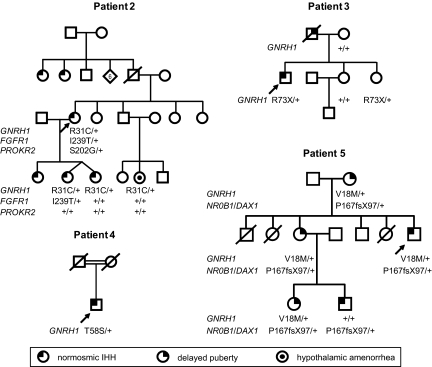
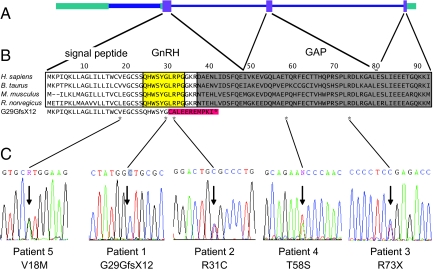
Idiopathic hypogonadotropic hypogonadism (IHH) is a condition characterized by failure to undergo puberty in the setting of low sex steroids and low gonadotropins. IHH is due to abnormal secretion or action of the master reproductive hormone gonadotropin-releasing hormone (GnRH). Several genes have been found to be mutated in patients with IHH, yet to date no mutations have been identified in the most obvious candidate gene, GNRH1 itself, which encodes the preprohormone that is ultimately processed to produce GnRH. We screened DNA from 310 patients with normosmic IHH (nIHH) and 192 healthy control subjects for sequence changes in GNRH1. In 1 patient with severe congenital nIHH (with micropenis, bilateral cryptorchidism, and absent puberty), a homozygous frameshift mutation that is predicted to disrupt the 3 C-terminal amino acids of the GnRH decapeptide and to produce a premature stop codon was identified. Heterozygous variants not seen in controls were identified in 4 patients with nIHH: 1 nonsynonymous missense mutation in the eighth amino acid of the GnRH decapeptide, 1 nonsense mutation that causes premature termination within the GnRH-associated peptide (GAP), which lies C-terminal to the GnRH decapeptide within the GnRH precursor, and 2 sequence variants that cause nonsynonymous amino-acid substitutions in the signal peptide and in GnRH-associated peptide. Our results establish mutations in GNRH1 as a genetic cause of nIHH.
Conflict of interest statement
The authors declare no conflict of interest.
Figures
References
-
- Gore AC. GnRH: The Master Molecule of Reproduction. Boston: Kluwer Academic Publishers; 2002.
-
- Crowe S, Cushing H, Homans J. Experimental hypophysectomy. Bull Johns Hopkins Hospital. 1910;21:127–167.
-
- Harris GW. The induction of ovulation in the rabbit by electrical stimulation of the hypothalamo-hypophysial mechanism. Proc R Soc Lond B Biol Sci. 1937;122:374–394.
-
- Hinsey JC. The relation of the nervous system to ovulation and other phenomena of the female reproductive tract. Cold Spring Harbor Symp Quant Biol. 1937;5:269–279.
-
- Brooks CM. A study of the mechanism whereby coitus excites the ovulation-producing activity of the rabbit's pituitary. Am J Physiol. 1938;121:157–177.
Publication types
MeSH terms
Substances
Grants and funding
LinkOut - more resources
Full Text Sources
Medical
Molecular Biology Databases
Miscellaneous
