


Cancer prevalence in the United Kingdom: estimates for 2008
- PMID: 19568236
- PMCID: PMC2720244
- DOI: 10.1038/sj.bjc.6605148
Cancer prevalence in the United Kingdom: estimates for 2008
Abstract
Background: Identifying and addressing the requirements of cancer survivors is currently a high priority for the NHS, yet little is known about the population of cancer survivors in the United Kingdom.
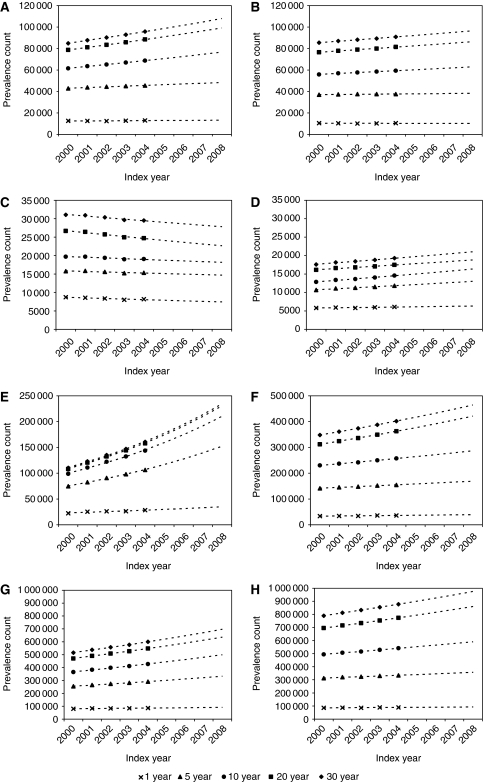
Methods: Data from cancer registries in England, Northern Ireland, Scotland and Wales were analysed to provide limited-duration prevalence estimates for 2004. Log-linear regression models were used to extend these to complete prevalence estimates. Trends in prevalence from 2000 to 2004 were used to project complete prevalence estimates forward from 2004 to 2008.
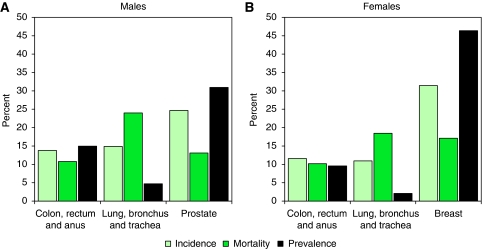
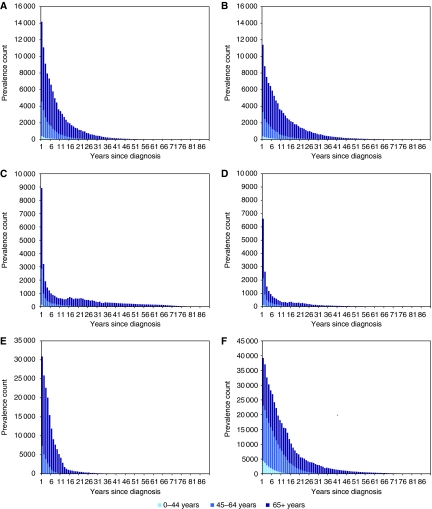
Results: We estimated that in total, there were 2 million cancer survivors in the United Kingdom at the end of 2008, approximately 3% of the population overall and 1 in 8 of those aged 65 years and more. Prostate and female breast cancers were the most prevalent. The number of cancer survivors is increasing by approximately 3% each year. Estimates are also provided by time since diagnosis.
Conclusion: These estimates are the most up-to-date available, and as such will be useful for statutory and voluntary sector organisations that are responsible for planning and providing treatment and support to cancer survivors in the United Kingdom.
Figures
References
-
- Brown ML, Riley GF, Potosky AL, Etzioni RD (1999) Obtaining long-term disease specific costs of care: application to Medicare enrollees diagnosed with colorectal cancer. Med Care 37: 1249–1259 - PubMed
-
- Cancer Research UK (2007) Trends in cancer survival rates. http://info.cancerresearchuk.org/cancerstats/survival/fiveyear/
-
- Cancer Research UK (2008) CancerStats: Key Facts http://publications.cancerresearchuk.org/WebRoot/crukstoredb/CRUK_PDFs/A... (Accessed 17 June 2009)
-
- Capocaccia R, De Angelis R (1997) Estimating the completeness of prevalence based on cancer registry data. Stat Med 16: 425–440 - PubMed
-
- Capocaccia R, Gatta G, Chessa E, Valente F (1999) The EUROCARE-2 study. IARC Sci Publ 151: 1–40
Publication types
MeSH terms
Grants and funding
LinkOut - more resources
Full Text Sources
