. 2009 Jul 1;4(7):e6121.
doi: 10.1371/journal.pone.0006121.

Evidence for X-chromosomal schizophrenia associated with microRNA alterations

Affiliations

Evidence for X-chromosomal schizophrenia associated with microRNA alterations

Jinong Feng et al. PLoS One. .

Abstract

Background: Schizophrenia is a severe disabling brain disease affecting about 1% of the population. Individual microRNAs (miRNAs) affect moderate downregulation of gene expression. In addition, components required for miRNA processing and/or function have also been implicated in X-linked mental retardation, neurological and neoplastic diseases, pointing to the wide ranging involvement of miRNAs in disease.

Methods and findings: To explore the role of miRNAs in schizophrenia, 59 microRNA genes on the X-chromosome were amplified and sequenced in males with (193) and without (191) schizophrenia spectrum disorders to test the hypothesis that ultra-rare mutations in microRNA collectively contribute to the risk of schizophrenia. Here we provide the first association of microRNA gene dysfunction with schizophrenia. Eight ultra-rare variants in the precursor or mature miRNA were identified in eight distinct miRNA genes in 4% of analyzed males with schizophrenia. One ultra-rare variant was identified in a control sample (with a history of depression) (8/193 versus 1/191, p = 0.02 by one-sided Fisher's exact test, odds ratio = 8.2). These variants were not found in an additional 7,197 control X-chromosomes.

Conclusions: Functional analyses of ectopically expressed copies of the variant miRNA precursors demonstrate loss of function, gain of function or altered expression levels. While confirmation is required, this study suggests that microRNA mutations can contribute to schizophrenia.


Conflict of interest statement

Competing Interests: Steve S. Sommer, MD, PhD is currently the Chairman and Founder of MEDomics. However, all the laboratory work was carried out when he was Chair of the Department of Molecular Genetics at City of Hope, Duarte, CA. None of the funding came from MEDomics, nor did any of the data collection and analysis, decision to publish, or the original preparation of the manuscript. Some of the revision leading to the second submission of this manuscript was performed while CB and SS were at MEDomics.

Figures

Figure 1
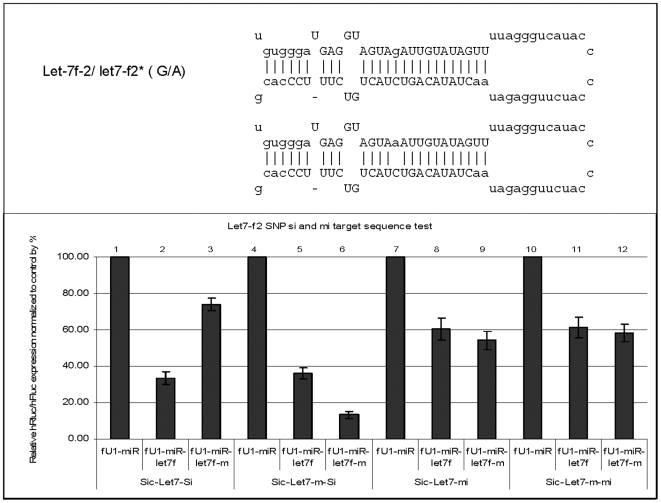
Figure 1. Function test of let-7f-2-G/A.
A single base substitution G>A was identified in the mature miRNA of let-7f-2 at position 11. To examine the possible functional consequences of this mutation, the wild type and mutant variants were tested against its corresponding ‘si’ and ‘mi’ target sequence. The results obtained with these analyses demonstrate that the mutant sequence can downregulate its own fully complementary ‘si’ sequence (bar #6), but its knockdown of the let-7f ‘si’ sequence was dramatically reduced (bar #3). On the other hand, the let-7f knockdown of the mutant ‘si-target’ remained unperturbed (bar #5). These results demonstrate that the mutant produces a stronger siRNA phenotype than the wild type miRNA with the cognate complementary targets. On the other hand, the variant elicits a weaker miRNA phenotype than the wild type. Sic-[target]-Si and Sic-[target]-Mi: Dual reporters containing the miRNA target sequences (Si, fully complementary; Mi, partially complementary) in the 3′UTR of the Renilla luciferase gene (for details, see Materials and Methods). fU1-miR-[miRNA] and fU1-miR-[miRNA]-m: miRNA expression vectors containing the primary sequence of a specific miRNA gene (wild type and mutant, respectively) (for details, see Materials and Methods). fU1-miR: Expression vector alone without the miRNA gene inserted.
Figure 2
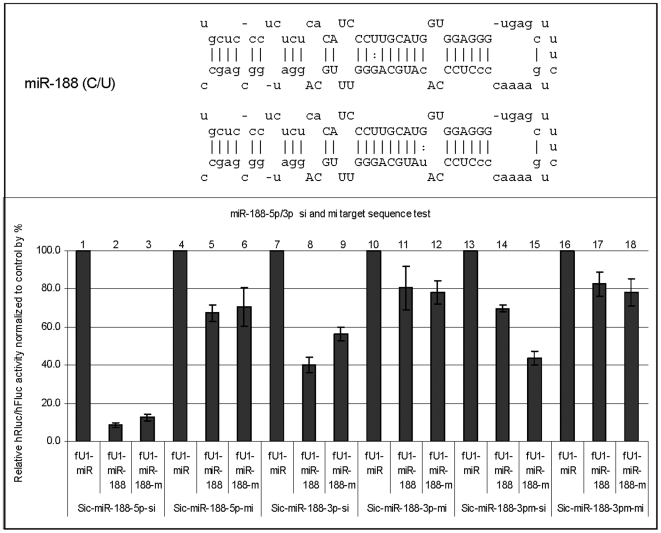
Figure 2. Function test of miR-188-5p/3p.
Variant miR-188-5p/3p-m has a ‘C’ to ‘T’ (U) transition at the 7th nt of the mature miR-188-3p within the seed sequence. This variant results in a change of G∶C to G∶U pairing in the seed sequence. In our assay system, the effect of the variant is not dramatic. Nevertheless, this variant will create a seed sequence where this position can pair with an A, thus potentially affecting the expression of new target sequences with a matched seed sequence. Sic-[target]-Si and Sic-[target]-Mi: Dual reporters containing the miRNA target sequences (Si, fully complementary; Mi, partially complementary) in the 3′UTR of the Renilla luciferase gene (for details, see Materials and Methods). fU1-miR-[miRNA] and fU1-miR-[miRNA]-m: miRNA expression vectors containing the primary sequence of a specific miRNA gene (wild type and mutant, respectively) (for details, see Materials and Methods). fU1-miR: Expression vector alone without the miRNA gene inserted.
Figure 3
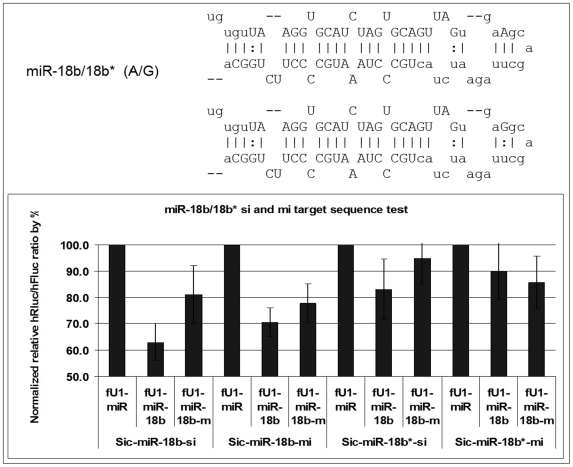
Figure 3. Function test of miR-18b-A/G.
Variant miR-18b/18b*-m has an ‘A’ to ‘G’ mutation at the 4th nt following the last base of the mature sequence, which is also in the predicted terminal loop structure. This sequence difference may affect processing and/or stability as there is a reduction in the level of target knockdown activity when compared to wild type in the ‘si-target’ (bar #2 vs #3) and the ‘mi-target’ assays (bar #5 vs #6). In contrast, the function of the miR-18* strand does not appear to be affected by this mutation (bar#8 vs 9 and Bar #11 vs 12). Sic-[target]-Si and Sic-[target]-Mi: Dual reporters containing the miRNA target sequences (Si, fully complementary; Mi, partially complementary) in the 3′UTR of the Renilla luciferase gene (for details, see Materials and Methods). fU1-miR-[miRNA] and fU1-miR-[miRNA]-m: miRNA expression vectors containing the primary sequence of a specific miRNA gene (wild type and mutant, respectively) (for details, see Materials and Methods). fU1-miR: Expression vector alone without the miRNA gene inserted.
Figure 4
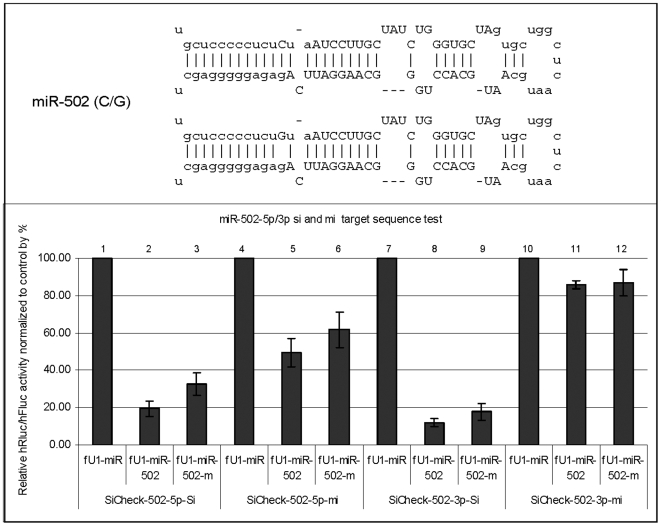
Figure 4. Function test of miR-502-C/G.
Variant miR-502-5p/3p-m has a ‘C’ to ‘G’ transversion at the 3rd nt upstream of the mature miR-502-5p sequence. This mutation will produce a bulge which changes the structure of the stem of the precursor miRNA. Most likely, this structural change will affect the site of Drosha cleavage in producing pre-miR-502; therefore, both the 5p and 3p products should be affected. Reduced target knockdowns were observed in transfection assays (bar #2 vs 3, # 5 vs 6 and # 8 vs 9). Sic-[target]-Si and Sic-[target]-Mi: Dual reporters containing the miRNA target sequences (Si, fully complementary; Mi, partially complementary) in the 3′UTR of the Renilla luciferase gene (for details, see Materials and Methods). fU1-miR-[miRNA] and fU1-miR-[miRNA]-m: miRNA expression vectors containing the primary sequence of a specific miRNA gene (wild type and mutant, respectively) (for details, see Materials and Methods). fU1-miR: Expression vector alone without the miRNA gene inserted.
Figure 5
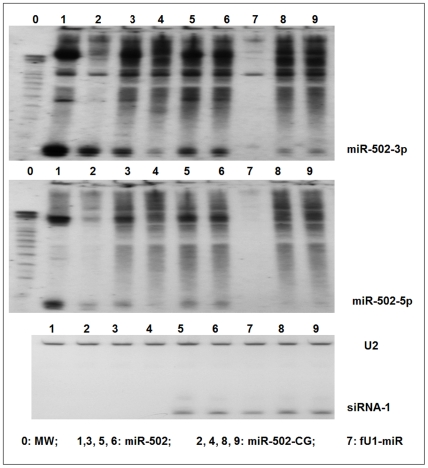
Figure 5. Northern blot results of miR-502-C/G.
The impaired functional activity of the variant miR-502-C/G was supported by Northern blot analyses, as the production of pre-miR-502 and mature 502-5p/3p were both reduced. Top is the result of the blot that was hybridized with miR-502 3p probe; middle is the result of the blot that was hybridized with the 5p probe; bottom is the result of the blot that was hybridized with U2 snoRNA probe and spike-in siRNA probe. U2 was used as RNA sample loading control. SiRNA-1 that targets HIV Tat/Rev was used as a transfection control. Lanes 1, 3, 5, and 6 are miR-502; Lanes 2, 4, 8, and 9 are transfected with the variant. Lane 7 is the expression vector alone: fU1-miR.

References

    1. Jablensky A. Epidemiology of schizophrenia: the global burden of disease and disability. Eur Arch Psychiatry Clin Neurosci. 2000;250:274–285. - PubMed
    1. Ambros V. MicroRNA pathways in flies and worms: growth, death, fat, stress, and timing. Cell. 2003;113:673–676. - PubMed
    1. Bartel DP. MicroRNAs: genomics, biogenesis, mechanism, and function. Cell. 2004;116:281–297. - PubMed
    1. Lai EC. Micro RNAs are complementary to 3′ UTR sequence motifs that mediate negative post-transcriptional regulation. Nat Genet. 2002;30:363–364. - PubMed
    1. Filipowicz W, Bhattacharyya SN, Sonenberg N. Mechanisms of post-transcriptional regulation by microRNAs: are the answers in sight? Nat Rev Genet. 2008;9:102–114. - PubMed

Publication types