


Head and neck cancer in Germany: a site-specific analysis of survival of the Thuringian cancer registration database
- PMID: 19568769
- PMCID: PMC11828329
- DOI: 10.1007/s00432-009-0636-y
Head and neck cancer in Germany: a site-specific analysis of survival of the Thuringian cancer registration database
Abstract
Objective: To describe epidemiology and prognosis of head and neck cancer in Germany.
Methods: We analyzed the Thuringian cancer registry database from 1996 to 2005. 3,821 cases with primary head and neck cancer were evaluated for patient's characteristics, tumor stage, incidence, treatment, and trends in overall survival.
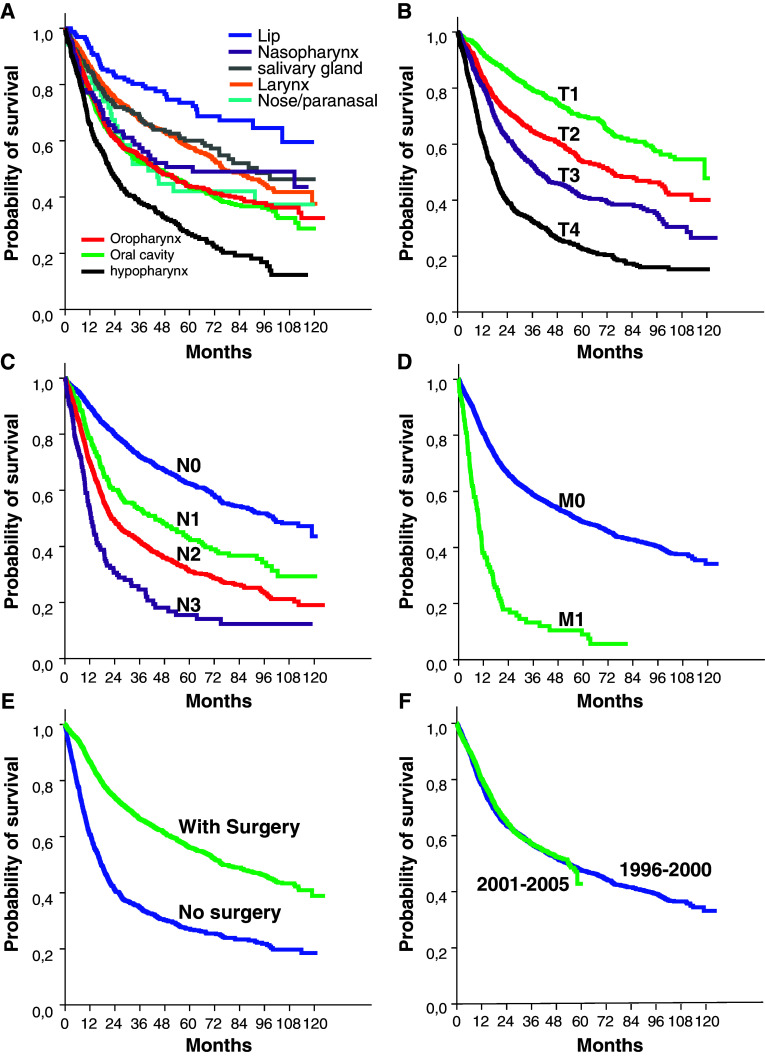
Results: During the period 1996-2005, the incidence of oropharynx, hypopharynx, larynx, and salivary gland cancer increased significantly for males, and of oral cavity and hypopharynx cancer for females. There was a significant trend using more multimodal therapy combining surgery, radiotherapy, and chemotherapy, and to use less radiotherapy as a single modality. The median follow-up time of patients alive was 42 months. The 5-year overall survival rate (OS) for all patients was 47.8%. The site-specific 5-year OS for lip, oral cavity, nasopharynx, oropharynx, hypopharynx, larynx, salivary gland, and nose/paranasal sinus cancer was 75.7, 42.6, 43.5, 45.9, 27.2, 57.3, 61.0, and 34.9%, respectively. The multivariate analysis showed that male gender, age ≥ 60 years, therapy without surgery, higher T classification, N classification, and M classification were independent significant negative risk factors for OS (p < 0.0001). Cancer of the oral cavity and of the hypopharynx had a significant lower OS than lip cancer (p = 0.012 and p = 0.044, respectively). Comparing the periods 1996-2000 with the period 2001-2005, there was no significant improvement of OS for any subsite.
Conclusions: Many subsites of head and neck cancer have changing incidence. Although treatment strategies have changed, outcome has not improved significantly from 1995 to 2006.
Figures
References
-
- AJCC (2002) Cancer staging manual, 6th edn. Springer, Berlin
-
- Bernier J, Cooper J, Pajak T et al (2005) Defining risk levels in locally advanced head and neck cancers: a comparative analysis of concurrent postoperative radiation plus chemotherapy trials of the EORTC (#22931) and RTOG (#9501). Head Neck 27:843–850 - PubMed
-
- Carvalho A, Nishimoto I, Califano J et al (2005) Trends in incidence and prognosis for head and neck cancer in the United States: a site-specific analysis of the SEER database. Int J Cancer 114:806–816 - PubMed
-
- Davies L, Welch Hg (2006) Epidemiology of head and neck cancer in the United States. Otolaryngol Head Neck Surg 135:451–457 - PubMed
-
- Ettrich K, Fischer-Cyrulies A (2005) Substance abuse in middle and old age-everyday drug alcohol and nicotine: use and abuse. Z Gerontol Geriatr 38:47–59 - PubMed
MeSH terms
LinkOut - more resources
Full Text Sources
Medical
