. 2010 Jan;51(1):140-9.
doi: 10.1194/jlr.M900273-JLR200.

A new method for measurement of total plasma PCSK9: clinical applications

Affiliations

A new method for measurement of total plasma PCSK9: clinical applications

Geneviève Dubuc et al. J Lipid Res. 2010 Jan.

Abstract

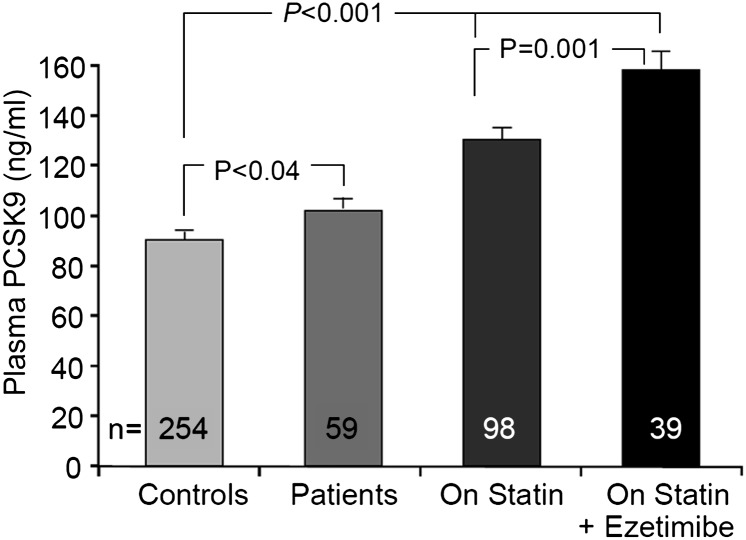
The proprotein convertase subtilisin kexin-9 (PCSK9) circulates in plasma as mature and furin-cleaved forms. A polyclonal antibody against human PCSK9 was used to develop an ELISA that measures total plasma PCSK9 rather than only the mature form. A cross-sectional study evaluated plasma levels in normal (n = 254) and hypercholesterolemic (n = 200) subjects treated or untreated with statins or statin plus ezetimibe. In controls, mean plasma PCSK9 (89.5 +/- 31.9 ng/ml) correlated positively with age, total cholesterol, LDL-cholesterol (LDL-C), triglycerides, and fasting glucose. Sequencing PCSK9 from individuals at the extremes of the normal PCSK9 distribution identified a new loss-of-function R434W variant associated with lower levels of circulating PCSK9 and LDL-C. In hypercholesterolemic subjects, PCSK9 levels were higher than in controls (99.3 +/- 31.7 ng/ml, P < 0.04) and increased in proportion to the statin dose, combined or not with ezetimibe. In treated patients (n = 139), those with familial hypercholesterolemia (FH; due to LDL receptor gene mutations) had higher PCSK9 values than non-FH (147.01 +/- 42.5 vs. 127.2 +/- 40.8 ng/ml, P < 0.005), but LDL-C reduction correlated positively with achieved plasma PCSK9 levels to a similar extent in both subsets (r = 0.316, P < 0.02 in FH and r = 0.275, P < 0.009 in non-FH). The detection of circulating PCSK9 in both FH and non-FH subjects means that this assay could be used to monitor response to therapy in a wide range of patients.


Figures
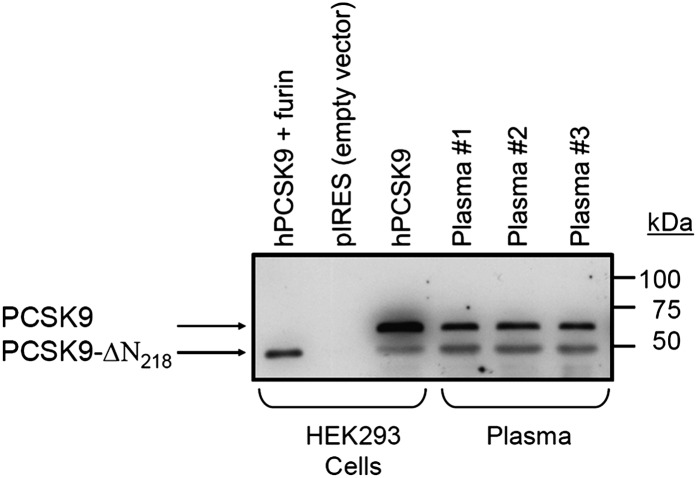
Fig. 1.
Fig. 1.
Specificity of hPCSK9-Ab for native PCSK9 in culture medium and plasma. Immunoprecipitation was carried out with polyclonal hPCSK9-Ab against culture media of HEK293 cells respectively transfected with vector alone (pIRES), PCSK9, PCSK9 and furin, and against plasma from three different individuals. Immunoprecipitates were separated by a 4–20% polyacrylamide gradient SDS-PAGE, transferred to a polyvinylidene difluoride membrane, and revealed with hPCSK9-Ab-HRP. PCSK9-ΔN218 represents PCSK9 cleaved by furin (17).
Fig. 2.
Fig. 2.
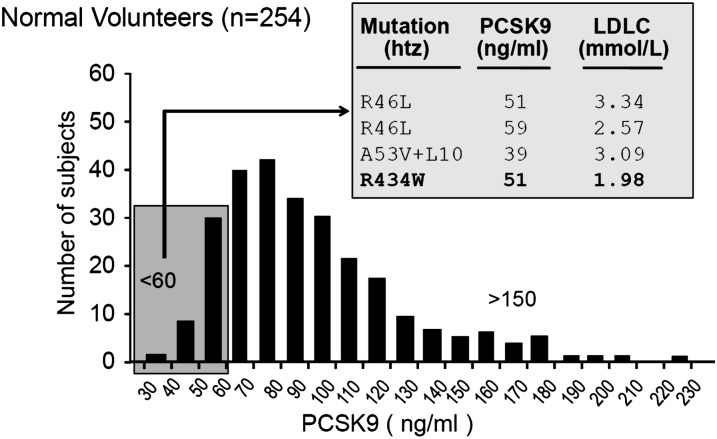
Sequencing PCSK9 in individuals from extremes of distribution of plasma levels revealed a novel R434W mutation. The cohort consisted of 117 males and 137 females ranging from 20 to 77 years of age. Plasma was diluted 1:20 and PCSK9 measured by sandwich ELISA as described. DNA from subjects exhibiting low (<60 ng/ml) and high (>150 ng/ml) PCSK9 plasma levels was subjected to exon sequencing. The new mutation R434W is emphasized in bold.
Fig. 3.
Fig. 3.
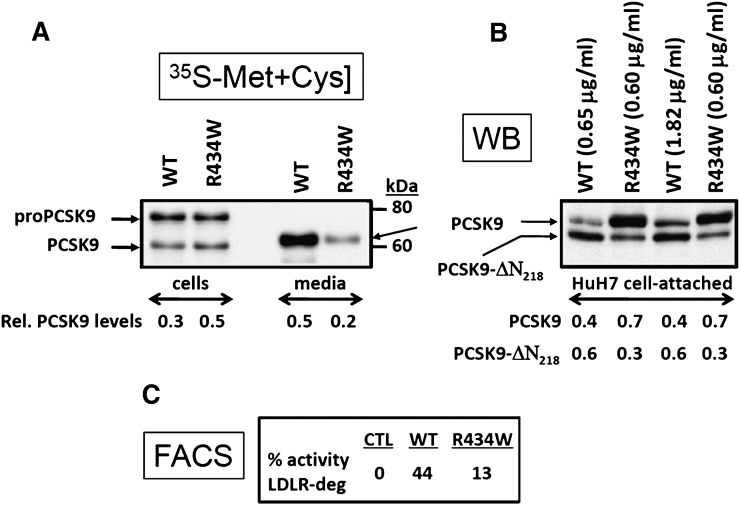
Functional analysis of the PCSK9-R434W variant. (A) HEK293 cells transiently transfected with cDNAs coding for either the V5-tagged PCSK9 (WT) or its R434W variant were pulse labeled with 35S-[Met+Cys] for 4 h and the cell extract and media immunoprecipitated with a V5-mAb and the precipitate separated by 8% SDS-PAGE in 3% Tricine. Autoradiography allowed the identification of the various forms of PCSK9 and image analysis allowed the quantification of the relative amounts of mature PCSK9 in cells and media versus the total levels (17). (B) Spent media from HEK293 cells containing either 0.65 or 1.82 µg/ml of PCSK9 or 0.6 µg/ml of PCSK9-R434W were incubated overnight with naïve HuH7 cells. Following washes, the cells were then detached by EDTA and analyzed by Western blot (WB) using the V5-mAb. Notice that the R434W variant is somewhat resistant to furin cleavage, as evidenced by the lower levels of the PCSK9-ΔN218 form. The relative quantitation of the two forms is presented at the bottom of Figure 3B. (C) The detached HuH7 cells were also analyzed by FACS using a C-7 mAb directed against the LDLR. The levels of the remaining cell-surface LDLR are then expressed as compared with cells incubated with media of HEK293 cells transfected with an empty vector.
Fig. 4.
Fig. 4.
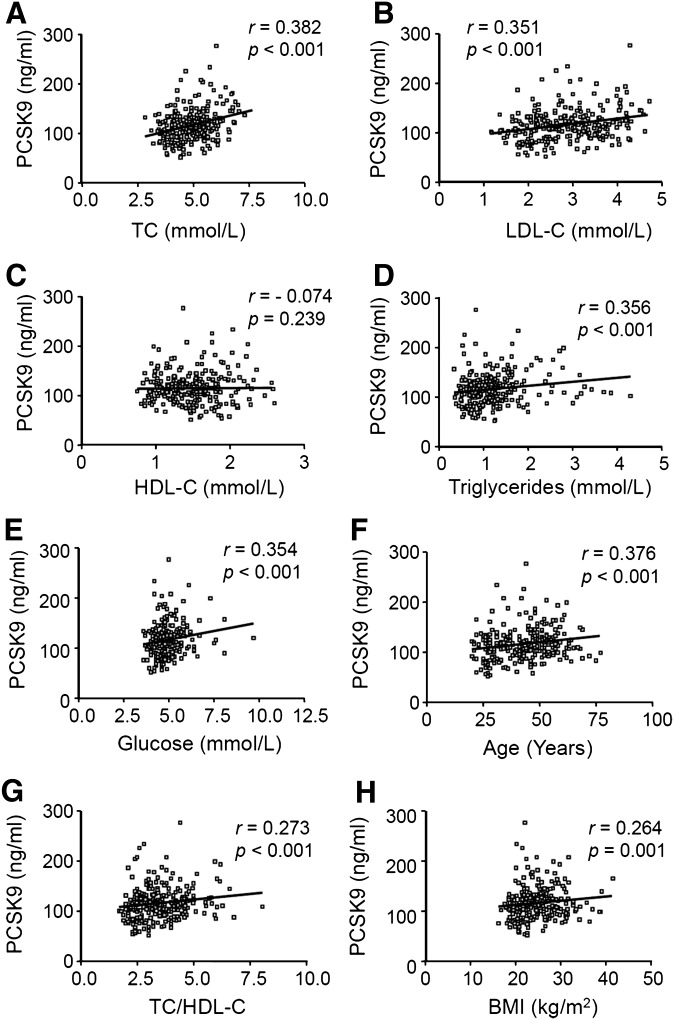
Relationship between plasma PCSK9 and (A) TC, (B) LDL-C, (C) HDL-C, (D) TG, (E) fasting glucose, (F) age, (G) TC/HDL-C ratio and (H) BMI. r and P were determined using GraphPad Prism software.
Fig. 5.
Fig. 5.
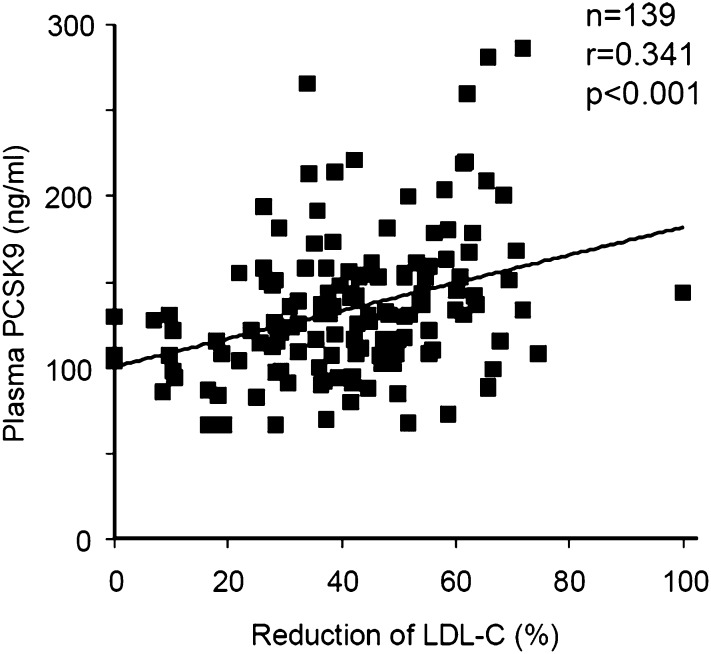
Statins and ezetimibe are associated with high levels of human plasma PCSK9 as a function of LDL-C reduction. Plasma PCSK9 levels of 139 hypercholesterolemic subjects were measured by ELISA as described. Hypercholesterolemic patients were being treated with one of the following: statins, ezetimibe, or a combination of both. The percent reduction in LDL-C was then plotted against PCSK9 levels (ng/ml). r and P were determined with GraphPad Prism software.
Fig. 6.
Fig. 6.
Relationship of hypercholesterolemia, statins, and statin-ezetimibe combination with plasma PCSK9. Mean ± SEM. Significance was determined by Student's t-test.

References

    1. Goldstein J. L., Hobbs H. H., Brown M. S. Familial hypercholesterolemia. 2001. The metabolic and molecular bases of inherited disease. Valle D., Scriver C. R., Beaudet A. L., Sly W. S., Childs B., Volgestein B., editors. Chapter 120, 8th edition McGraw Hill, New York: 2863–2913.
    1. Innerarity T. L., Weisgraber K. H., Arnold K. S., Mahley R. W., Krauss R. M., Vega G. L., Grundy S. M. 1987. Familial defective apolipoprotein B-100: low density lipoproteins with abnormal receptor binding. Proc. Natl. Acad. Sci. USA. 84: 6919–6923. - PMC - PubMed
    1. Abifadel M., Varret M., Rabes J. P., Allard D., Ouguerram K., Devillers M., Cruaud C., Benjannet S., Wickham L., Erlich D., et al. 2003. Mutations in PCSK9 cause autosomal dominant hypercholesterolemia. Nat. Genet. 34: 154–156. - PubMed
    1. Seidah N. G., Benjannet S., Wickham L., Marcinkiewicz J., Jasmin S. B., Stifani S., Basak A., Prat A., Chretien M. 2003. The secretory proprotein convertase neural apoptosis-regulated convertase 1 (NARC-1): liver regeneration and neuronal differentiation. Proc. Natl. Acad. Sci. USA. 100: 928–933. - PMC - PubMed
    1. Seidah N. G., Prat A. 2007. The proprotein convertases are potential targets in the treatment of dyslipidemia. J. Mol. Med. 85: 685–696. - PubMed

Publication types

MeSH terms