


Mental rotation of faces in healthy aging and Alzheimer's disease
- PMID: 19572013
- PMCID: PMC2700266
- DOI: 10.1371/journal.pone.0006120
Mental rotation of faces in healthy aging and Alzheimer's disease
Abstract
Background: Previous research has shown that individuals with Alzheimer's disease (AD) develop visuospatial difficulties that affect their ability to mentally rotate objects. Surprisingly, the existing literature has generally ignored the impact of this mental rotation deficit on the ability of AD patients to recognize faces from different angles. Instead, the devastating loss of the ability to recognize friends and family members in AD has primarily been attributed to memory loss and agnosia in later stages of the disorder. The impact of AD on areas of the brain important for mental rotation should not be overlooked by face processing investigations -- even in early stages of the disorder.
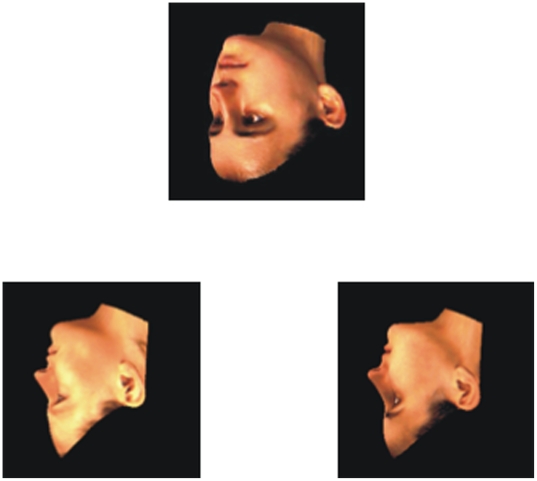
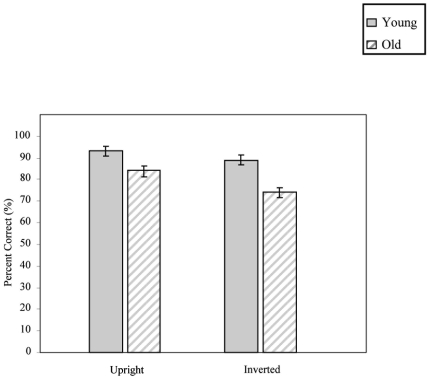
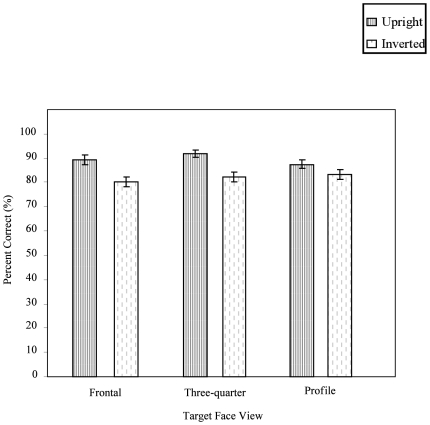
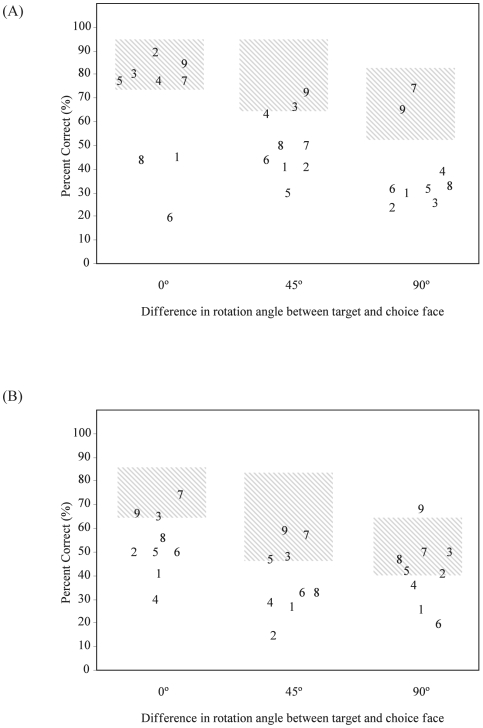
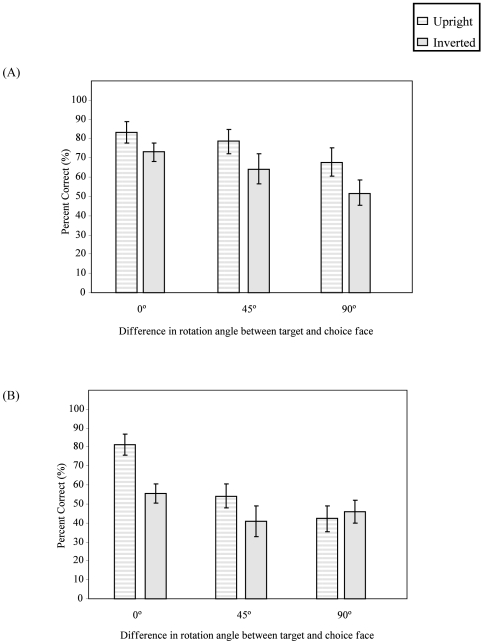
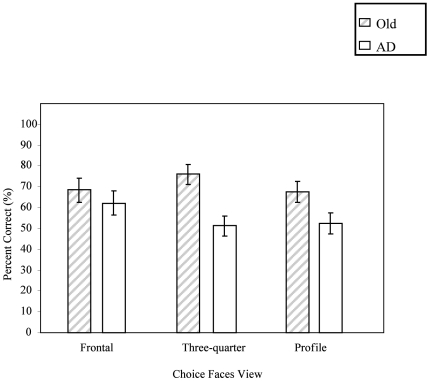
Methodology/principal findings: This study investigated the sensitivity of face processing in AD, young controls and older non-neurological controls to two changes of the stimuli -- a rotation in depth and an inversion. The control groups showed a systematic effect of depth rotation, with errors increasing with the angle of rotation, and with inversion. The majority of the AD group was not impaired when faces were presented upright and no transformation in depth was required, and were most accurate when all faces were presented in frontal views, but accuracy was severely impaired with any rotation or inversion.
Conclusions/significance: These results suggest that with the onset of AD, mental rotation difficulties arise that affect the ability to recognize faces presented at different angles. The finding that a frontal view is "preferred" by these patients provides a valuable communication strategy for health care workers.
Conflict of interest statement
Figures
References
-
- Shepard RN, Metzler J. Mental rotation of three-dimensional objects. Science. 1971;171:701–703. - PubMed
-
- Tarr M, Pinker S. Mental rotation and orientation dependence in shape recognition. Cognitive Psychology. 1989;21:233–282. - PubMed
-
- Bruce V, Humphreys GW. Recognizing objects and faces. Visual Cognition. 1994;1:141–180.
-
- Troje NF, Kersten D. Viewpoint-dependent recognition of familiar faces. Perception. 1999;28:483–487. - PubMed
Publication types
MeSH terms
LinkOut - more resources
Full Text Sources
Medical
