


Intervention mapping for development of a participatory return-to-work intervention for temporary agency workers and unemployed workers sick-listed due to musculoskeletal disorders
- PMID: 19573229
- PMCID: PMC2718881
- DOI: 10.1186/1471-2458-9-216
Intervention mapping for development of a participatory return-to-work intervention for temporary agency workers and unemployed workers sick-listed due to musculoskeletal disorders
Abstract
Background: In the past decade in activities aiming at return-to-work (RTW), there has been a growing awareness to change the focus from sickness and work disability to recovery and work ability. To date, this process in occupational health care (OHC) has mainly been directed towards employees. However, within the working population there are two vulnerable groups: temporary agency workers and unemployed workers, since they have no workplace/employer to return to, when sick-listed. For this group there is a need for tailored RTW strategies and interventions. Therefore, this paper aims to describe the structured and stepwise process of development, implementation and evaluation of a theory- and practise-based participatory RTW program for temporary agency workers and unemployed workers, sick-listed due to musculoskeletal disorders (MSD). This program is based on the already developed and cost-effective RTW program for employees, sick-listed due to low back pain.
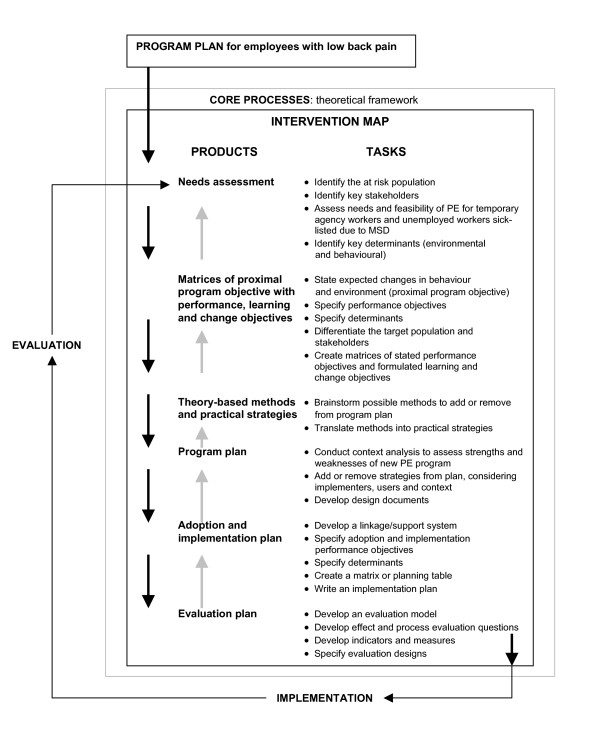
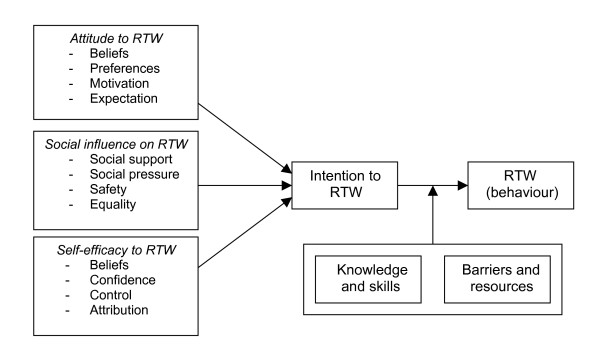
Methods: The Intervention Mapping (IM) protocol was used to develop a tailor-made RTW program for temporary agency workers and unemployed workers, sick-listed due to MSD. The Attitude-Social influence-self-Efficacy (ASE) model was used as a theoretical framework for determinants of behaviour regarding RTW of the sick-listed worker and development of the intervention. To ensure participation and facilitate successful adoption and implementation, important stakeholders were involved in all steps of program development and implementation. Results of semi-structured interviews and 'fine-tuning' meetings were used to design the final participatory RTW program.
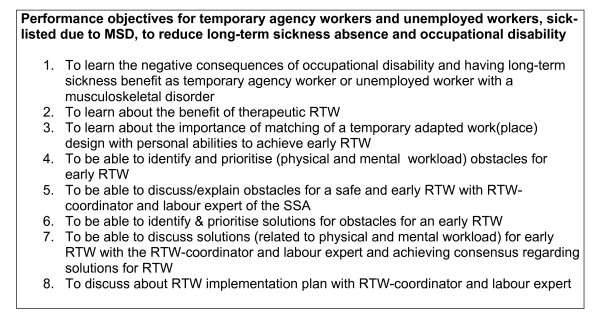
Results: A structured stepwise RTW program was developed, aimed at making a consensus-based RTW implementation plan. The new program starts with identifying obstacles for RTW, followed by a brainstorm session in which the sick-listed worker and the labour expert of the Social Security Agency (SSA) formulate solutions/possibilities for suitable (therapeutic) work. This process is guided by an independent RTW coordinator to achieve consensus. Based on the resulting RTW implementation plan, to create an actual RTW perspective, a vocational rehabilitation agency is assigned to find a matching (therapeutic) workplace. The cost-effectiveness of this participatory RTW program will be evaluated in a randomised controlled trial.
Conclusion: IM is a promising tool for the development of tailor-made OHC interventions for the vulnerable working population.
Figures
References
-
- Inspectie voor Werk en Inkomen [Inspection for Work and Income] Vangnet of springplank? De reïntegratie van zieke werknemers zonder dienstverband door UWV [Safety net or stepping stone? Vocational rehabilitation of sick-listed workers without an employment contract by the Social Security Agency] Den Haag: IWI; 2005.
-
- Lambeek LC, Anema JR, van Royen BJ, Buijs PC, Wuisman PI, van Tulder MW, van Mechelen W. Multidisciplinary outpatient care program for patients with chronic low back pain: design of a randomized controlled trial and cost-effectiveness study. BMC Public Health. 2007;7:254. doi: 10.1186/1471-2458-7-254. - DOI - PMC - PubMed
Publication types
MeSH terms
LinkOut - more resources
Full Text Sources
Medical
Research Materials
Miscellaneous
