. 2009 Jul 21;106(29):12067-72.
doi: 10.1073/pnas.0900971106. Epub 2009 Jul 2.

5'-triphosphate RNA requires base-paired structures to activate antiviral signaling via RIG-I

Affiliations

5'-triphosphate RNA requires base-paired structures to activate antiviral signaling via RIG-I

Andreas Schmidt et al. Proc Natl Acad Sci U S A. .

Abstract

The ATPase retinoid acid-inducible gene (RIG)-I senses viral RNA in the cytoplasm of infected cells and subsequently activates cellular antiviral defense mechanisms. RIG-I recognizes molecular structures that discriminate viral from host RNA. Here, we show that RIG-I ligands require base-paired structures in conjunction with a free 5'-triphosphate to trigger antiviral signaling. Hitherto unavailable chemically synthesized 5'-triphosphate RNA ligands do not trigger RIG-I-dependent IFN production in cells, and they are unable to trigger the ATPase activity of RIG-I without a base-paired stretch. Consistently, immunostimulatory RNA from cells infected with a virus recognized by RIG-I is sensitive to double-strand, but not single-strand, specific RNases. In vitro, base-paired stretches and the 5'-triphosphate bind to distinct sites of RIG-I and synergize to trigger the induction of signaling competent RIG-I multimers. Strengthening our model of a bipartite molecular pattern for RIG-I activation, we show that the activity of supposedly "single-stranded" 5'-triphosphate RNAs generated by in vitro transcription depends on extended and base-paired by-products inadvertently, but commonly, produced by this method. Together, our findings accurately define a minimal molecular pattern sufficient to activate RIG-I that can be found in viral genomes or transcripts.


Conflict of interest statement

The authors declare no conflict of interest.

Figures
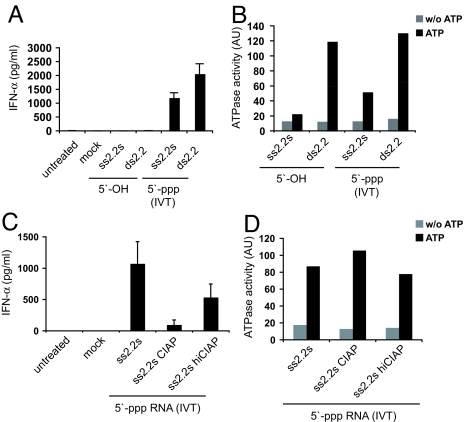
Fig. 1.
Fig. 1.
In vitro transcribed ssRNA has a feature other than the 5′-triphosphate necessary for RIG-I activation. (A) Primary human monocytes were stimulated with ss- and dsRNAs that were chemically synthesized (5′-OH) or generated by IVT (5′-ppp). After 36 h, IFN-α was quantified in the supernatant by ELISA. (B) The same set of RNA ligands was assayed for their ability to induce ATPase activity in recombinant purified full-length RIG-I protein. Each condition was done in the presence and absence of ATP. (C) Untreated or CIAP-treated 5′-ppp-ssRNA (IVT) was tested for immunostimulatory capacity on monocytes as in A. RNA treatment with heat-inactivated (hi)CIAP was used as a control. (D) Fluorescence signal of the ATPase assay was measured after incubation of full-length RIG-I protein with RNA oligonucleotides from C.
Fig. 2.
Fig. 2.
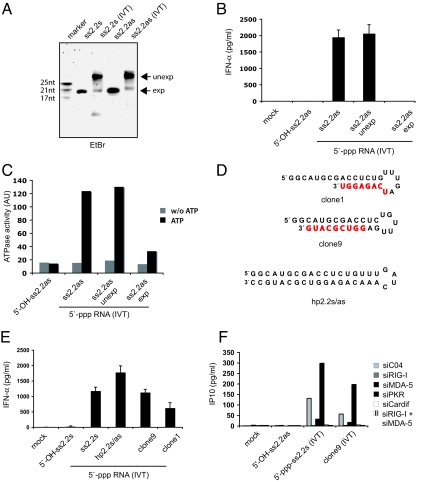
5′-triphosphate RNAs generated by IVT contain base-paired by-products that activate RIG-I. (A) Chemically synthesized 5′-OH-ssRNAs and 5′-ppp-ss2.2 RNAs generated by IVT were analyzed by denaturing gel electrophoresis and ethidium bromide (EtdBr) staining. Products of the expected (lower arrow in all samples), and unexpected (upper arrow in lanes containing 5′-ppp-RNA generated by IVT) size were reisolated for further analysis. (B) Reisolated IVT products were compared with 5′-OH-ss2.2as RNA and unpurified 5′-ppp-ss2.2as (IVT) RNA, for their ability to induce IFN-α production in human monocytes. (C) Stimulation of ATPase activity of recombinant, full-length RIG-I protein with reisolated and control RNAs. (D) Clones 1 and 9 are 2 RNA-sequences identified by 5′-ppp-ss2.2 RNA (IVT) small RNA cloning and sequencing. Nucleotides not encoded by the DNA template are indicated in red. Also, the sequence of a designed hairpin RNA (hp2.2s/as) based on the 2.2 model sequence is displayed. Secondary structures (minimum free energy) of clone 1, clone 9, and hp2.2s/as are as predicted by the Mfold software (21). (E) RNAs of clone 1, clone 9, and hp2.2s/as were generated by IVT and transfected into human monocytes. Production of IFN-α was measured by ELISA after 36 h. (F) The 1205Lu human melanoma cells were treated with the indicated siRNAs for 48 h and subsequently transfected with the indicated RNAs; 12 h after stimulation, supernatants were subjected to IP10 analysis by ELISA.
Fig. 3.
Fig. 3.
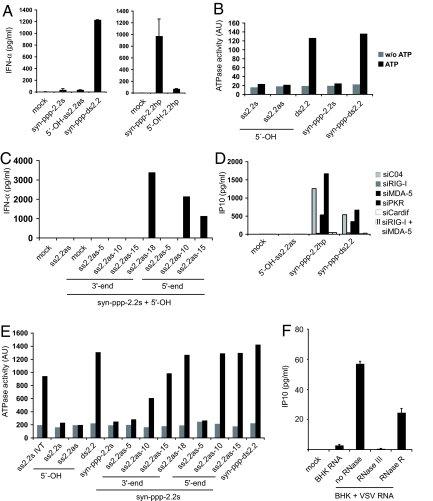
A small base-paired stretch and the 5′-triphosphate are necessary and sufficient to activate RIG-I. (A) Chemically synthesized 5′-triphosphate 2.2 RNA (syn-ppp-2.2s) either alone or after hybridization (syn-ppp-2.2ds) to 5′-OH-ss2.2as RNA (Left) and chemically synthesized 2.2 hairpin RNA with (syn-ppp-2.2hp) or without (5′-OH-2.2hp) a 5′-triphosphate (Right) was transfected into human monocytes. IFN-α secretion was analyzed after 36 h. (B) Activation of ATP hydrolysis by full-length RIG-I protein was studied with chemically synthesized RNAs bearing either a 5′-OH group or a 5′-ppp group. (C) syn-ppp-2.2s RNA was hybridized to complementary OH-RNA of variable length. The length gradually increased from either the 3′- or the 5′-end. IFN-α production was assessed in human monocytes as in A. (D) 1205Lu human melanoma cells were stimulated with chemically synthesized RNAs after treatment with the indicated siRNAs for 48 h. IP10 levels were measured after 12 h by ELISA. (E) RNA oligonucleotides used in C were examined for their induction of RIG-I ATPase activity in full-length protein. (F) 1205Lu cells stimulated with total RNA isolated from BHK cells infected or not with VSV for 16 h at a multiplicity of infection of 0.2. RNA isolates from VSV-infected BHK cells were treated with equal activities of the RNases III or RNase R before transfection. IP10 levels were determined by ELISA 14 h after stimulation.
Fig. 4.
Fig. 4.
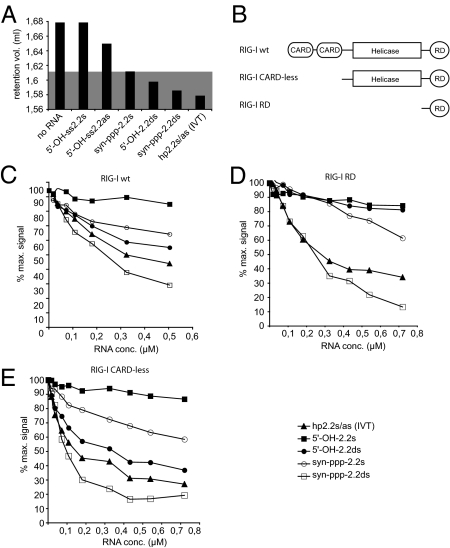
Double-stranded 5′-triphosphate RNAs have multiple binding sites on RIG-I and induce dimerization of RIG-I. (A) Different RNAs were examined for their ability to induce homodimerization of recombinant full-length RIG-I protein. The protein-RNA mixture was loaded onto a gel filtration column, and the absorbance at 280 nm was determined. RIG-I elution volume peaks of the different mixtures are represented as columns. The gray area indicates the range of values interpreted as dimeric RIG-I-RNA complexes. (B) Schematic representation of the recombinant RIG-I proteins used in C, D, and E. (C) Recombinant RIG-I full-length protein prebound to fluorescently labeled 5′-ppp-hp2.2s/as RNA (IVT) was incubated with increasing amounts of unlabeled competitor RNAs. Fluorescence anisotropy was determined multiple times after each addition and equilibration. Binding and competition of the unlabeled RNAs is seen as a progressive loss of anisotropy signal. Background values were subtracted, and the anisotropy value of labeled RNA bound to RIG-I in the absence of a competitor was set as 100%. (D) The RNAs used in C were assayed by using recombinant RIG-I RD domain. (E) The RNAs used in C were assayed by using recombinant RIG-I protein lacking both CARD domains.

References

    1. Akira S, Uematsu S, Takeuchi O. Pathogen recognition and innate immunity. Cell. 2006;124:783–801. - PubMed
    1. Andrejeva J, et al. The V proteins of paramyxoviruses bind the IFN-inducible RNA helicase, mda-5, and inhibit its activation of the IFN-beta promoter. Proc Natl Acad Sci USA. 2004;101:17264–17269. - PMC - PubMed
    1. Rothenfusser S, et al. The RNA helicase Lgp2 inhibits TLR-independent sensing of viral replication by retinoic acid-inducible gene-I. J Immunol. 2005;175:5260–5268. - PubMed
    1. Yoneyama M, et al. The RNA helicase RIG-I has an essential function in double-stranded RNA-induced innate antiviral responses. Nat Immunol. 2004;5:730–737. - PubMed
    1. Samanta M, Iwakiri D, Kanda T, Imaizumi T, Takada K. EB virus-encoded RNAs are recognized by RIG-I and activate signaling to induce type I IFN. EMBO J. 2006;25:4207–4214. - PMC - PubMed

Publication types