Breast cancer subtypes based on ER/PR and Her2 expression: comparison of clinicopathologic features and survival
- PMID: 19574486
- PMCID: PMC2705275
- DOI: 10.3121/cmr.2009.825
Breast cancer subtypes based on ER/PR and Her2 expression: comparison of clinicopathologic features and survival
Abstract
Objective: To compare the clinicopathologic features and survival in the four breast cancer subtypes defined by immunohistochemistry (IHC) expression of estrogen receptor (ER) or progesterone receptor (PR) and human epidermal growth factor receptor 2 (Her2): ER/PR+, Her2+; ER/PR+, Her2-; ER/PR-, Her2+; and ER/PR-, Her2-.
Methods: A 7-year retrospective study of 1134 invasive breast cancer subjects. Clinical and pathologic features and survival of the four subtypes were compared.
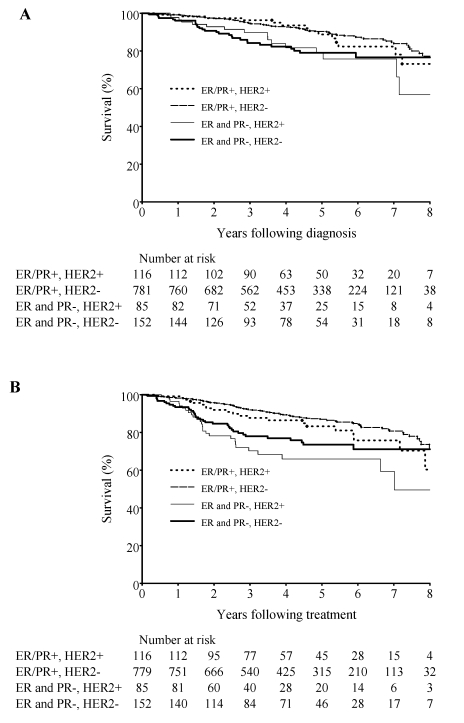
Results: Using ER/PR+ and Her2- as a reference, ER/PR-, Her2- had the worst overall survival (hazard ratio, 1.8; 95% confidence interval [CI], 1.06-3.2) and the worst disease-free survival (hazard ratio, 1.5; 95% CI, 0.8-3.0). In ER/PR+, Her2-, chemotherapy conferred significant overall and disease-free survival advantages. Subtype comparison revealed statistically significant differences in outcomes.
Conclusion: The triple negative subtype has the worst overall and disease free survival. Efforts should be directed at standardization of current testing methods and development of more reliable and reproducible testing.
Figures
References
-
- Glass AG, Lacey JV Jr, Carreon JD, Hoover RN. Breast cancer incidence, 1980–2006: combined roles of menopausal hormone therapy, screening mammography, and estrogen receptor status. J Natl Cancer Inst 2007;99:1152–1161. - PubMed
-
- Ravdin PM, Cronin KA, Howlader N, Berg CD, Chlebowski RT, Feuer EJ, Edwards BK, Berry DA. The decrease in breast-cancer incidence in 2003 in the United States. N Engl J Med 2007;356:1670–1674. - PubMed
-
- Carey LA, Perou CM, Livasy CA, Dressler LG, Cowan D, Conway K, Karaca G, Troester MA, Tse CK, Edmiston S, Deming SL, Geradts J, Cheang MC, Nielsen TO, Moorman PG, Earp HS, Millikan RC. Race, breast cancer subtypes, and survival in the Carolina Breast Cancer Study. JAMA 2006;295:2492–2502. - PubMed
-
- Chang HY, Nuyten DS, Sneddon JB, Hastie T, Tibshirani R, Sørlie T, Dai H, He YD, van’t Veer LJ, Bartelink H, van de Rijn M, Brown PO, van de Vijver MJ. Robustness, scalability, and integration of a wound-response gene expression signature in predicting breast cancer survival. Proc Natl Acad Sci U S A 2005;102:3738–3743. - PMC - PubMed
-
- Dolled-Filhart M, Rydén L, Cregger M, Jirström K, Harigopal M, Camp RL, Rimm DL. Classification of breast cancer using genetic algorithms and tissue microarrays. Clin Cancer Res 2006;12:6459–6468. - PubMed
MeSH terms
Substances
LinkOut - more resources
Full Text Sources
Other Literature Sources
Medical
Research Materials
Miscellaneous