Review
. 2009 Aug;9(8):556-67.
doi: 10.1038/nri2586. Epub 2009 Jul 3.

Structure and signalling in the IL-17 receptor family

Affiliations
Review

Structure and signalling in the IL-17 receptor family

Sarah L Gaffen. Nat Rev Immunol. 2009 Aug.

Erratum in

  • Nat Rev Immunol. 2009 Oct;9(10):747

Abstract

Interleukin-17A (IL-17A), the hallmark cytokine of the newly defined T helper 17 (T(H)17) cell subset, has important roles in protecting the host against extracellular pathogens, but also promotes inflammatory pathology in autoimmune disease. IL-17A and its receptor (IL-17RA) are the founding members of a newly described family of cytokines and receptors that have unique structural features which distinguish them from other cytokine families. Research defining the signal transduction pathways induced by IL-17R family cytokines has lagged behind that of other cytokine families, but studies in the past 2 years have begun to delineate unusual functional motifs and new proximal signalling mediators used by the IL-17R family to mediate downstream events.


Figures
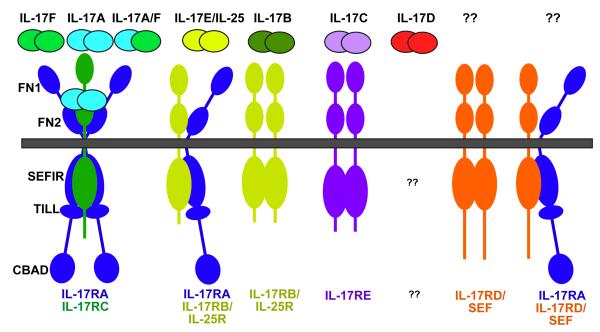
Figure 1
Figure 1. IL-17 receptor family ligand-receptor relationships and main structural features
So far, five members of the IL-17 receptor superfamily have been identified, as indicated in Table 1. The various receptor complexes that correspond to each ligand are indicated, although it should be emphasized that in no instance has the stoichiometry been demonstrated definitively. The receptor for IL-17D is unknown, as is the ligand(s) for IL-17RD/SEF or an IL-17RA/IL-17RD pairing if it exists (see Ref 75). FN, fibronectin III-like domain; SEFIR, SEF/IL-17R-related signalling domain; TILL, TIR-like loop; CBAD, C/EBPβ activation domain.
Figure 2
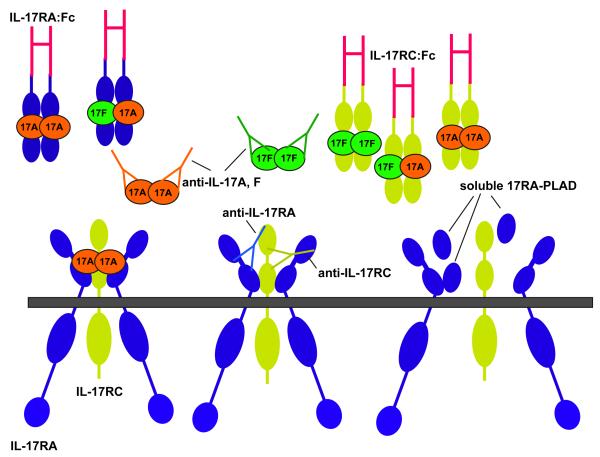
Figure 2. IL-17R binding complex and strategies for blockade
The IL-17R complex contains an undetermined number of IL-17RA and IL-17RC subunits, although studies so far indicate that it might be at minumum trimeric, which is the form shown here. Both IL-17A and IL-17F signal through these subunits, although IL-17A has far higher affinity for IL-17RA than for IL-17RC, whereas IL-17F has a somewhat greater affinity for IL-17RC than for IL-17RA . There are multiple anti-cytokine strategies proposed designed to block signalling through the IL-17 receptor . Antibodies specific for individual ligands or the individual receptor subunits represent the most straightforward approach. Additionally, soluble IL-17R subunits such as fusions to IgG-Fc have been evaluated in pre-clinical models (reviewed in Ref. 93). Finally, preventing receptor assembly by means of soluble PLAD peptides is another possible avenue for drug development, analogous to approaches used with TNFR signalling ,.
Figure 3
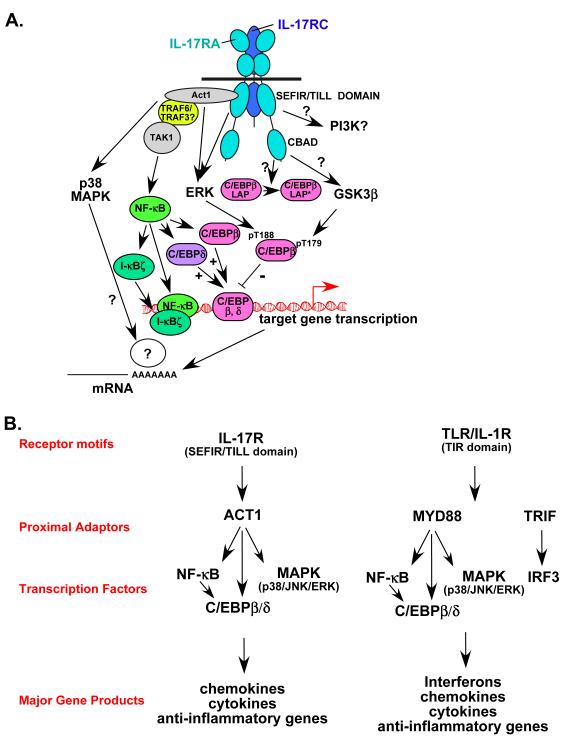
Figure 3. A. Schematic diagram of IL-17 signalling
The IL-17R complex is composed of IL-17RA and IL-17RC. Both subunits encode SEFIR domains , but a sequence similar to the TIR BB-loop is found only on IL-17RA, termed a TIR-like loop (TILL) . IL-17RA engages the SEFIR-containing ACT1 adaptor to mediate a variety of downstream events . Specifically, ACT1 is required for recruitment of TRAF6 (and possibly TRAF3), which is an essential upstream activator of the classical NF-κB pathway. It is not clear whether TRAF6 is also required for MAPK activation. Act1-/- cells fail to upregulate C/EBPβ (LAP and LAP* splice variants) and C/EBPδ as well, another event that might be downstream of NF-κB , . ACT1, but not TRAF6, is required for IL-17A-induced stabilization of several target mRNAs, particularly those encoding chemokines and cytokines . Interestingly, ERK might also be controlled, at least indirectly, by ACT1-independent pathways, as Act1-/- cells show strong upregulation of ERK phosphorylation 24 hours after IL-17A stimulation . ERK mediates rapid phosphorylation of C/EBPβ on Thr-188 . A second functional domain on IL-17RA is located in the C-terminal region, and is not required for efficient activation of NF-κB or the MAPK pathways. However, deletion of this domain results in impaired alternative translation of C/EBPβ from the LAP isoform to the LAP* isoform , and hence was termed the ”C/EBPβ-activation domain” (CBAD). The CBAD is also required for IL-17A-mediated inducible phosphorylation of C/EBPβ on Thr-179, which is mediated by GSK3β . B. Comparison of IL-17R and TLR/IL-1R signalling. IL-17R and TLR/IL-1R signalling differ in functional receptor motifs (SEFIR/TILL versus TIR) and proximal adaptors (ACT1 versus MYD88 and TRIF), but converge on common pathways (NF-κB, C/EBP and MAPK). Hence these receptors activate similar, although not identical, panels of downstream genes.
Timeline
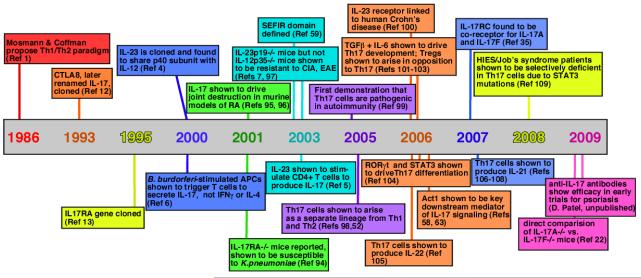
Timeline. Major events in the history of the IL-17/Th17 field
References in: , , , , - , -

References

    1. Mosmann TR, Cherwinski H, Bond MW, Giedlin MA, Coffman RL. Two types of murine helper T cell clone. I. Definition according to profiles of lymphokine activities and secreted proteins. J Immunol. 1986;136:2348–2357. - PubMed
    1. Gor DO, Rose NR, Greenspan NS. TH1-TH2: a procrustean paradigm. Nature immunology. 2003;4:503–505. - PubMed
    1. Steinman L. A brief history of T(H)17, the first major revision in the T(H)1/T(H)2 hypothesis of T cell-mediated tissue damage. Nature Med. 2007;13:139–145.This review article outlines the history of discrepancies in the TH1–TH2 cell paradigm, presented as a “cautionary tale” of the process of scientific inquiry

    1. Oppmann B, et al. Novel p19 protein engages IL-12p40 to form a cytokine, IL-23, with biological activities similar as well as distinct from IL-12. Immunity. 2000;13:715–725. - PubMed
    1. Aggarwal S, Ghilardi N, Xie MH, De Sauvage FJ, Gurney AL. Interleukin 23 promotes a distinct CD4 T cell activation state characterized by the production of interleukin 17. The journal of biological chemistry. 2002;3:1910–1914. - PubMed

MeSH terms