


Sensitivity to spatial frequency and orientation content is not specific to face perception
- PMID: 19576237
- PMCID: PMC2886984
- DOI: 10.1016/j.visres.2009.06.019
Sensitivity to spatial frequency and orientation content is not specific to face perception
Abstract
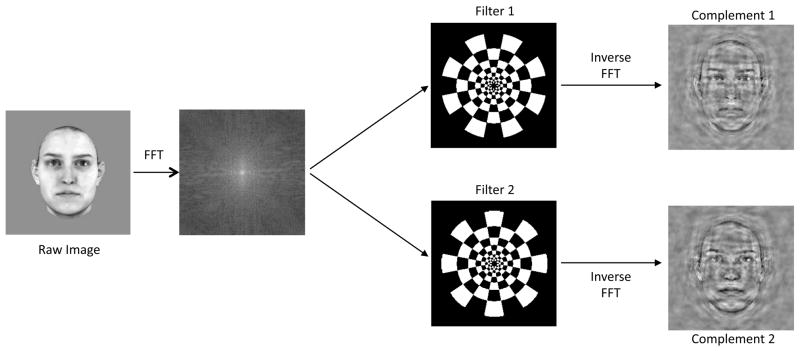
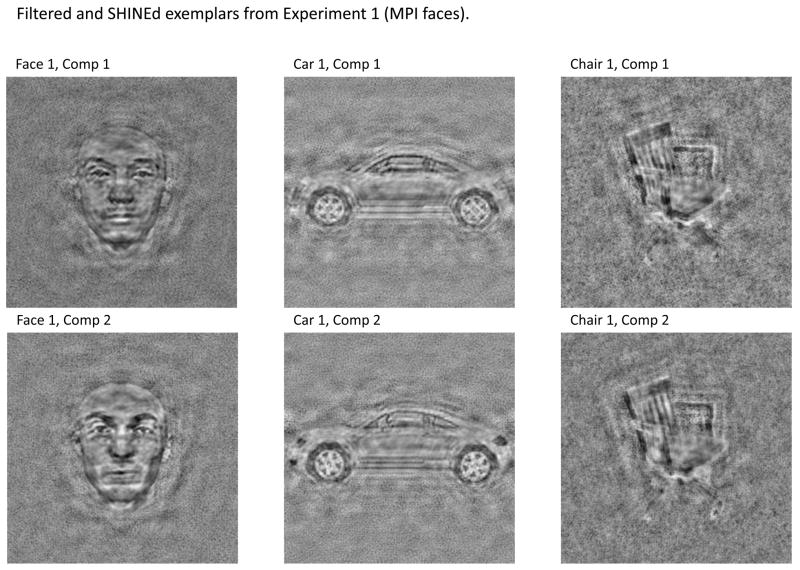
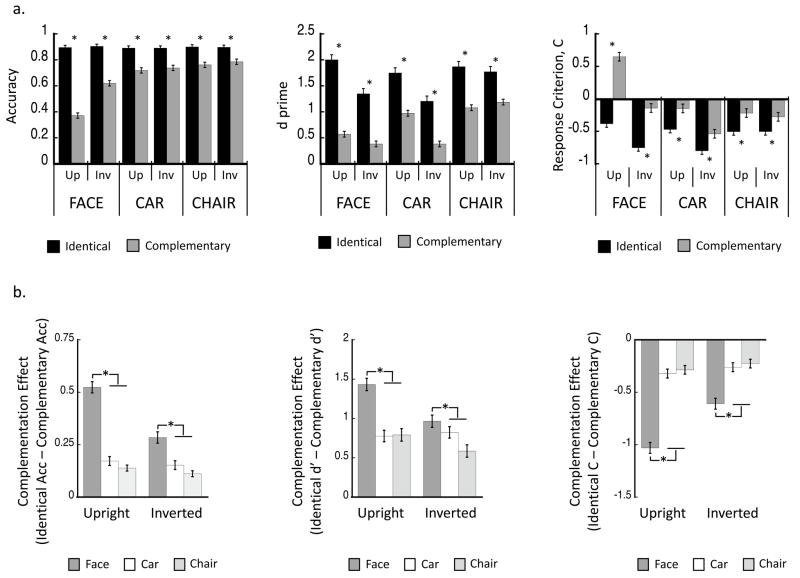
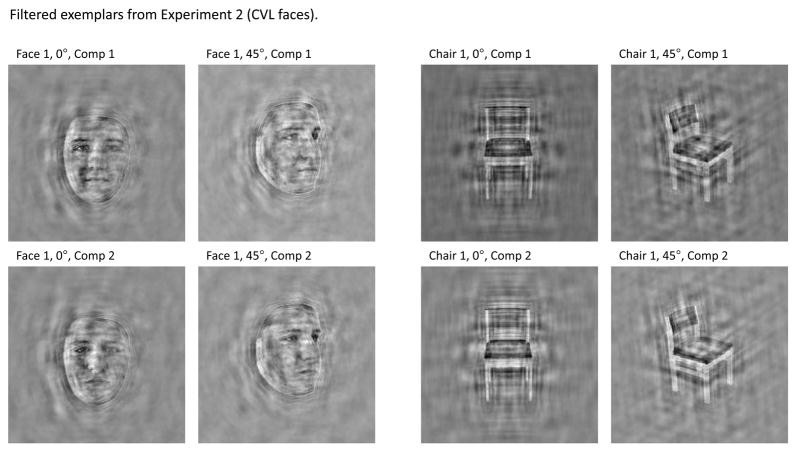
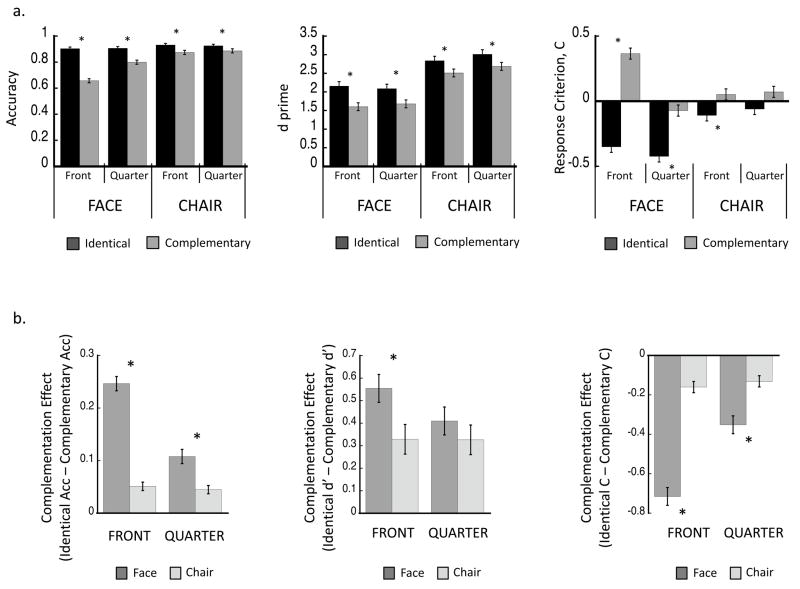
Prior work using a matching task between images that were complementary in spatial frequency and orientation information suggested that the representation of faces, but not objects, retains low-level spatial frequency (SF) information [Biederman, I., & Kalocsai, P. (1997). Neurocomputational bases of object and face recognition. Philosophical Transactions of the Royal Society of London, Series B Biological Sciences, 352, 1203-1219]. In two experiments, we reexamine the claim that face perception is uniquely sensitive to changes in SF. In contrast to prior work, we used a design allowing the computation of sensitivity and response criterion for each category, and in one experiment, equalized low-level image properties across object categories. In both experiments, we find that observers are sensitive to SF and orientation changes for upright and inverted faces and non-face objects. Differential response biases across categories contributed to a larger sensitivity for faces, but even sensitivity showed a larger effect for faces, especially when faces were upright and in a front-facing view. However, when objects were inverted, or upright but shown in a three-quarter view, the matching of objects and faces was equally sensitive to SF changes. Accordingly, face perception does not appear to be uniquely affected by changes in spatial filter components.
Figures
References
-
- Biederman I. Recognition-by-components: A theory of human image understanding. Psychological Review. 1987;94:115–147. - PubMed
-
- Biederman I, Ju G. Surface versus edge-based determinants of visual recognition. Cognitive Psychology. 1988;20:38–64. - PubMed
-
- Blanz V, Vetter T. A Morphable Model for the Synthesis of 3D Faces. Presented at Proceedings of the 26th annual conference on Computer graphics and interactive techniques.1999.
-
- Bruce V, Hanna E, Dench N, Healey P, Burton M. The importance of “mass” in line drawings of faces. Applied Cognitive Psychology. 1992;6:619–628.
MeSH terms
Grants and funding
LinkOut - more resources
Full Text Sources
