Review
. 2009 Jul;17(7):269-78.
doi: 10.1016/j.tim.2009.04.004. Epub 2009 Jul 1.

What we can learn about Escherichia coli through application of Gene Ontology

Affiliations
Review

What we can learn about Escherichia coli through application of Gene Ontology

James C Hu et al. Trends Microbiol. 2009 Jul.

Abstract

How we classify the genes, products and complexes that are present or absent in genomes, transcriptomes, proteomes and other datasets helps us place biological objects into subsystems with common functions, see how molecular functions are used to implement biological processes and compare the biology of different species and strains. Gene Ontology (GO) is one of the most successful systems for classifying biological function. Although GO is widely used for eukaryotic genomics, it has not yet been widely used for bacterial systems. The potential applications of GO are currently limited by the need to improve the annotation of bacterial genomes with GO and to improve how prokaryotic biology is represented in the ontology. Here, we discuss why GO should be adopted by microbiologists, and describe recent efforts to build and maintain high-quality GO annotation for Escherichia coli as a model system.


Figures
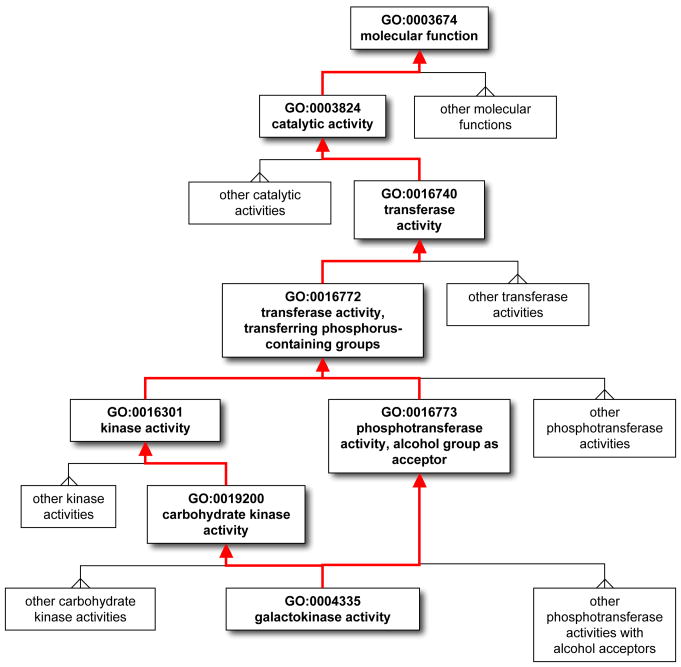
Figure 1
Figure 1
Relationships between GO terms in a Directed Acyclic Graph (DAG). The figure illustrates a subset of the molecular function DAG for galactokinase_activity (GO:0004335). Arrows indicate relationships of the is_a type. The ancestors of GO:0004335 are highlighted back to the root of the molecular function ontology via arrows highlighted in red. The other boxes indicate alternative branches from each ancestor; these contain many GO terms (not shown).
Figure 2
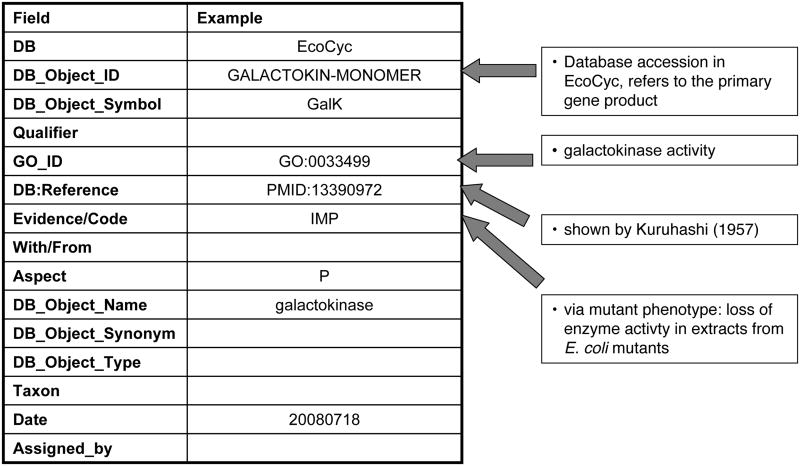
Figure 2
A typical E. coli GO annotation. The structure of an annotation for the E. coli galK gene product is shown. Note that the text of the database accessions from EcoCyc should not be used to infer anything about the protein.
Figure 3
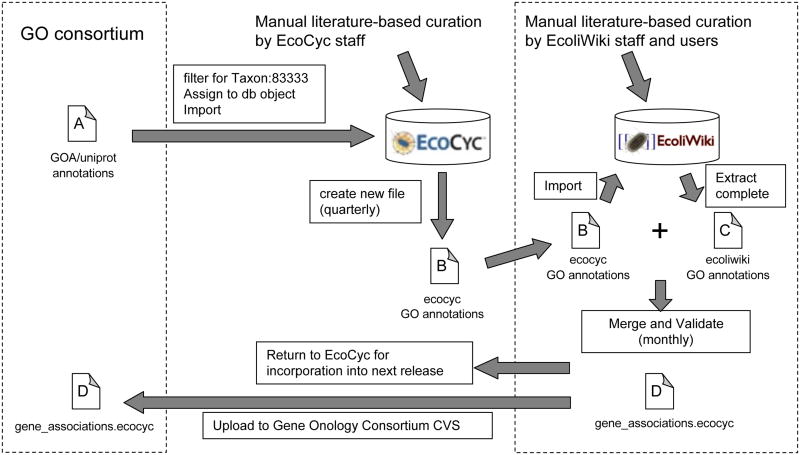
Figure 3
Workflow for updating gene_association.ecocyc, the list of GO annotations maintained by EcoCyc/EcoliWiki. GO annotations from UniProt (A) are downloaded from the GO Consortium and imported to EcoCyc after filtering and processing as described in the text. A file merging these annotations with manual annotations made by EcoCyc curators (B) is sent to EcoliWiki. This is merged with manual annotations extracted from EcoliWiki (C) to generate a final gene association file (D), which is submitted back to the GO consortium.

References

    1. Ingraham J, et al. Growth of the bacterial cell. Sinauer Associates, Inc; 1983.
    1. Riley M, Space DB. Genes and proteins of Escherichia coli (GenProtEc) Nucleic Acids Res. 1996;24:40. - PMC - PubMed
    1. Karp PD, et al. EcoCyc: an encyclopedia of Escherichia coli genes and metabolism. Nucleic Acids Res. 1996;24:32–39. - PMC - PubMed
    1. Fleischmann RD, et al. Whole-genome random sequencing and assembly of Haemophilus influenzae Rd. Science. 1995;269:496–512. - PubMed
    1. Peterson JD, et al. The Comprehensive Microbial Resource. Nucleic Acids Res. 2001;29:123–125. - PMC - PubMed

Publication types

MeSH terms

Substances