


Defects along the T(H)17 differentiation pathway underlie genetically distinct forms of the hyper IgE syndrome
- PMID: 19577286
- PMCID: PMC2828264
- DOI: 10.1016/j.jaci.2009.05.004
Defects along the T(H)17 differentiation pathway underlie genetically distinct forms of the hyper IgE syndrome
Abstract
Background: The hyper IgE syndrome (HIES) is characterized by abscesses, eczema, recurrent infections, skeletal and connective tissue abnormalities, elevated serum IgE, and diminished inflammatory responses. It exists as autosomal-dominant and autosomal-recessive forms that manifest common and distinguishing clinical features. A majority of those with autosomal-dominant HIES have heterozygous mutations in signal transducer and activator of transcription (STAT)-3 and impaired T(H)17 differentiation.
Objective: To elucidate mechanisms underlying different forms of HIES.
Methods: A cohort of 25 Turkish children diagnosed with HIES were examined for STAT3 mutations by DNA sequencing. Activation of STAT3 by IL-6 and IL-21 and STAT1 by IFN-alpha was assessed by intracellular staining with anti-phospho (p)STAT3 and -pSTAT1 antibodies. T(H)17 and T(H)1 cell differentiation was assessed by measuring the production of IL-17 and IFN-gamma, respectively.
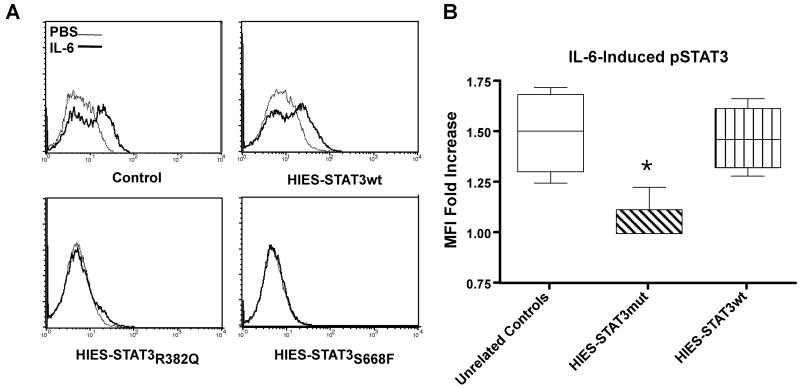
Results: Six subjects had STAT3 mutations affecting the DNA binding, Src homology 2, and transactivation domains, including 3 novel ones. Mutation-positive but not mutation-negative subjects with HIES exhibited reduced phosphorylation of STAT3 in response to cytokine stimulation, whereas pSTAT1 activation was unaffected. Both patient groups exhibited impaired T(H)17 responses, but whereas STAT3 mutations abrogated early steps in T(H)17 differentiation, the defects in patients with HIES with normal STAT3 affected more distal steps.
Conclusion: In this cohort of Turkish children with HIES, a majority had normal STAT3, implicating other targets in disease pathogenesis. Impaired T(H)17 responses were evident irrespective of the STAT3 mutation status, indicating that different genetic forms of HIES share a common functional outcome.
Figures



References
-
- Davis SD, Schaller J, Wedgwood RJ. Job's Syndrome. Recurrent, “cold”, staphylococcal abscesses. Lancet. 1966;1:1013–5. - PubMed
-
- Buckley RH, Wray BB, Belmaker EZ. Extreme hyperimmunoglobulinemia E and undue susceptibility to infection. Pediatrics. 1972;49:59–70. - PubMed
-
- Grimbacher B, Holland SM, Gallin JI, Greenberg F, Hill SC, Malech HL, et al. Hyper-IgE syndrome with recurrent infections--an autosomal dominant multisystem disorder. N Engl J Med. 1999;340:692–702. - PubMed
-
- Minegishi Y, Saito M, Morio T, Watanabe K, Agematsu K, Tsuchiya S, et al. Human tyrosine kinase 2 deficiency reveals its requisite roles in multiple cytokine signals involved in innate and acquired immunity. Immunity. 2006;25:745–55. - PubMed
-
- Minegishi Y, Saito M, Tsuchiya S, Tsuge I, Takada H, Hara T, et al. Dominant-negative mutations in the DNA-binding domain of STAT3 cause hyper-IgE syndrome. Nature. 2007;448:1058–62. - PubMed
Publication types
MeSH terms
Substances
Grants and funding
LinkOut - more resources
Full Text Sources
Molecular Biology Databases
Research Materials
Miscellaneous
