Review
. 2009 Jul;17(7):295-303.
doi: 10.1016/j.tim.2009.04.007. Epub 2009 Jul 3.

Gene Ontology and the annotation of pathogen genomes: the case of Candida albicans

Affiliations
Review

Gene Ontology and the annotation of pathogen genomes: the case of Candida albicans

Martha B Arnaud et al. Trends Microbiol. 2009 Jul.

Abstract

The Gene Ontology (GO) is a structured controlled vocabulary developed to describe the roles and locations of gene products in a consistent manner and in a way that can be shared across organisms. The unicellular fungus Candida albicans is similar in many ways to the model organism Saccharomyces cerevisiae but, as both a commensal and a pathogen of humans, differs greatly in its lifestyle. With an expanding at-risk population of immunosuppressed patients, increased use of invasive medical procedures, the increasing prevalence of drug resistance and the emergence of additional Candida species as serious pathogens, it has never been more crucial to improve our understanding of Candida biology to guide the development of better treatments. In this brief review, we examine the importance of GO in the annotation of C. albicans gene products, with a focus on those involved in pathogenesis. We also discuss how sequence information combined with GO facilitates the transfer of knowledge across related species and the challenges and opportunities that such an approach presents.


Figures
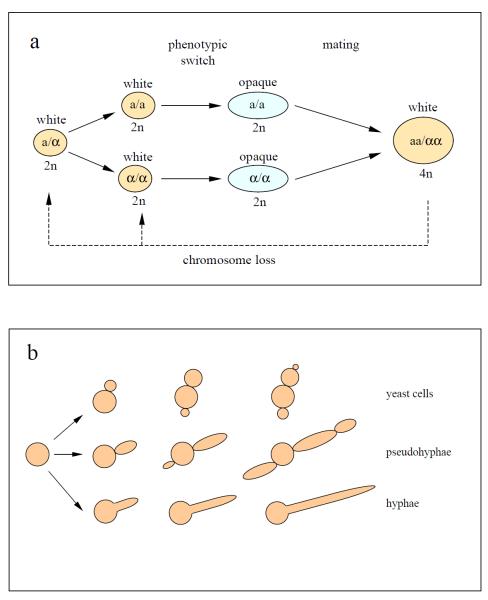
Figure 1
Figure 1
Life cycle and morphology of Candida albicans. (a) C. albicans parasexual cycle. Diploid yeast-form cells that have become homozygous (‘a/a’ or ‘α/α’) at the mating-type-like locus (MTL) may undergo a phenotypic switch from "white" to mating-competent, "opaque" cells. The mating of opaque cells of opposite mating types produces a tetraploid ‘aa/αα’ cell that returns to the diploid state via chromosome loss. (b) Different shapes of C. albicans. Depending on the environmental conditions, C. albicans can grow in distinct morphological forms: round, budding yeast-like cells easily separate from each other, whereas elongated, filament-forming true hyphal and pseudohyphal cells remain attached; the constriction between cells is a distinguishing feature of pseudohyphae. Figure adapted from reference [36].
Figure 2
Figure 2
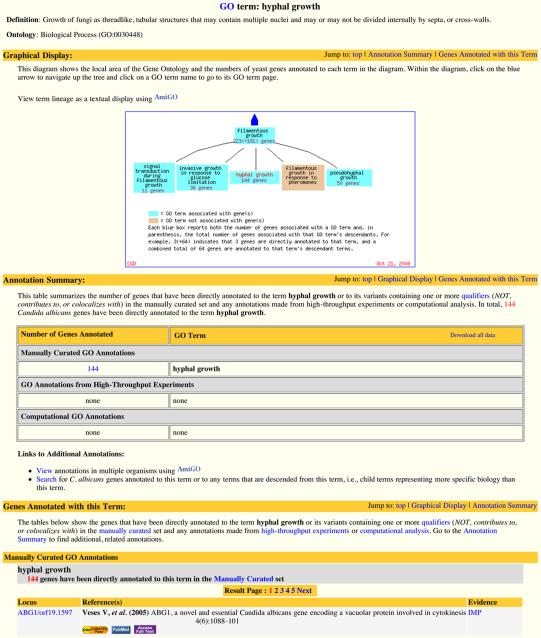
Example GO term page for the Biological Process term “hyphal growth” from the CGD web site (http://www.candidagenome.org/cgi-bin/GO/go.pl?goid=30448, as seen on January 13, 2009). The page displays the definition of the term, with a graphic showing its location within the hierarchy. The page also contains a table that shows the number of annotations within various summary categories, including annotations made from high-throughput and computationally based experiments. A list of all of the annotated genes, along with references and evidence codes, is displayed at the bottom of the page. AmiGO is a web-based tool for searching and browsing the GO, which is provided by the Gene Ontology Consortium and is available at http://amigo.geneontology.org/cgi-bin/amigo/go.cgi. The evidence code IMP indicates that the annotation is “Inferred from Mutant Phenotype.”
Figure 3
Figure 3
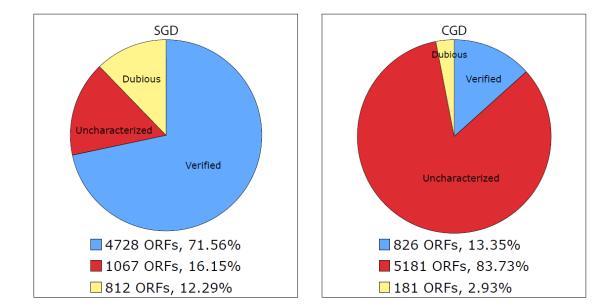
Comparison of C. albicans and S. cerevisiae genome annotation. ORFs are classified as ‘Verified’ if there is experimental evidence for a functional gene product. ‘Uncharacterized’ ORFs are predicted based on sequence analysis, but currently lack experimental characterization. ORFs labeled as ‘Dubious’ have no experimental characterization and appear indistinguishable from random non-coding sequence.
Figure 4
Figure 4
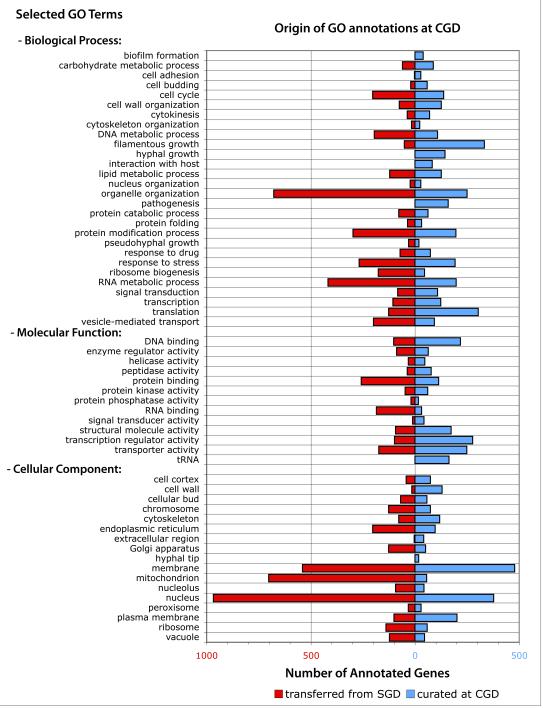
Statistics of GO term transfer to C. albicans based on S. cerevisiae annotation. Red bars represent the number of C. albicans genes at CGD annotated to the selected GO terms (annotated directly to each term itself, or annotated to one of its more specific child terms) by transferring annotations from orthologous characterized S. cerevisiae genes at SGD. Blue bars represent genes annotated at CGD based on published literature.

References

    1. Pfaller MA, Diekema DJ. Epidemiology of invasive candidiasis: a persistent public health problem. Clinical microbiology reviews. 2007;20:133–163. - PMC - PubMed
    1. Schelenz S. Management of candidiasis in the intensive care unit. The Journal of antimicrobial chemotherapy. 2008;61(Suppl 1):i31–34. - PubMed
    1. d'Enfert C. Biofilms and their role in the resistance of pathogenic Candida to antifungal agents. Current drug targets. 2006;7:465–470. - PubMed
    1. Lewis K. Multidrug tolerance of biofilms and persister cells. Current topics in microbiology and immunology. 2008;322:107–131. - PubMed
    1. Mean M, et al. Bench-to-bedside review: Candida infections in the intensive care unit. Critical care (London, England) 2008;12:204. - PMC - PubMed

Publication types

MeSH terms