. 2009 Aug 13;460(7257):909-13.
doi: 10.1038/nature08210. Epub 2009 Jul 5.

A role for Lin28 in primordial germ-cell development and germ-cell malignancy

Affiliations

A role for Lin28 in primordial germ-cell development and germ-cell malignancy

Jason A West et al. Nature. .

Abstract

The rarity and inaccessibility of the earliest primordial germ cells (PGCs) in the mouse embryo thwart efforts to investigate molecular mechanisms of germ-cell specification. stella (also called Dppa3) marks the rare founder population of the germ lineage. Here we differentiate mouse embryonic stem cells carrying a stella transgenic reporter into putative PGCs in vitro. The Stella(+) cells possess a transcriptional profile similar to embryo-derived PGCs, and like their counterparts in vivo, lose imprints in a time-dependent manner. Using inhibitory RNAs to screen candidate genes for effects on the development of Stella(+) cells in vitro, we discovered that Lin28, a negative regulator of let-7 microRNA processing, is essential for proper PGC development. Furthermore, we show that Blimp1 (also called Prdm1), a let-7 target and a master regulator of PGC specification, can rescue the effect of Lin28 deficiency during PGC development, thereby establishing a mechanism of action for Lin28 during PGC specification. Overexpression of Lin28 promotes formation of Stella(+) cells in vitro and PGCs in chimaeric embryos, and is associated with human germ-cell tumours. The differentiation of putative PGCs from embryonic stem cells in vitro recapitulates the early stages of gamete development in vivo, and provides an accessible system for discovering novel genes involved in germ-cell development and malignancy.


Figures
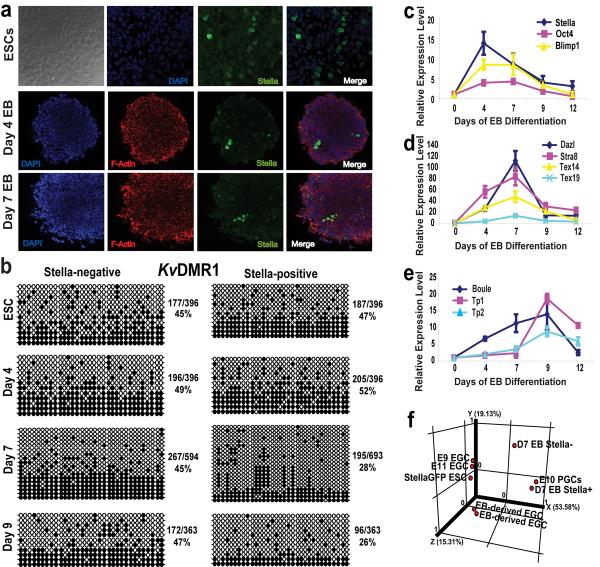
Figure 1
Figure 1. ESC differentiation into putative PGCs in vitro is marked by Stella expression
a, Immunofluorescent detection of StellaGFP, F-actin and DAPI expression in ESCs and EBs at days 4 and 7 (63× confocal objective). b, Bisulfite sequencing at the KvDMR1 imprinted locus. White circles, unmethylated CpG dinucleotides; black circles, methylated CpGs. The percentage of methylated CpGs is noted next to each panel. c-e, Relative gene expression within Stella+ cells during EB differentiation, including the pre-migratory PGC markers, Stella, Oct4, and Blimp1 (c), migratory and post-migratory markers Dazl, Stra8, Tex14, and Tex19 (d), and Boule, a marker of meiosis, and the transition proteins Tp1 and Tp2 (e), by real time-PCR. Levels are relative to day 0 Stella+ cells and the data are represented as a mean +/- the s.d. n=3. f, PCA of Stella ESCs, EB-derived and embryo-derived EGCs (E9 and E11), day 7 EB cells (both Stella+ and Stella-negative) and E10.5 embryo-derived PGCs.
Figure 2
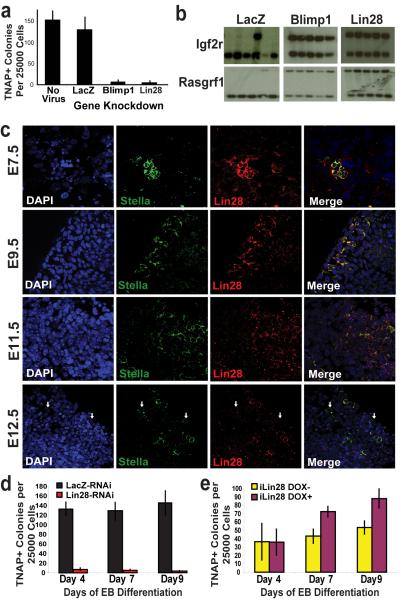
Figure 2. Lin28 regulates PGC development
a, The effects of candidate gene knockdown on TNAP+ EGC-colony formation from day 9 EB-derived Stella+ cells following in vitro differentiation of ESCs carrying shRNA-mediated gene knockdown, as indicated. n=3 b, Imprint status at the Igf2r and Rasgrf1 loci of individual clones derived from day 9 EB-derived Stella+ cells carrying gene knockdown of either LacZ, Blimp1, or Lin28. c, Expression of Lin28 during embryonic PGC development. By E12.5, multiple Stella+ PGCs within the genital ridge are negative for Lin28 (white arrows). (63× confocal objective) d, Lin28-RNAi prevents TNAP+ EGC-colony formation during EB differentiation. n=3 e, Induced Lin28 expression enhances TNAP+ EGC-colony formation on and after day 7 of EB differentiation compared to the uninduced control. n=3 All error bars depicted represent the S.E.M.
Figure 3
Figure 3. Lin28 and Blimp1 regulate PGC development in vivo
a, Representative images of genital ridges from E12.5 embryos chimerized with StellaGFP ESCs harbouring either LacZ-RNAi, Blimp1-RNAi, ectopic Blimp1 expression, Lin28-RNAi, ectopic Lin28 expression, Lin28-RNAi plus ectopic Blimp1 expression, or ectopic Lin28 plus Blimp1-RNAi. Scale bar = 100 μm. b, Quantification by flow cytometry of the percent of Stella+ PGCs in E12.5 genital ridges dissected from chimeric embryos created with StellaGFP ESCs containing the following: LacZ-RNAi, Blimp1-RNAi, ectopic Blimp1 expression, Lin28-RNAi, ectopic Lin28 expression, Lin28-RNAi plus ectopic Blimp1 expression, or ectopic Lin28 plus Blimp1-RNAi. Black horizontal bars represent the median. Non-significant p-values, n.s. c, Immunoblot for Blimp1 expression in extracts from ESCs and day 5 EBs with or without doxycycline induction of let-7s-21L. Gapdh served as a loading control.
Figure 4
Figure 4. LIN28 expression in human germ cell tumours
a, Primary malignant germ cell tumours of multiple histologies show consistent high expression of LIN28 and LIN28B. Benign teratomas and normal testis show no significant expression of LIN28 or LIN28B. Mixed germ cell tumour (GCT); yolk-sac tumour (YST); Choriocarcinoma (C); Embryonal carcinoma (EC); Seminoma (S); Teratoma (Ter); and Normal testis (Tes). b, Immunohistochemical detection of LIN28 in primary embryonal carcinoma. Left panel: Cytoplasmic immunoreactivity of embryonal carcinoma cells for LIN28 (between arrowheads). Endodermal epithelial elements of the teratoma (arrows) and tumoural stroma are not immunoreactive. Middle panel: Higher magnification of immunoreactive embryonal carcinoma. Adjacent seminiferous tubules are negative (between arrows). Right panel: Intratubular germ cell neoplasia within the embryonal carcinoma demonstrates LIN28 immunoreactivity. (40× magnification).

References

    1. Payer B, Saitou M, Barton SC, et al. Curr Biol. 2003;13(23):2110. - PubMed
    1. Payer B, Chuva de Sousa Lopes SM, Barton SC, et al. Genesis. 2006;44(2):75. - PubMed
    1. Heo I, Joo C, Cho J, et al. Molecular Cell. 2008;32(2):276. - PubMed
    1. Newman MA, Thomson JM, Hammond SM. RNA. 2008;14(8):1539. - PMC - PubMed
    1. Rybak A, Fuchs H, Smirnova L, et al. Nature Cell Biology. 2008;10(8):987. - PubMed

Publication types

MeSH terms

Associated data