. 2009 Jul 6:10:298.
doi: 10.1186/1471-2164-10-298.

Whole genome expression analysis within the angiotensin II-apolipoprotein E deficient mouse model of abdominal aortic aneurysm

Affiliations

Whole genome expression analysis within the angiotensin II-apolipoprotein E deficient mouse model of abdominal aortic aneurysm

Catherine Rush et al. BMC Genomics. .

Abstract

Background: An animal model commonly used to investigate pathways and potential therapeutic interventions relevant to abdominal aortic aneurysm (AAA) involves subcutaneous infusion of angiotensin II within the apolipoprotein E deficient mouse. The aim of this study was to investigate genes differentially expressed in aneurysms forming within this mouse model in order to assess the relevance of this model to human AAA.

Results: Using microarrays we identified genes relevant to aneurysm formation within apolipoprotein E deficient mice. Firstly we investigated genes differentially expressed in the aneurysm prone segment of the suprarenal aorta in these mice. Secondly we investigated genes that were differentially expressed in the aortas of mice developing aneurysms relative to those that did not develop aneurysms in response to angiotensin II infusion. Our findings suggest that a host of inflammation and extracellular matrix remodelling pathways are upregulated within the aorta in mice developing aneurysms. Kyoto Encyclopedia of Genes and Genome categories enriched in the aortas of mice with aneurysms included cytokine-cytokine receptor interaction, leukocyte transendothelial migration, natural killer cell mediated cytotoxicity and hematopoietic cell lineage. Genes associated with extracellular matrix remodelling, such as a range of matrix metalloproteinases were also differentially expressed in relation to aneurysm formation.

Conclusion: This study is the first report describing whole genome expression arrays in the apolipoprotein E deficient mice in relation to aneurysm formation. The findings suggest that the pathways believed to be critical in human AAA are also relevant to aneurysm formation in this mouse model. The findings therefore support the value of this model to investigate interventions and mechanisms of human AAA.


Figures
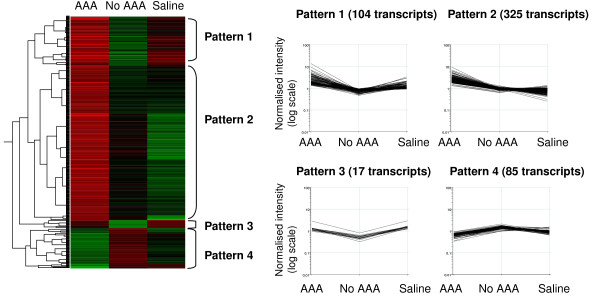
Figure 1
Figure 1
Heatmap of 531 genes differentially expressed in the aortas of angiotensin II treated mice that developed aneurysms (n = 5) versus those that did not develop aneurysms (n = 7). A complete list of the genes used for this analysis is provided in Additional File 3. Expression in the saline controls (n = 6) for each of these genes is also shown. Each line in the heatmap represents a gene with mean upregulated (red) or downregulated (green) expression for the three groups. Black colour denotes no change in expression. Different patterns of gene expression are indicated as Patterns 1–4 and associated gene lists are provided in Additional Files 6, 7, 8 and 9 and Table 4. A Volcano plot (two fold change, p < 0.05) comparing the aneurysm group with aneurysm resistant group was used to select genes for this analysis.
Figure 2
Figure 2
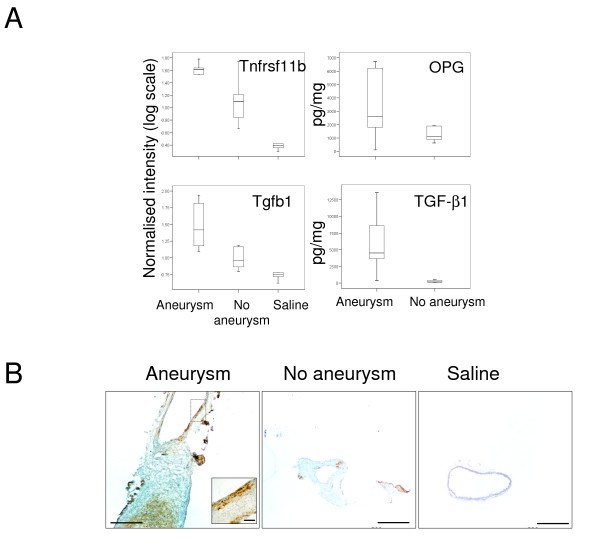
Verification of microarray data for two genes in which aortic expression was related to aneurysm formation. A) ELISA for aortic osteoprotegerin and transforming growth factor beta-1 (right panel) confirmed microarray expression data (left panel). Gene expression data are presented as boxplots of normalised intensity for Tnfsf11b (OPG) and Tgfb1 (TGFb-1) for each group (aneurysmal mice n = 5, non-aneurysmal mice n = 7, saline controls n = 6). ELISA data from suprarenal AAAs (n = 9) and suprarenal aortas without AAA (n = 9) of ApoE-/- mice infused with angiotensin II. B) Immunohistochemistry confirms OPG localisation to aortic media (inset) and thrombus in suprarenal aortas with aneurysm. Aneurysm resistant and saline control aortas showed minimal OPG staining. Scale bars represent 500 μm, except inset where bar represents 50 μm.
Figure 3
Figure 3
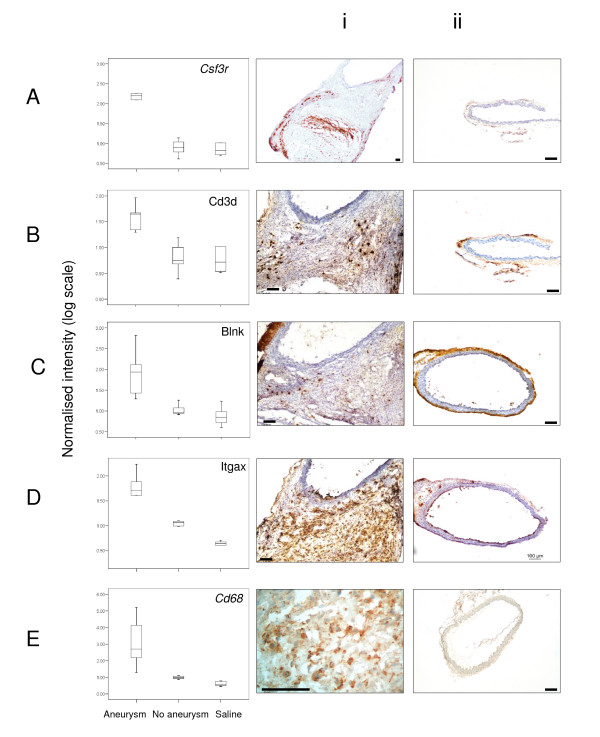
Immunohistochemistry demonstrating inflammatory cells in the suprarenal aorta of mice with aneurysms demonstrating functional confirmation of microarray expression data. Boxplots show normalised expression of genes that are markers of various haematopoietic cell lineages; Csf3r (neutrophils), Cd3d (T lymphocytes), Blnk (B lymphocytes), Itgax (dendritic cells) and Cd68 (monocyte/macrophages) from aneurysmal (n = 5), non-aneurysmal (n = 7) and saline control (n = 6) mice. Shown are sections stained for (A) neutrophils, (B) T lymphocytes (C) B lymphocytes (D) dendritic cells (E), macrophages in mice with aneurysms (i) and those without aortic dilatation (ii). Scale bars represent 100 μm.

References

    1. Fleming C, Whitlock EP, Beil TL, Lederle FA. Screening for abdominal aortic aneurysm: a best-evidence systematic review for the U.S. Preventive Services Task Force. Ann Intern Med. 2005;142:203–211. - PubMed
    1. Timaran CH, Veith FJ, Rosero EB, Modrall JG, Arko FR, Clagett GP, Valentine RJ. Endovascular aortic aneurysm repair in patients with the highest risk and in-hospital mortality in the United States. Arch Surg. 2007;142:520–524. doi: 10.1001/archsurg.142.6.520. - DOI - PubMed
    1. Miniño A, Heron M, Smith B, Kochanek K. Deaths: Final data for 2004. National vital statistics reports Hyattsville, MD. http://www.cdc.gov/nchs/products/pubs/pubd/hestats/finaldeaths04/finalde... - PubMed
    1. Daugherty A, Cassis LA. Mouse models of abdominal aortic aneurysms. Arterioscler Thromb Vasc Biol. 2004;24:429–434. doi: 10.1161/01.ATV.0000118013.72016.ea. - DOI - PubMed
    1. Manning MW, Cassis LA, Huang J, Szilvassy SJ, Daugherty A. Abdominal aortic aneurysms: fresh insights from a novel animal model of the disease. Vasc Med. 2002;7:45–54. doi: 10.1191/1358863x02vm413ra. - DOI - PubMed

Publication types