Phase III, randomized study of gemcitabine and oxaliplatin versus gemcitabine (fixed-dose rate infusion) compared with gemcitabine (30-minute infusion) in patients with pancreatic carcinoma E6201: a trial of the Eastern Cooperative Oncology Group
- PMID: 19581537
- PMCID: PMC2727286
- DOI: 10.1200/JCO.2008.20.9007
Phase III, randomized study of gemcitabine and oxaliplatin versus gemcitabine (fixed-dose rate infusion) compared with gemcitabine (30-minute infusion) in patients with pancreatic carcinoma E6201: a trial of the Eastern Cooperative Oncology Group
Erratum in
- J Clin Oncol. 2009 Dec 1;27(34):5859
Abstract
Purpose: Single-agent gemcitabine (GEM) is standard treatment of metastatic pancreatic cancer. Fixed-dose rate (FDR) GEM and GEM plus oxaliplatin have shown promise in early clinical trials. E6201 was designed to compare overall survival (OS) of standard weekly GEM 1,000 mg/m(2)/30 minutes versus GEM FDR 1,500 mg/m(2)/150 minutes or GEM 1,000 mg/m(2)/100 minutes/day 1 plus oxaliplatin 100 mg/m(2)/day 2 every 14 days (GEMOX).
Methods: This trial included patients with metastatic or locally advanced pancreatic cancer, normal organ function, and performance status of 0 to 2. The study was designed to detect a 33% difference in median survival (hazard ratio [HR] < or = 0.75 for either of the experimental arms) with 81% power while maintaining a significance level of 2.5% in a two-sided test for each of the two primary comparisons.
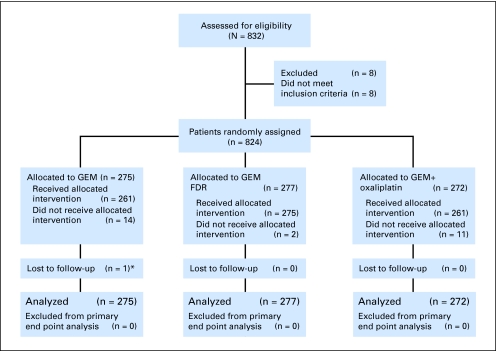
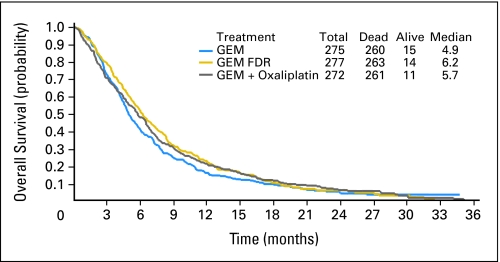
Results: Eight hundred thirty-two patients were enrolled. The median survival and 1-year survival were 4.9 months (95% CI, 4.5 to 5.6) and 16% for GEM, 6.2 months (95% CI, 5.4 to 6.9), and 21% for GEM FDR (HR, 0.83; stratified log-rank P = .04), and 5.7 months (95% CI, 4.9 to 6.5) and 21% for GEMOX (HR, 0.88; stratified log-rank P = .22). Neither of these differences met the prespecified criteria for significance. Survival was 9.2 months for patients with locally advanced disease, and 5.4 months for those with metastatic disease. Grade 3/4 neutropenia and thrombocytopenia were greatest with GEM FDR. GEMOX caused higher rates of nausea, vomiting, and neuropathy.
Conclusion: Neither GEM FDR nor GEMOX resulted in substantially improved survival or symptom benefit over standard GEM in patients with advanced pancreatic cancer.
Conflict of interest statement
Authors' disclosures of potential conflicts of interest and author contributions are found at the end of this article.
Figures
References
-
- American Cancer Society. Atlanta, GA: American Cancer Society; 2008. Facts and Figures 2008.
-
- Parkin M, Bray FJ, Ferlay J, et al. Global Cancer Statistics 2002. CA: Cancer J for Clinicians. 2005;55:74–108. - PubMed
-
- Burris HA, III, Moore MJ, Andersen J, et al. Improvements in survival and clinical benefit with gemcitabine as first-line therapy for patients with advanced pancreas cancer: A randomized trial. J Clin Oncol. 1997;15:2403–2413. - PubMed
-
- Tempero M, Plunkett W, Ruiz van Haperen V, et al. Randomized phase II comparison of dose-intense gemcitabine: Thirty-minute infusion and fixed dose rate infusion in patients with pancreatic adenocarcinoma. J Clin Oncol. 2003;21:3402–3408. - PubMed
-
- Louvet C, Labianca R, Hammel P, et al. Gemcitabine in combination with oxaliplatin compared with gemcitabine alone in locally advanced or metastatic pancreatic cancer: Results of a GERCOR and GISCAD phase III trial. J Clin Oncol. 2005;23:3509–3516. - PubMed
Publication types
MeSH terms
Substances
Grants and funding
LinkOut - more resources
Full Text Sources
Other Literature Sources
Medical
Research Materials
Miscellaneous