Novel susceptibility loci for second primary tumors/recurrence in head and neck cancer patients: large-scale evaluation of genetic variants
- PMID: 19584075
- PMCID: PMC2964280
- DOI: 10.1158/1940-6207.CAPR-09-0025
Novel susceptibility loci for second primary tumors/recurrence in head and neck cancer patients: large-scale evaluation of genetic variants
Abstract
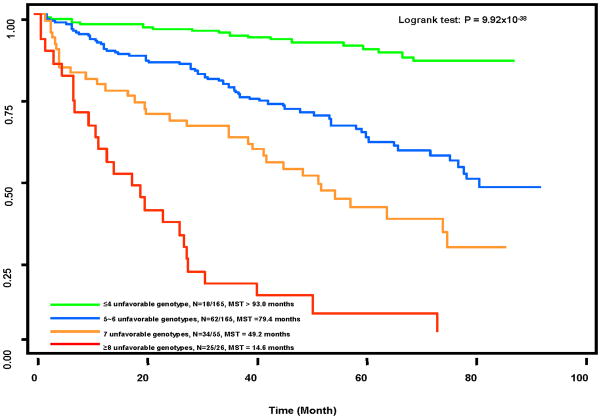
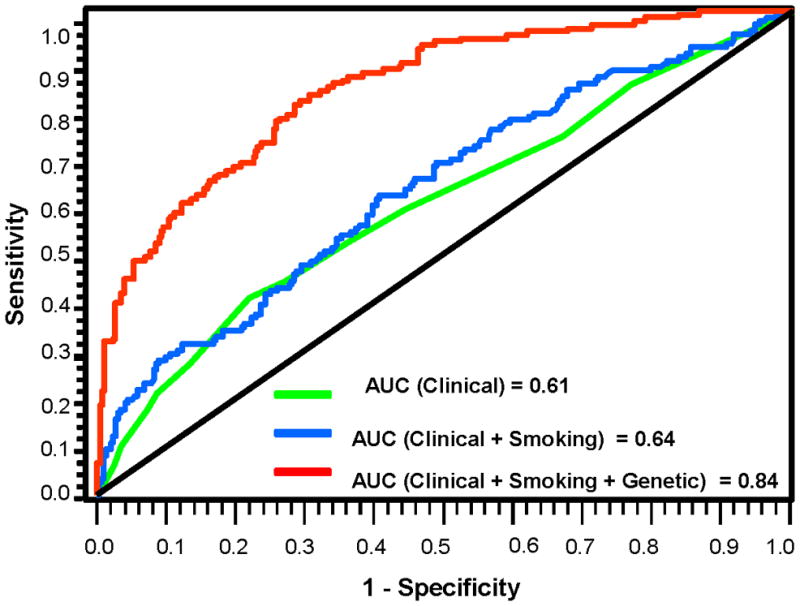
This study was aimed to identify novel susceptibility variants for second primary tumor (SPT) or recurrence in curatively treated early-stage head and neck squamous cell carcinoma (HNSCC) patients. We constructed a custom chip containing a comprehensive panel of 9,645 chromosomal and mitochondrial single nucleotide polymorphisms (SNP) representing 998 cancer-related genes selected by a systematic prioritization schema. Using this chip, we genotyped 150 early-stage HNSCC patients with and 300 matched patients without SPT/recurrence from a prospectively conducted randomized trial and assessed the association of these SNPs with risk of SPT/recurrence. Individually, six chromosomal SNPs and seven mitochondrial SNPs were significantly associated with risk of SPT/recurrence after adjustment for multiple comparisons. A strong gene-dosage effect was observed when these SNPs were combined, as evidenced by a progressively increasing SPT/recurrence risk as the number of unfavorable genotypes increased (P for trend < 1.00 x 10(-20)). Several polygenic analyses suggest an important role of interconnected functional network and gene-gene interaction in modulating SPT/recurrence. Furthermore, incorporation of these genetic markers into a multivariate model improved significantly the discriminatory ability over the models containing only clinical and epidemiologic variables. This is the first large-scale systematic evaluation of germ-line genetic variants for their roles in HNSCC SPT/recurrence. The study identified several promising susceptibility loci and showed the cumulative effect of multiple risk loci in HNSCC SPT/recurrence. Furthermore, this study underscores the importance of incorporating germ-line genetic variation data with clinical and risk factor data in constructing prediction models for clinical outcomes.
Figures
Comment in
-
Emerging molecular technologies for identifying the risk of second cancers.Cancer Prev Res (Phila). 2009 Jul;2(7):605-7. doi: 10.1158/1940-6207.CAPR-09-0101. Cancer Prev Res (Phila). 2009. PMID: 19584072 Free PMC article. No abstract available.
References
-
- Khuri FR, Kim ES, Lee JJ, Winn RJ, Benner SE, Lippman SM, et al. The impact of smoking status, disease stage, and index tumor site on second primary tumor incidence and tumor recurrence in the head and neck retinoid chemoprevention trial. Cancer Epidemiol Biomarkers Prev. 2001;10(8):823–9. - PubMed
-
- Khuri FR, Lee JJ, Lippman SM, Kim ES, Cooper JS, Benner SE, et al. Randomized phase III trial of low-dose isotretinoin for prevention of second primary tumors in stage I and II head and neck cancer patients. J Natl Cancer Inst. 2006;98(7):441–50. - PubMed
-
- Bedi GC, Westra WH, Gabrielson E, Koch W, Sidransky D. Multiple head and neck tumors: evidence for a common clonal origin. Cancer Res. 1996;56(11):2484–7. - PubMed
-
- Mao L, Hong WK, Papadimitrakopoulou VA. Focus on head and neck cancer. Cancer Cell. 2004;5(4):311–6. - PubMed
Publication types
MeSH terms
Grants and funding
LinkOut - more resources
Full Text Sources
Medical